The Mantra Playbook
A playbook to build your subculture of innovation with intention

Was this forwarded to you? Subscribe here to get one leadership framework per week.
Welcome back to The Idea Bucket. If you're new here, a quick grounding: A mantra is a short, sticky phrase a leader repeats until the team starts repeating it back. Underneath every successful. mantra sits a full Mantra Ladder: the goal you want, the mindset it comes from, the value you're prioritizing, and the standard you expect. And a mantra dashboard is the collection of go-to mantras you lead with as you intentionally build your subculture, organized so you can see the whole picture of what you're signaling to your team, and where you're silent.
Three months ago, I published mine: twenty-one mantras across seven categories, three deep in every column. I promised we'd go deep on every mantra we hadn't explored yet, and that when the series was complete, I'd compile the whole thing into a reference you could download, print, and keep coming back to as you build your own.
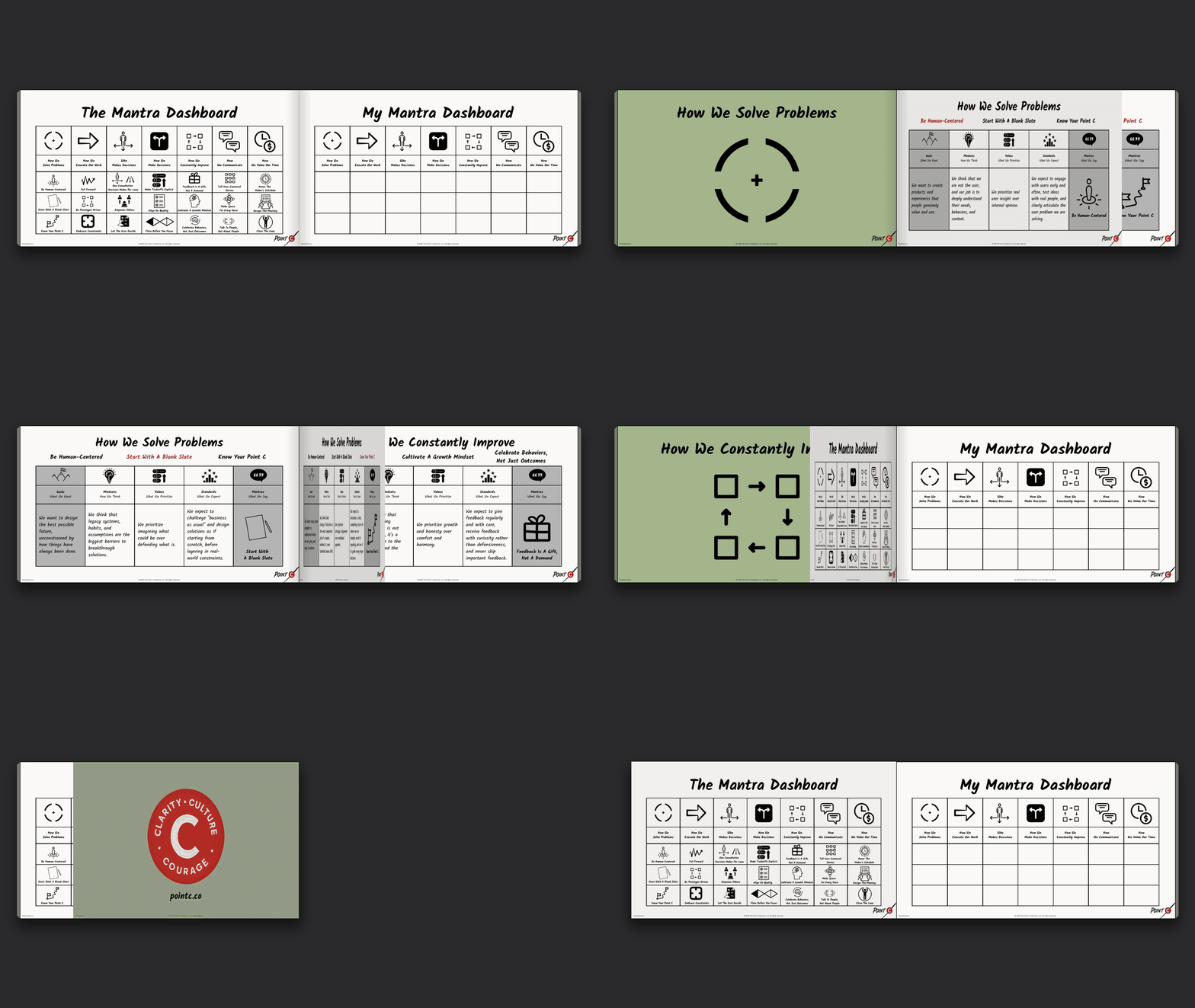
Last week, Design Your Subculture closed the series by taking you inside two jobs, one running on defaults and one built on purpose. So today I'm keeping the promise: every mantra below links to its own deep dive, and for the first time all twenty-one ladders are written out rung by rung in one place: The Mantra Playbook, the playbook for building your own subculture of innovation.
Your team is already living inside a subculture you're creating, whether or not you've made a single deliberate choice about it. What you repeat, reward, and refuse to tolerate is teaching your people what this place is, and your silence teaches too.
A subculture by default or a subculture by design. Every leader picks one. It's the difference between occupying a position of power and choosing to lead. This dashboard is what design looks like for me. Next week, I'll show you how to build a version that's yours.
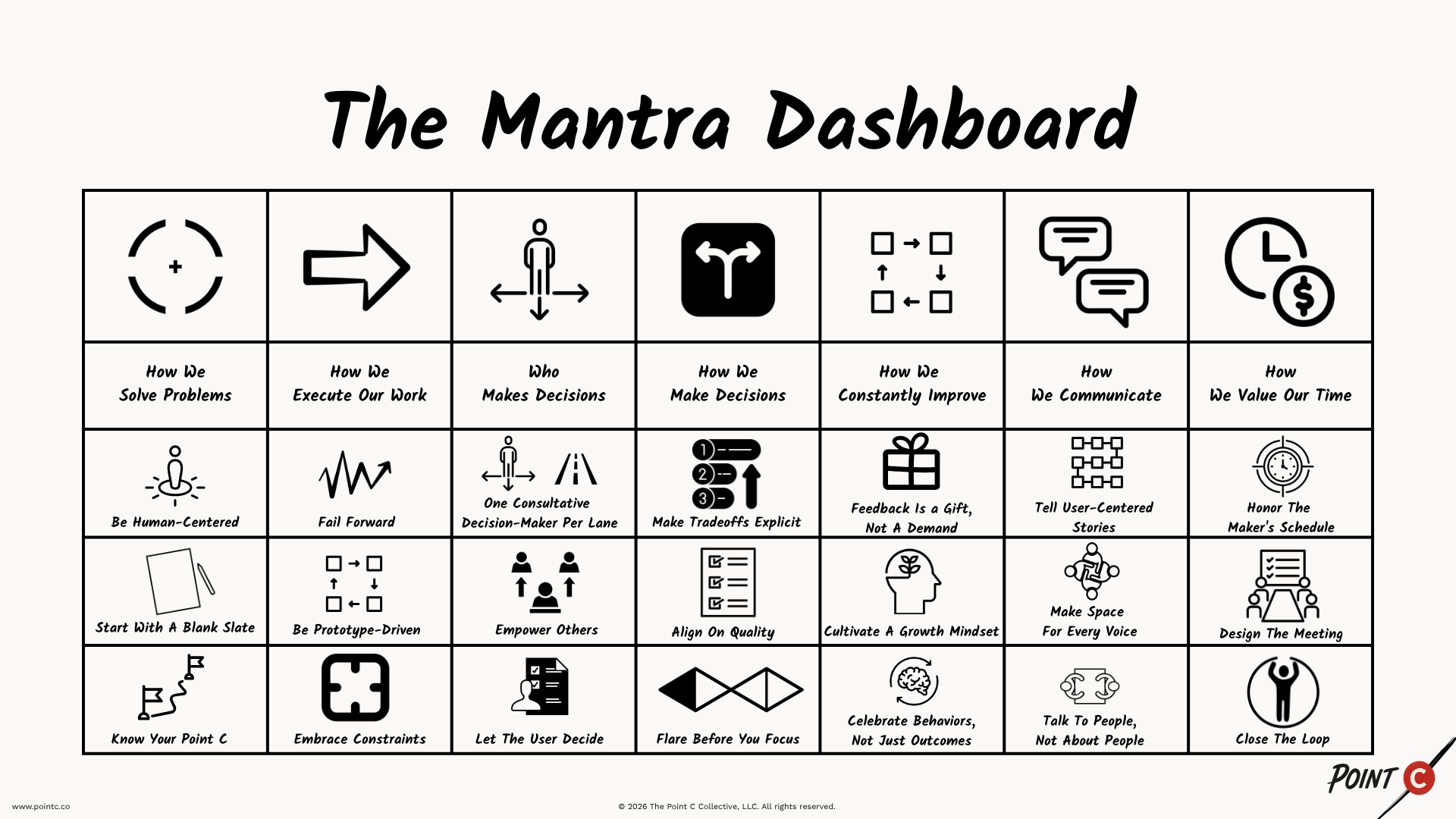
The Complete Mantra Dashboard
Here's the full dashboard. Each category answers one of the seven questions from the Subculture Coverage Matrix, each reinforced by a trio of mantras.
How We Solve Problems
These three are where every piece of work begins, because they answer the questions a team asks before anything gets built: who are we serving, what are we free to imagine, and where are we going? A team that skips them doesn't stop solving problems. It ends up solving the wrong ones.
- Be Human-Centered: Keep coming back to the user to guide your work.
- Start With A Blank Slate: Escape "business as usual" and design what's next.
- Know Your Point C: Make sure every team member understands where you're going and why it matters.
How We Execute Our Work
The thread through these three is the prototype mindset. Work is a series of experiments, failure is information, and constraints are design material. Teams that internalize them stop waiting for perfect conditions and start building their way to excellent.
- Fail Forward: Reinforce learning and experimentation.
- Be Prototype-Driven: Embrace imperfection and iteration.
- Embrace Constraints: Expand what's possible by working with what's not.
Who Makes Decisions
Most decision problems are actually clarity problems: nobody is sure whose call it is. These three establish ownership, push authority as close to the work as possible, and give the team a tiebreaker that lives outside the room. Get them working together and you build a culture where people feel truly empowered: clear on what they own and trusted to run with it.
- One Consultative Decision-Maker Per Lane: Empower your team, clarify roles, and unlock momentum.
- Empower Others: Push decisions down and give people room to own outcomes.
- Let The User Decide: When the team can't agree, go ask the user. They have the answer.
How We Make Decisions
Knowing who decides is only half the clarity your team needs; they also watch how the call gets made. These three guard against the failure modes I see most often: refusing to prioritize, discovering what's most important after the work is delivered, and narrowing to a decision before you've generated real options.
- Make Tradeoffs Explicit: "Everything is important" is lazy leadership. Always force-rank your priorities.
- Align On Quality: Define what excellent looks like before the work begins.
- Flare Before You Focus: Widen thinking before narrowing to decisions.
How We Constantly Improve
A team improves at the speed information flows. These three keep the channels open: feedback moves freely because it's offered as a gift, the work itself gets framed as figuring things out rather than proving you were right, and recognition lands on how people work, not only on what they deliver.
- Feedback Is A Gift, Not A Demand: Ensure the free flow of information.
- Cultivate A Growth Mindset: Frame work as a learning problem, not an execution problem.
- Celebrate Behaviors, Not Just Outcomes: Reinforce the behaviors and mindsets that lead to excellence.
How We Communicate
Culture lives in how information travels. This trio keeps communication concrete, inclusive, and direct: strategy gets told through real user journeys, quieter voices make it into the room, and hard conversations happen at the source instead of around it.
- Tell User-Centered Stories: Every strategy should be grounded in a concrete user journey.
- Make Space For Every Voice: Widen participation and improve decision quality.
- Talk To People, Not About People: Ensure direct, respectful communication at the source.
How We Value Our Time
Nothing signals what you value more clearly than what you do with your team's hours. These three protect deep work, make gathering time count, and keep open questions coming back with answers.
- Honor The Maker's Schedule: Ensure your team can do deep work.
- Design The Meeting: Value our time and leverage our moments of impact.
- Close The Loop: Get back to the team on outstanding decisions and actions.
And above all twenty-one, the mantra this entire series was building toward: Design Your Subculture. Every mantra on this page is a signal you can send. Design Your Subculture is the commitment to send those signals on purpose, and it's what turns the rest of the dashboard from a list of phrases into a leadership practice.
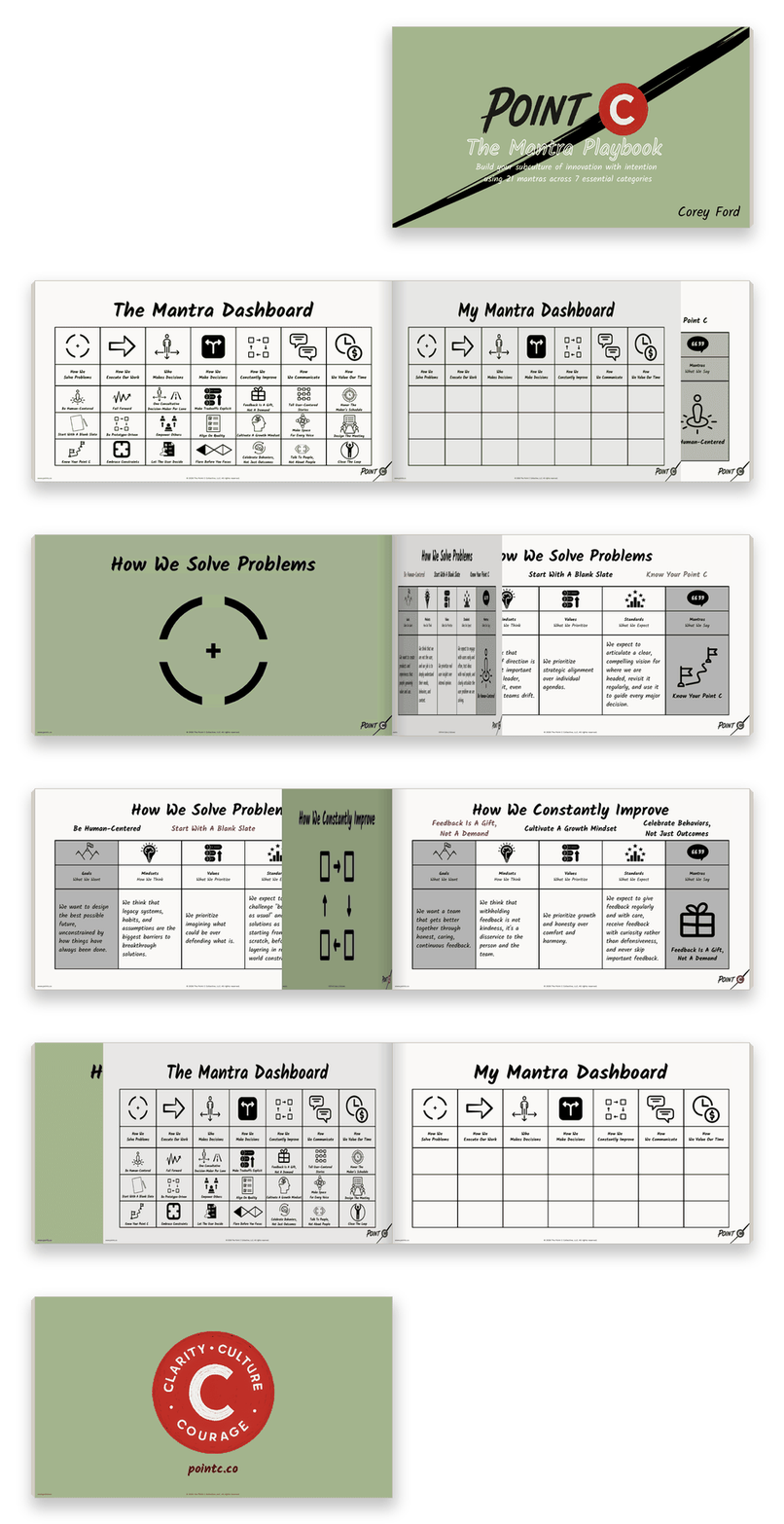
Download The Mantra Playbook
Everything above is free and stays free: the complete dashboard and every deep dive, all linked from this page. Steal from it. Share it, iterate on it, add to it, delete from it. Use it as a starting point and make it better. Adapt it for your unique context and your own voice. What matters is that you're prepared and intentional: that you always have a go-to dashboard in the moment, a prototype you can keep changing out and improving.
The playbook goes a level deeper. It's a single document with the complete dashboard and all twenty-one mantra ladders written out rung by rung, eleven of which have never appeared in the newsletter, plus a blank dashboard worksheet to build your own. Print it, mark it up, and post it where it can coach you at a glance.
The Mantra Playbook is a free download for coaching clients and premium subscribers:
Want The Mantra Playbook?
Your Challenge This Week
Look at the seven categories. In which one does your subculture most need to improve? If you're not sure, look for the column where your team has been inventing its own rules in your silence.
Then study that column's trio of mantras, read their deep dives, and apply them intentionally this week. Say them out loud in real moments: a meeting that's drifting, a one-on-one where something needs naming, a decision that's stalling. See what happens, both in the room and in you.
Next Week
If you take on this week's challenge, you'll notice something: some of these mantras you can say in your own voice, and some you'd have to rewrite before you could mean them. That's not a problem with the dashboard. That's the beginning of yours.
Next week: Make It Your Own.
Know someone who would find this useful? Forward this email to them. They can subscribe here to get their own weekly half sheet.
About This Newsletter
The Idea Bucket is a weekly newsletter and archive featuring one visual framework, supporting one act of leadership, that brings you one step closer to building a culture of innovation.
It’s written by Corey Ford — executive coach, strategic advisor, and founder of Point C, where he helps founders, CEOs, and executives clarify their visions, lead cultures of innovation, and navigate their next leadership chapters.
Want 1:1 executive coaching on this framework or others? Book your first coaching session. It's on me.