Talk To People, Not About People
A mantra to ensure direct, respectful communication

Was this forwarded to you? Subscribe here to get one leadership framework per week.
This is the ninth post in a series where I'm going deep on each mantra in my Mantra Dashboard. Last week, we explored why constraints are creative fuel, not excuses: Embrace Constraints.
This week's mantra lives in the How We Communicate category of my Subculture Coverage Matrix, alongside Make Space For Every Voice and Tell User-Centered Stories. Because it doesn't matter how many voices you make space for if the most important conversations are happening behind people's backs.
The mantra is: Talk To People, Not About People.
The Mantra Ladder
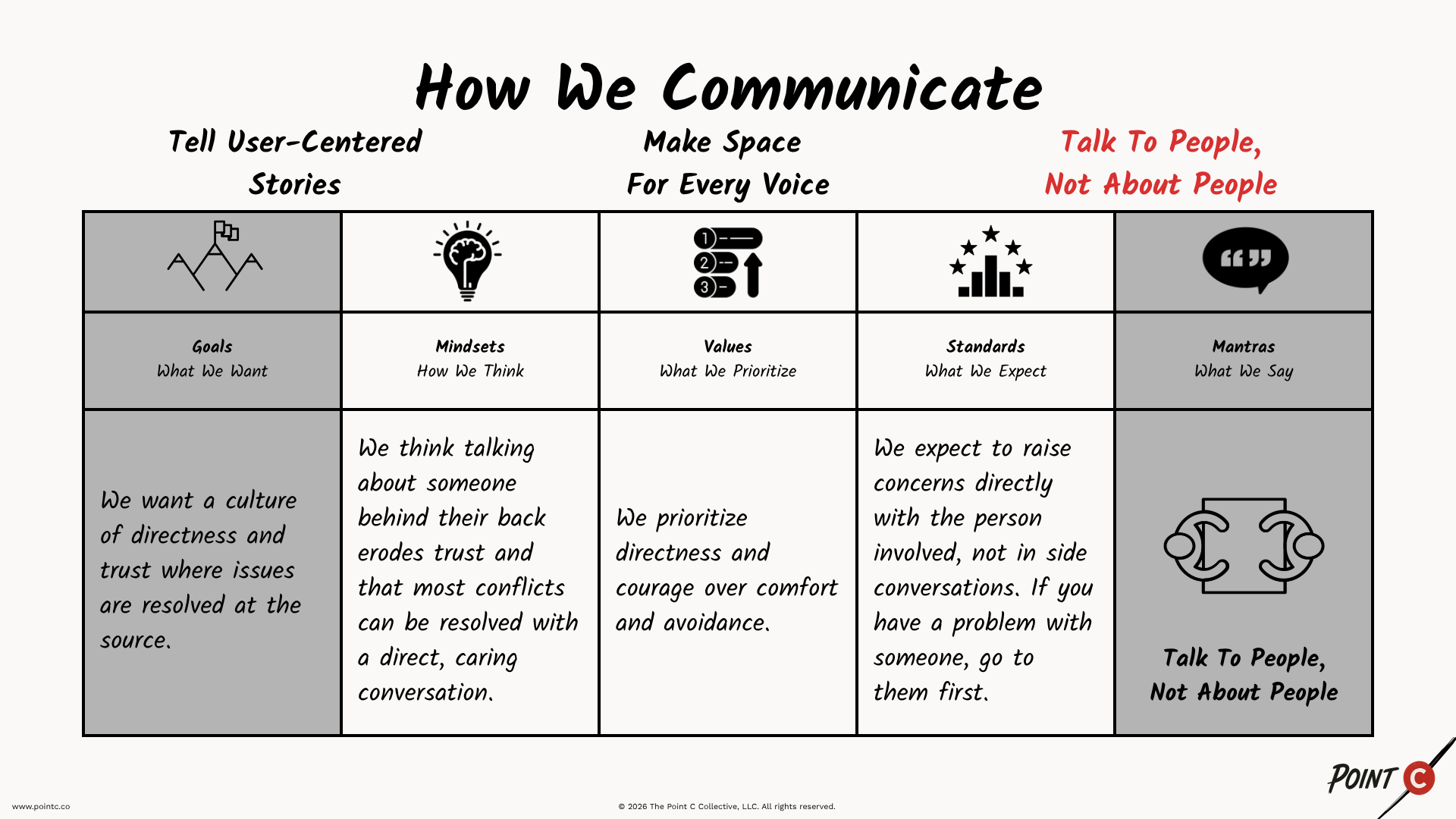
Here's the full Mantra Ladder for Talk To People, Not About People. The rest of this post unpacks it.
Goal (What We Want): We want a culture of directness and trust where issues are resolved at the source.
Mindset (How We Think): We think that talking about someone behind their back erodes trust faster than almost anything else, and that most conflicts can be resolved with a direct, caring conversation.
Value (What We Prioritize): We prioritize directness and courage over comfort and avoidance.
Standard (What We Expect): We expect to raise concerns directly with the person involved, not in side conversations. If you have a problem with someone, go to them first.
Mantra (What We Say): Talk To People, Not About People.
The Executive Meeting That Opened My Eyes
I was advising an executive team and sat in on one of their leadership meetings. What struck me was how much of the meeting was spent talking about people who weren't in the room. Complaining about a department head's performance. Venting about a team that wasn't delivering. Speculating about why someone wasn't stepping up. Almost the entire meeting was a conversation about other people rather than with them.
What made it worse was that the observations weren't just operational. They were personal. People were jumping over the net, making assumptions about other people's motives, characterizing their behavior, assigning intent. If the people being talked about could hear what was being said, they would have been horrified. Some of them probably would have left the organization.
And as I spent more time with the organization, I started to see the same pattern everywhere. In one-on-ones, people were venting about colleagues instead of addressing issues directly. In team meetings, problems with specific people were being discussed without those people in the room.
One leader used their time with their direct reports specifically to be a venting board and a therapist. It felt like being a great manager. It felt like being there for them. But it was actually reinforcing the dysfunction. There was a lot of talking about people. And almost no direct communication between the individuals involved.
That pattern was at the heart of the dysfunction I was seeing across the organization. And it started in the executive meeting room. Because when the leadership team models "talk about people, not to them," that behavior cascades. It becomes the norm. People learn that the way things work around here is you go to your boss, or you vent to a peer, or you complain in a meeting. You don't go directly to the person.
I had to name what was happening in order to start breaking it. And this mantra became the refrain that held us to a new norm. Every time someone started talking about a person who wasn't in the room, the question became: Have you told them this directly? Let's talk to people, not about people.
The Confession Booth
This pattern shows up most visibly in one-on-one meetings. Many leaders have experienced it. Your direct report comes to you, and instead of bringing a decision or an update, they bring a complaint about a colleague. They dump it on you. They expect you to handle it. And you, being a good empathetic leader, listen. You absorb it. Maybe you even try to fix it on their behalf.
That is the confession booth. And it is one of the biggest red flags I coach leaders on.
The trap of being a highly empathetic leader is that people sometimes see you as a therapist. They bring their frustrations to you because it feels safer than having the hard conversation directly. And every time you accept that role, you reinforce the pattern. They learn that the way to deal with conflict is to route it through you instead of resolving it at the source.
The coaching I do with leaders on this is direct: if somebody comes to you and starts venting about a colleague, stop them. Before they go any further, ask: "Have you talked to them about this?" If they haven't, that's the expectation. Go directly to the person first. Don't come to me as a workaround for the conversation you're avoiding.
This is not about being cold or dismissive. You can still be empathetic. You can still coach them on how to have the conversation. But you don't solve the problem for them by becoming the messenger. The moment you do that, you've become the conduit, and the game of telephone begins. Information gets filtered. Nuance gets lost. Assumptions multiply. And the person who actually needs to hear the feedback never gets it directly.
The Game Of Telephone
The confession booth is just one version of a broader pattern: the game of telephone. Feedback and concerns get routed through intermediaries instead of going directly to the person involved.
I see this constantly in my coaching. A leader gives feedback to a manager who is supposed to pass it along to the team member. A team member has a problem with a peer but goes to their boss instead. An executive has concerns about a department head but communicates them through a chief of staff. Every time the message passes through another person, it loses accuracy, gains assumptions, and creates confusion.
One leader I coached realized that all of the feedback her direct report was receiving was being filtered through a middle layer. The direct report never heard the feedback in its original form. And the middle layer was trying to protect relationships by softening the message, which meant the urgency was lost. The leader's realization was simple but important: "I need to be direct about this, even if the person in the middle feels like she can't be."
Another common version is going to someone's boss instead of going to them. You sit through a meeting, say nothing, and then afterward go upstairs and share your concerns with the person's manager. The person who presented never hears it from you. They hear a filtered version from their boss days later, if they hear it at all. That is not feedback. That is gossip with a corporate structure.
Saying Nothing Is Collusion
Stanford professor Carole Robin teaches something to every one of my leadership cohorts that stays with them long after the program ends: saying nothing is collusion.
If somebody is doing something that is hurting you, the relationship, your team, or your organization, and you don't say anything, you are essentially saying it's okay for them to continue doing it. Your silence is permission. And the longer you stay silent, the harder the conversation becomes. Because now you're not just addressing the issue. You're also addressing why you waited so long to bring it up.
This is where conflict avoidance becomes genuinely destructive. I see it all the time in organizations where people have strong personal relationships. Friends and former colleagues who work together don't want to have the hard conversations because the relationship feels too good to risk. This often looks like a "nice" culture that's actually stagnating. People are comfortable. They're avoiding tension. And the cost is that real issues never get surfaced, real feedback never gets delivered, and the quality of the work suffers because nobody is willing to push.
As I wrote in Design For The Roller Coaster: when tension rises, stakes are high, and emotions are running hot, that is the worst possible time to figure out how to communicate. People fall back on instinct. And instinct, in most organizations, looks like avoidance, defensiveness, or escalation. The antidote is not hoping your team will magically become better at hard conversations. It's building the norms and rituals that make directness the default before you need it.
How To Go Direct
Saying "go talk to them" is easy. Actually doing it is hard. That's why I've written extensively about the tools that make direct communication productive rather than destructive.
The foundation is what Carole Robin calls "staying on your side of the net." As I wrote in I Can't See Inside Their Head: when you assign intent, the conversation tightens. When you disclose impact and inquire, it opens. "When you did X, I felt Y" keeps the conversation about what happened and how it affected you. It doesn't assume why the other person did what they did. That's the difference between a direct conversation and an accusation.
If you find yourself speculating about someone's motives, the fallback is: "The story I'm telling myself is..." That phrase signals that you know you might be wrong. It invites the other person to correct your assumptions rather than defend against them.
And the language matters. As I wrote in Use The Language of Interests: there are three languages of conflict. Power ("I'm the boss, do it my way"), rights ("the policy says..."), and interests ("help me understand what feels most important to you here"). Using power early is lazy leadership. Starting with interests surfaces what each person actually needs and creates room for a solution that works for both.
The point is not that direct conversations are easy. The point is that they are a skill you can build, and there are tools that make them safer and more productive. The hard part is having the courage to start.
The Standard This Sets
We expect to raise concerns directly with the person involved, not in side conversations. If you have a problem with someone, go to them first. If someone starts venting to you about a teammate, the response is: "Have you told them this directly? Let's talk to people, not about people."
We hire for directness and self-awareness. We recognize people who have hard conversations with care and courage. And we let go of people who consistently undermine others through back-channel gossip.
The feeling on a team that lives this mantra is distinct. You feel trusted. You feel safe to be direct. And you don't carry the anxiety of wondering what's being said about you when you're not in the room. Because you know: if someone has a problem with you, they'll come to you. And if you have a problem with someone, you'll go to them. That's how things work here.
If your executive team meetings are becoming venting sessions about others in the organization, something is off. If your one-on-ones have turned into confession booths, something is off. The fix starts with naming the pattern. And this mantra is the refrain that holds everyone to a higher standard of communication.
Your Challenge This Week
Pay attention to the next time someone comes to you and starts venting about a colleague. Notice the moment it happens. And instead of absorbing it, redirect it. Ask: "Have you told them this?" If they haven't, coach them on how to have that conversation directly: "Let's talk to people, not about people." Help them find the language. But don't become the messenger.
Then pay attention to yourself. When you catch yourself talking about someone who isn't in the room, stop and ask: should I be saying this to them instead? In most cases, the answer is yes. And the conversation you've been avoiding is far less painful than the silence you've been carrying.
Next Week
We've gone deep on nine mantras across my Mantra Dashboard. We've talked about defining your vision, aligning on quality, embracing constraints, and now communicating directly. But there's one pattern that quietly derails teams even when all of those things are in place. It happens when someone raises an issue, asks a question, or flags a risk, and then hears nothing back. No response. No follow-up. No closure.
Next week: Close The Loop.
Know someone who would find this useful? Forward this email to them. They can subscribe here to get their own weekly half sheet.
About This Newsletter
The Idea Bucket is a weekly newsletter and archive featuring one visual framework, supporting one act of leadership, that brings you one step closer to building a culture of innovation.
It’s written by Corey Ford — executive coach, strategic advisor, and founder of Point C, where he helps founders, CEOs, and executives clarify their visions, lead cultures of innovation, and navigate their next leadership chapters.
Want 1:1 executive coaching on this framework or others? Book your first coaching session. It's on me.