The Mantra Dashboard
A playbook to proactively lead your team across seven essential categories

Was this forwarded to you? Subscribe here to get one leadership framework per week.
Two weeks ago in The Idea Bucket, we built The Mantra Ladder: the tool that connects your goals, mindsets, values, and standards to the sticky language your team actually remembers. Last week we celebrated one year of building this playbook in public. And now it's time to share the full dashboard.
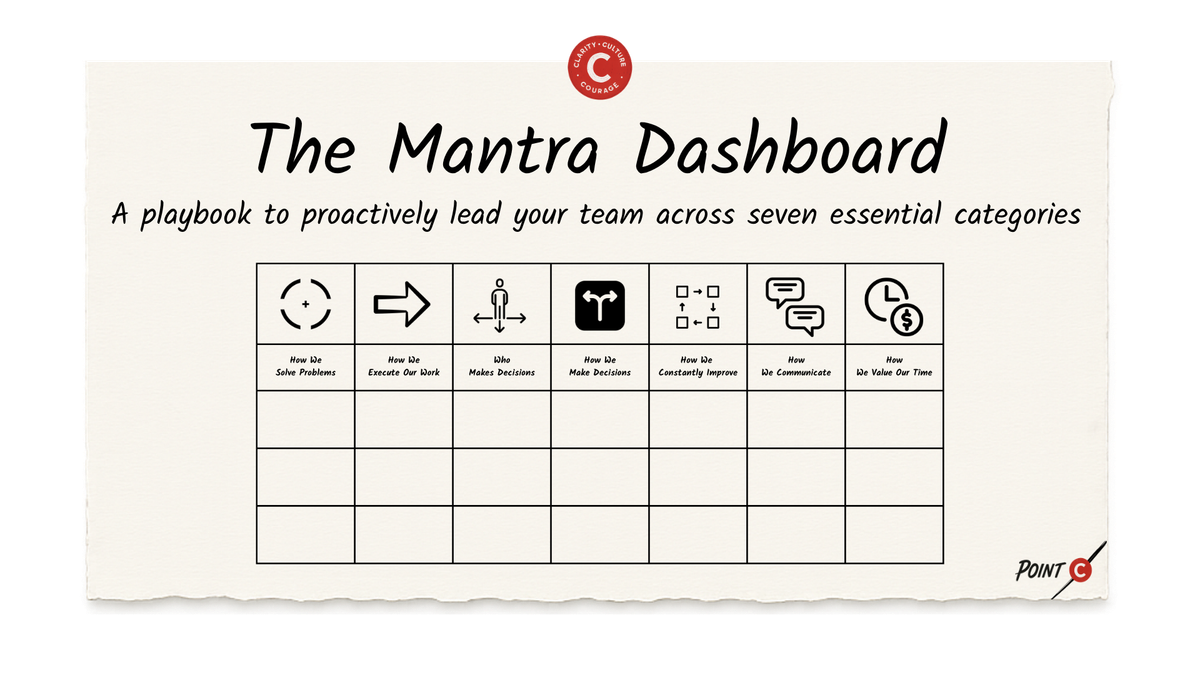
So here it is. My complete, updated Mantra Dashboard: twenty-one mantras across seven categories, three deep in every column:
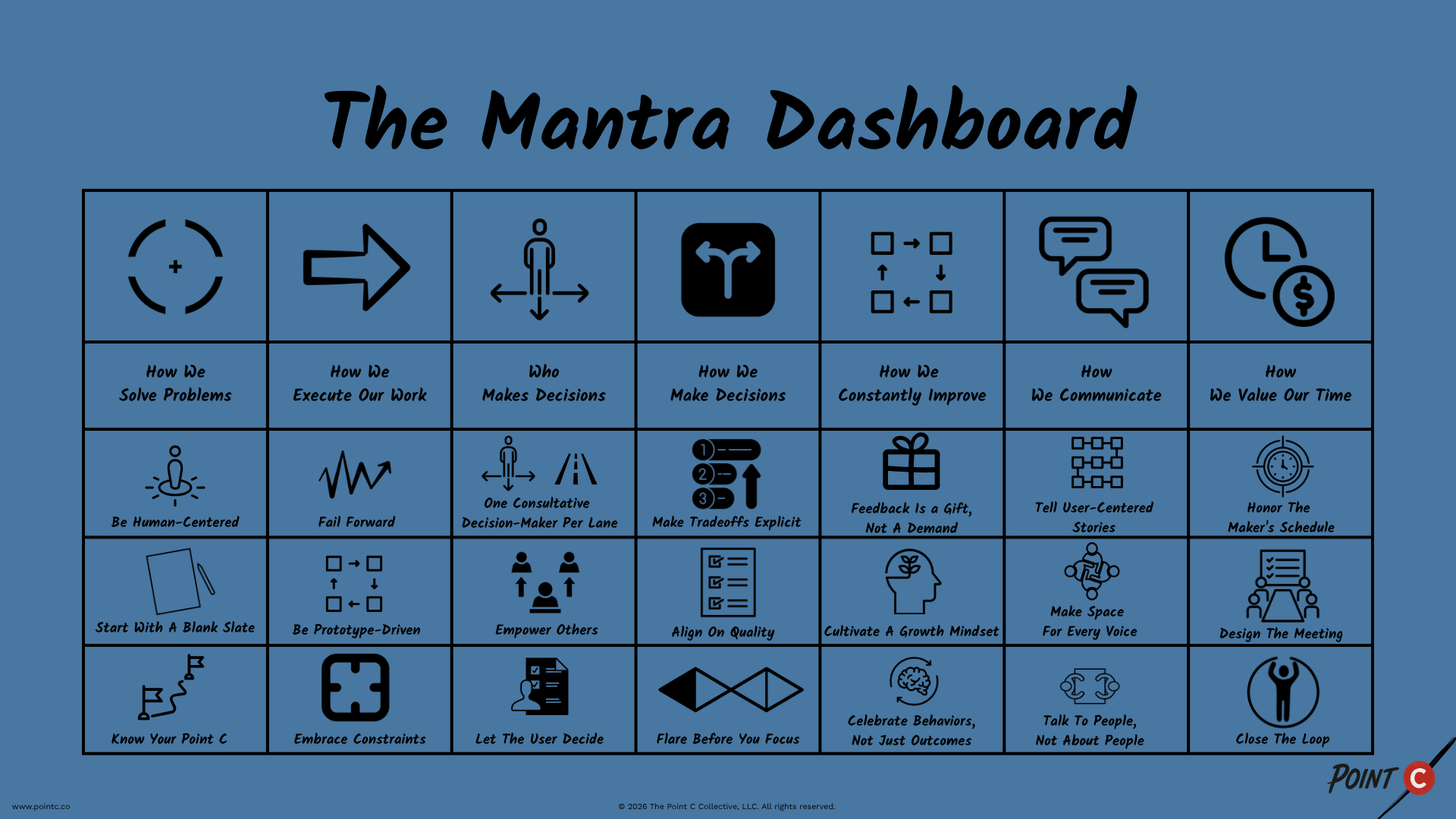
This is the one-page playbook of my current default go-to mantras. The ones I repeat, the ones I teach, the ones my teams hear from me over and over again.
I'm not sharing this to say you should adopt my mantras. I'm sharing it because I believe every leader should have their own. Feel free to steal from mine. Feel free to disagree with mine and build something completely different. But have one. Be intentional about the signals you're sending your team, and always have a dashboard ready to go for whatever situation you drop into.
Think of it as a go-to prototype that you're constantly refining. You tweak the language, sharpen the framing, swap in a mantra that's earning its spot and retire one that isn't landing. The dashboard you see today is the result of years of that process. And it will keep getting better.
Over the coming weeks, we're going deep on every mantra we haven't explored yet, complete with a full Mantra Ladder for each one. By the end of this series, every mantra on the dashboard will link to its own deep dive, and I'll compile the whole thing into a reference manual you can download and use with your team. Think of today's post as the table of contents and the kickoff.
Why A Dashboard
The Mantra Ladder showed you how to build a single mantra from the ground up. But one mantra only covers one dimension of your culture. And culture is not one-dimensional.
When I was at the d.school at Stanford, we had what we called mindsets. Be human-centered. Be prototype-driven. They were incredibly powerful. They shaped how I thought about solving problems and building products.
But when I started leading my own innovation teams, I realized those early mantras were incomplete. We could be great at being human-centered and terrible about roles and decision-making. We could have strong signals about how to approach problems and almost nothing about who owns the decision or how we value each other's time.
That gap is what led me to build a more complete, holistic set of leadership mantras. One that covers the full range of what a team needs to hear from its leader. Because the absence of a signal is itself a signal. When your team doesn't hear from you about how decisions get made, they make up their own rules. When you're silent about how time should be valued, people fill that silence with their own defaults.
That's what a dashboard is for. It helps you find the blind spots. You need more than a handful of go-to mantras. You need a way to see the whole picture and ask yourself: Where are my signals strong, and where are they absent?
The Seven Categories
Last year, I introduced The Subculture Coverage Matrix: a mapping tool to help you see what types of norms your mantras are reinforcing and what categories might be missing. Seven essential categories emerged:
1) How We Solve Problems. How we understand problems and design solutions.
2) How We Execute Our Work. How we turn ideas into action and deliver results.
3) Who Makes Decisions. How we define ownership and decision authority.
4) How We Make Decisions. How we evaluate options and choose a path forward.
5) How We Constantly Improve. How we learn, adapt, and get better over time.
6) How We Communicate. How we share information, ideas, and feedback.
7) How We Value Our Time. How we prioritize focus, collaboration, and attention.
Seven categories. Three mantras each. Twenty-one mantras total. That's the dashboard.
The Mantra Dashboard
Here's my current dashboard. Mantras that already have their own deep-dive post are linked. The rest are coming in the weeks ahead.
How We Solve Problems
- Be Human-Centered: Keep coming back to the user to guide your work.
- Start With A Blank Slate: Escape "business as usual" and design what's next.
- Know Your Point C: Make sure every team member understands where you're going and why it matters.
How We Execute Our Work
- Fail Forward: Reinforce learning and experimentation.
- Be Prototype-Driven: Embrace imperfection and iteration.
- Embrace Constraints: Expand what's possible by working with what's not.
Who Makes Decisions
- One Consultative Decision-Maker Per Lane: Empower your team, clarify roles, and unlock momentum.
- Empower Others: Push decisions down and give people room to own outcomes.
- Let The User Decide: When the team can't agree, go ask the user. They have the answer.
How We Make Decisions
- Make Tradeoffs Explicit: "Everything is important" is lazy leadership. Always force-rank your priorities.
- Align On Quality: Define what "good" looks like before the work begins.
- Flare Before You Focus: Widen thinking before narrowing to decisions.
How We Constantly Improve
- Feedback Is A Gift, Not A Demand: Ensure the free flow of information.
- Cultivate A Growth Mindset: Frame work as a learning problem, not an execution problem.
- Celebrate Behaviors, Not Just Outcomes: Reinforce the behaviors and mindsets that lead to excellence.
How We Communicate
- Tell User-Centered Stories: Every strategy should be grounded in a concrete user journey.
- Make Space For Every Voice: Widen participation and improve decision quality.
- Talk To People, Not About People: Ensure direct, respectful communication.
How We Value Our Time
- Honor The Maker's Schedule: Ensure your team can do deep work.
- Design The Meeting: Value our time and leverage our moments of impact.
- Close The Loop: Get back to the team on outstanding decisions and actions.
A Living Document
If you read the original Subculture Coverage Matrix, you'll see that it is slightly different. Mantras have sharpened, moved categories, and earned or lost their spots. That's by design. A dashboard is a living document, not a finished product. The ladder beneath each mantra gets clearer over time, and when the ladder gets clearer, the mantra gets sharper. That's the prototype mindset at work.
The Series Ahead
You'll notice that some of the mantras above are linked to their own deep-dive posts and some are not. Over the past year, we've already explored eleven of these twenty-one mantras in depth. The unlinked ones are coming. Over the coming weeks, each one will get its own deep dive with a full Mantra Ladder.
When the series is complete, I'll compile the entire dashboard into a downloadable reference manual. All twenty-one mantras, all twenty-one ladders, all linked to their deep dives.
Your Challenge This Week
- Look at the seven categories. Before you look at my mantras, ask yourself: Do I have a norm, an operating principle, for each of these categories?
- Map your own mantras into the grid. Where are you strong? Where are you silent? The silent categories are your biggest blind spots.
- For each blank category, draft a placeholder mantra. It doesn't have to be perfect. A rough phrase is infinitely better than an empty lane.
Next Week
If your team doesn't know where you're headed, none of the other mantras on this dashboard matter. You can have the best decision-making framework in the world, but if people don't understand the destination, they can't make good decisions about how to get there.
Next week, we explore why clarity of direction is the most important job of a leader: Know Your Point C.
Know someone who would find this useful? Forward this email to them. They can subscribe here to get their own weekly half sheet.
About This Newsletter
The Idea Bucket is a weekly newsletter and archive featuring one visual framework, supporting one act of leadership, that brings you one step closer to building a culture of innovation.
It’s written by Corey Ford — executive coach, strategic advisor, and founder of Point C, where he helps founders, CEOs, and executives clarify their visions, lead cultures of innovation, and navigate their next leadership chapters.
Want 1:1 executive coaching on this framework or others? Book your first coaching session. It's on me.