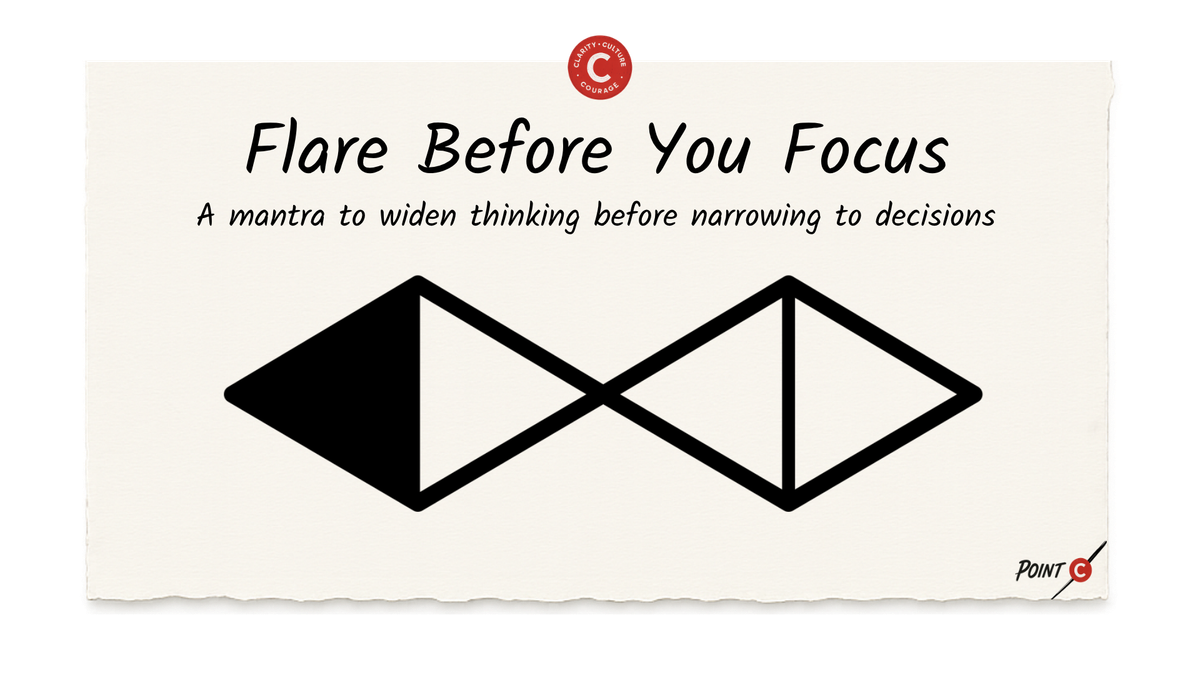
Flare Before You Focus
A mantra to widen thinking before narrowing to decisions

This week in The Idea Bucket we continue unpacking the ten levers that you can pull to increase psychological safety in your subculture. So far we've explored the following mantras:
- Cultivate A Growth Mindset
- Fail Forward
- Feedback Is A Gift — Not A Demand
- Lead With Vulnerability
- Make Space For Every Voice
- Design For The Roller Coaster
- Celebrate Behaviors, Not Just Outcomes
- You Own Your Role, We Own The Outcome
Today we pull the lever of modeling curiosity and asking questions.
In a previous post, I introduced the mantra Always Separate Flaring And Focusing as a design discipline. That was about structure: when you brainstorm, don't evaluate. When you evaluate, don't brainstorm. Keep the two modes in separate containers so that creativity and rigor can each do their jobs.
But there's something deeper going on. The process only works if the leader genuinely shows up curious. Otherwise, the team will go through the motions of flaring on the surface while focusing underneath, still trying to figure out what the boss thinks.
That's why this week's mantra isn't about the design process. It's about the leader's posture.
Model Curiosity & Ask Questions
As a reminder, one of the ten levers you can pull to increase psychological safety in your subculture is to model curiosity and ask questions.
Leaders shape the quality of thinking in the room. When curiosity leads, exploration feels expected. When answers lead, ideas get filtered.
In the Anxiety Zone, people self-edit. Curiosity signals that ideas are welcome, not risky.
When you model curiosity:
- You ask before asserting
- You hold back your opinion to avoid anchoring
- You explore disagreement instead of defending
This is not about indecision. It’s about exploration before convergence.
Before you narrow to a decision, flare before you focus and widen the thinking in the room.
The Smartest Person Trap
I coach leaders at some of the most well-known companies in the world. And there is a type of culture I keep encountering, especially among organizations that attract high-achievers, where being the smartest person in the room is the currency. The people are brilliant. They are well-educated, deeply experienced, and can out-argue almost anyone. And the culture reinforces this at every turn. The people who rise tend to be the people who "act the smartest" in the room.
From the outside it looks like a culture of excellence and rigorous debate. From the inside, it's something else entirely.
What I see when I work with leaders in that environment is that their meetings aren't explorations. They're performances. Two people, both in Focus mode, talking across each other, each trying to prove they have the sharper analysis. Everyone in the room thinks they're having a robust debate. What they're actually having is two monologues masquerading as a conversation.
Nobody is flaring. Nobody is genuinely curious about the other person's perspective. Nobody is asking, What am I not seeing? Instead, they're asking themselves, How do I make sure everyone knows I'm smart?
If you read my previous post on Cultivate A Growth Mindset, you'll recognize what's happening here. This is the Kryptonite of Smart playing out at the team level. When a culture rewards appearing smart, people optimize for proving rather than learning. They bring their conclusions to the meeting instead of their curiosity. And the quality of collective thinking goes down, even though every individual in the room is extraordinary.
The irony is that these are often the most talented teams in the organization. They have all the ingredients for great decisions. But they never flare. They jump straight to their conclusions and spend the meeting defending them. What gets lost is the exploration that would have made their conclusions better.
And the cost is enormous. So much of my coaching work in these environments is spent helping people navigate the personalities in these meetings. So much energy focused on the wrong thing. All because the culture gets this one thing wrong.
When you put brilliant people in a room and the outcome is less than the sum of their parts, that's not a talent problem. That's a leadership problem.
The Patience Problem
When I work with individual leaders who struggle with flaring, it is almost always a problem of patience and self-regulation.
They know, intellectually, that brainstorming is valuable. They understand the concept. But when they're in the room and the conversation starts to wander, or someone floats an idea that feels off-track, or the discussion isn't converging fast enough, they can't help themselves. They jump in. They redirect. They steer the conversation back to their conclusion before the room has had a chance to explore.
And here's what I find interesting: they spend more energy and time fighting the flare than it would have taken to actually do it. They think they're saving time by cutting to the answer. What they're really doing is shutting down the very thinking that would have strengthened their decision.
Sometimes, if I'm being honest, it looks a bit pathetic. It's the kid who takes the basketball home when the game isn't going his way. Except now that kid runs a team. And every time they pull the ball away, they teach their team that exploration isn't safe. That the leader's conclusion is the only one that matters. That flaring is a waste of time.
And all the leader really had to do was take a few deep breaths, listen, and get curious. It takes the same amount of time.
But, in the absence of this, over time, the team stops offering ideas. They stop pushing back. They start trying to guess what the boss already thinks and tailor their contributions accordingly. The flare dies, and the leader never knows it happened. They think they have a team of people who agree with them. What they actually have is a team of people who have stopped trying.
If you recognize this in yourself, don't beat yourself up about it. But do something about it. If you find yourself getting impatient during a brainstorm, or feeling the urge to cut off an exploration that isn't converging fast enough, that feeling is the signal. That is exactly the moment to take a breath and get curious.
Genuine Curiosity vs. Performative Curiosity
There's a version of this that looks like flaring but isn't.
It's the leader who says, "What does everyone think?" but has already made up their mind. People can feel the difference. When a leader asks a question they genuinely don't know the answer to, the energy in the room shifts. People lean in. They take the question seriously because they can tell it's real.
When a leader asks a question to check a box before announcing their decision, people disengage. They learn very quickly that the flare is theater. And theater doesn't build psychological safety.
Genuine curiosity sounds like:
What are we not seeing? Who disagrees with where this is heading, and why? I'm not sure about this. How are you all thinking about it?
It's the willingness to not know. To sit in the discomfort of an open question long enough for the room to actually think.
This connects to the voting methodology I use with teams and described in Make Space for Every Voice. When I facilitate a decision, I have each person write their vote privately before anyone speaks. Then we reveal and discuss, starting with the minority voices. The leader goes last. The whole structure is designed to protect the flare from being collapsed by the most powerful person in the room. But the structure only works if the leader genuinely wants to hear what surfaces. If they're going through the motions, the team will feel it.
It also connects to Feedback Is A Gift, Not A Demand. Genuine flaring means treating every perspective that enters the room as information worth exploring, not as something to evaluate and accept or reject in real time. When someone shares an idea during a flare, the leader's job is to be curious about it, not to judge it. The judgment comes later, during the focus.
How to Flare Before You Focus
If you want to model curiosity in a way that actually increases psychological safety on your team, here are some concrete shifts you can make.
Hold your opinion. When a decision is on the table, resist the instinct to share your view first. Your opinion anchors the room whether you intend it to or not. Speak last. Let the thinking develop without your fingerprints on it.
Ask, don't assert. When someone brings you a recommendation, resist the instinct to evaluate it immediately. Instead, ask them what alternatives they considered and what they learned from those. This signals that you value the process of exploration, not just the conclusion.
Notice leading questions. There's a big difference between "Have we thought about doing X?" (which is really a suggestion) and "What haven't we considered yet?" (which is a genuine invitation to flare). Train yourself to ask the second kind.
Sit with the discomfort. Flaring feels slow. It feels inefficient. That discomfort is the point. It means the room is actually thinking rather than performing. If you catch yourself wanting to speed things up, that's your signal to ask one more question.
Name what you're doing. Tell your team: I'm going to hold my opinion until I've heard from everyone. I want to make sure we flare before we focus. When you name the behavior, you normalize it. Over time, your team will start doing it without being asked.
Your Challenge This Week
1) In your next meeting where a decision needs to be made, notice your first instinct. Do you want to share your view right away?
2) Instead of asserting, ask one genuinely curious question. Not a leading question. A real one.
3) Wait. See what surfaces that wouldn't have surfaced if you'd spoken first.
4) If you catch yourself getting impatient with the conversation, pause. Ask yourself: Am I trying to be right, or am I trying to learn?
5) At the end of the meeting, reflect: Did the quality of thinking in the room change? Did someone say something they wouldn't have said if you'd led with your conclusion?
Next Week
As a reminder, here are the ten corresponding mantras to increase psychological safety in your organization:
- Cultivate A Growth Mindset
- Fail Forward
- Feedback Is A Gift — Not A Demand
- Lead With Vulnerability
- Make Space For Every Voice
- Design For The Roller Coaster
- Celebrate Behaviors, Not Just Outcomes
- You Own Your Role, We Own The Outcome
- Flare Before You Focus
- Make Expectations Explicit
Next week, we dive into the final mantra of our series. We pull the lever of setting clear norms and expectations: Make Expectations Explicit.
About This Newsletter
The Idea Bucket is a weekly newsletter and archive featuring one visual framework, supporting one act of leadership, that brings you one step closer to building a culture of innovation.
It’s written by Corey Ford — executive coach, strategic advisor, and founder of Point C, where he helps founders, CEOs, and executives clarify their visions, lead cultures of innovation, and navigate their next leadership chapters.
Want 1:1 executive coaching on this framework or others? Book your first coaching session. It's on me.