The Mantra Ladder
A way to turn goals into mantras

Last week in The Idea Bucket we completed the ten levers you can pull to increase psychological safety in your subculture. The final lever, Make Expectations Explicit, was the capstone: the meta-mantra that makes all the other mantras work.
But it left a question unanswered: How do you actually build a mantra?
Not borrow one from a leadership book. Not repeat something you heard at a conference. But build one from the ground up, rooted in what you actually believe, what you actually expect, and what you actually want your team to become.
Today I'll share the tool I use to do exactly that: The Mantra Ladder.
The Four Foundational Elements
Before we can talk about mantras, we need to talk about what sits beneath them.
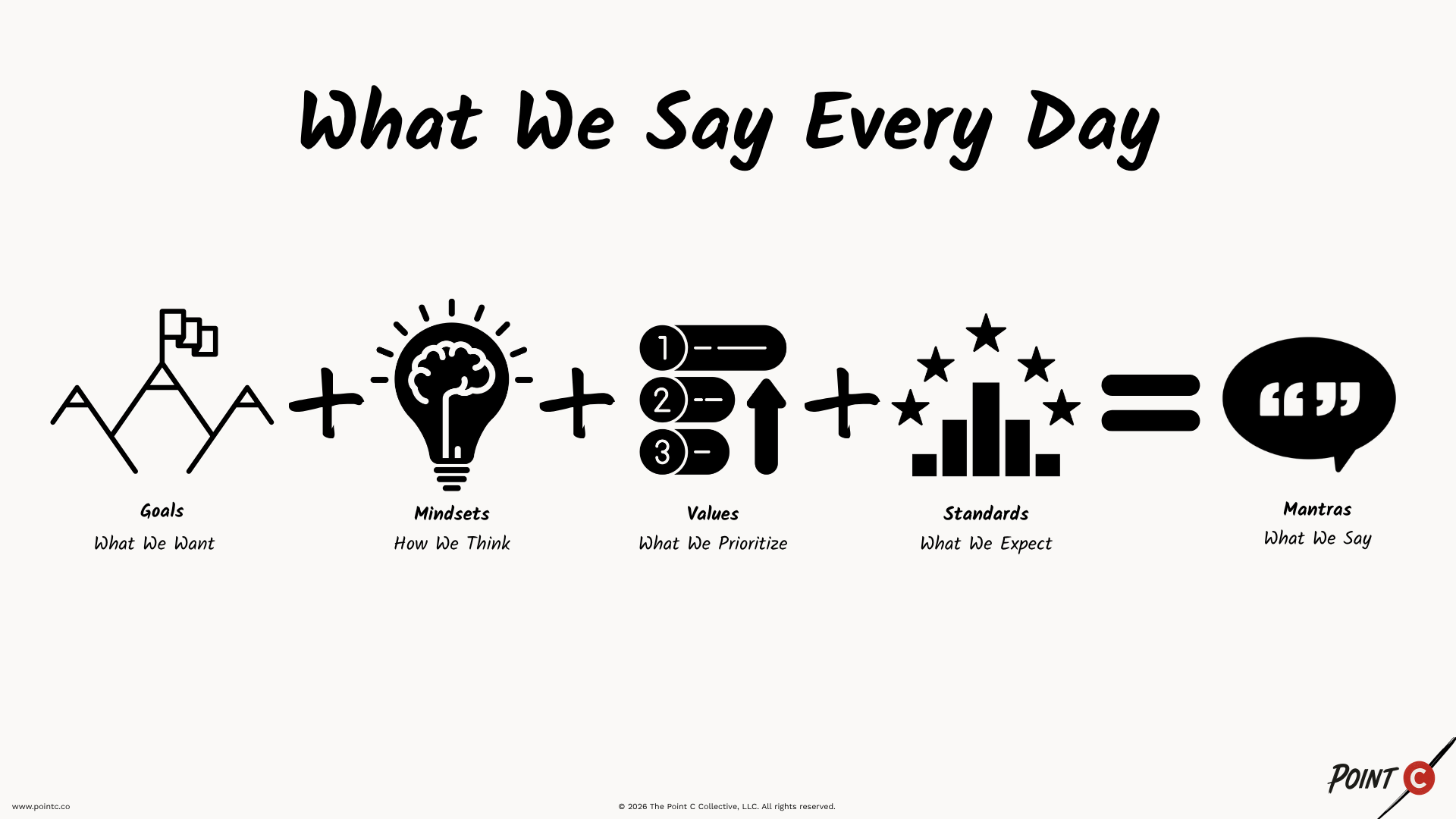
Every culture, whether it's been articulated or not, rests on four foundational elements:
Goals: What We Want. The outcomes we are trying to create and the vision we are working toward.
Mindsets: How We Think. The beliefs and assumptions that shape how we interpret problems and make decisions.
Values: What We Prioritize. The principles that guide how we make tradeoffs when we cannot do everything.
Standards: What We Expect. The level of quality and behavior we consistently expect and enforce.
Most organizations have these. Many have even taken the time to develop and document them. They run an offsite. They write them up. They put them in a Google doc or a slide deck. And then, slowly, they get buried and forgotten.
If I dropped into your organization today and randomly asked someone to tell me your team's goals, mindsets, values, and standards, could they? Could they articulate them clearly, in the moment, without pulling up a document?
More often than not, the answer is no. And that's the problem. These foundational elements are critically important. But if they're not living and breathing in your culture every day, they're not really there.
The Air A Culture Breathes
So how do you make them live and breathe?
You add a fifth element: Mantras. What We Say.
Mantras are the simple, repeatable language we use to reinforce what matters most. They are sticky shorthand that compresses your goals, mindsets, values, and standards into phrases your team can remember in the moments that matter. When they're making a decision. When they're in a difficult conversation. When they're under pressure and no one has the bandwidth to pull up a document.
As I've said before, leaders are the signal generators of culture. The mantras you repeat are the sticky signals your team will follow. And you need to repeat them so often that your team starts to lovingly mock you for it. That's how you know they're landing.
But here's the thing that separates a real mantra from a platitude. A platitude is a phrase disconnected from practice. It sounds good on a poster. A mantra is a phrase connected to a goal, a mindset, a value, and a standard that your team actually holds each other to. It has intention. And that intention is what gives it weight.
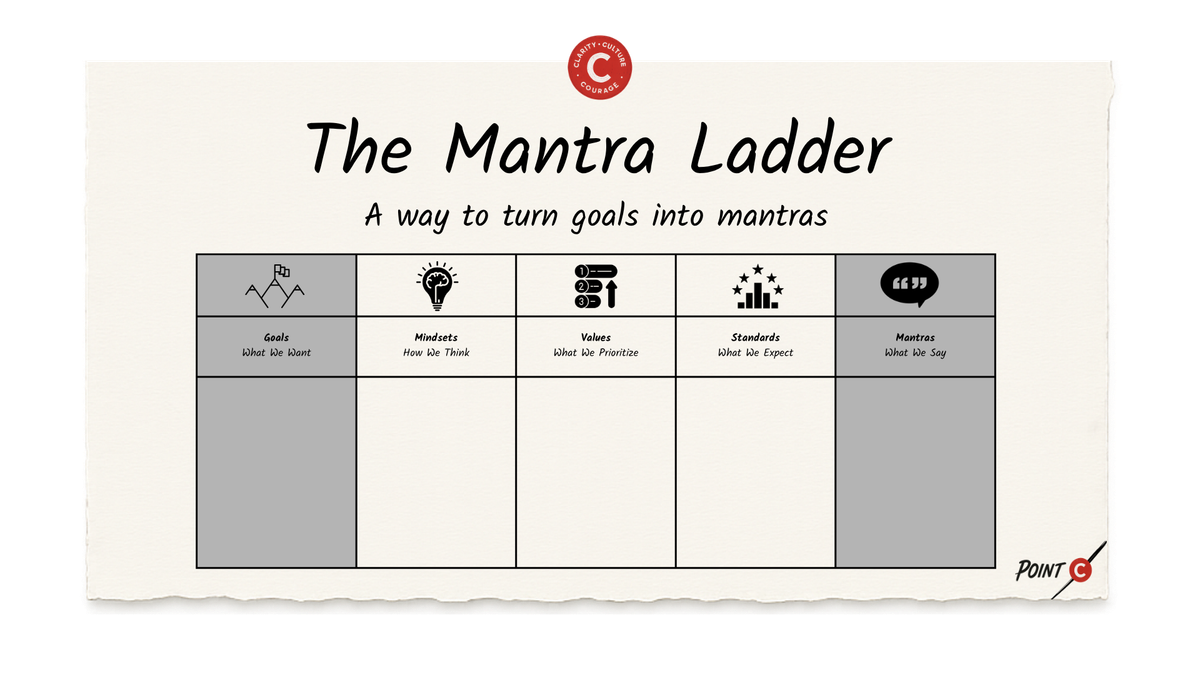
The Mantra Ladder
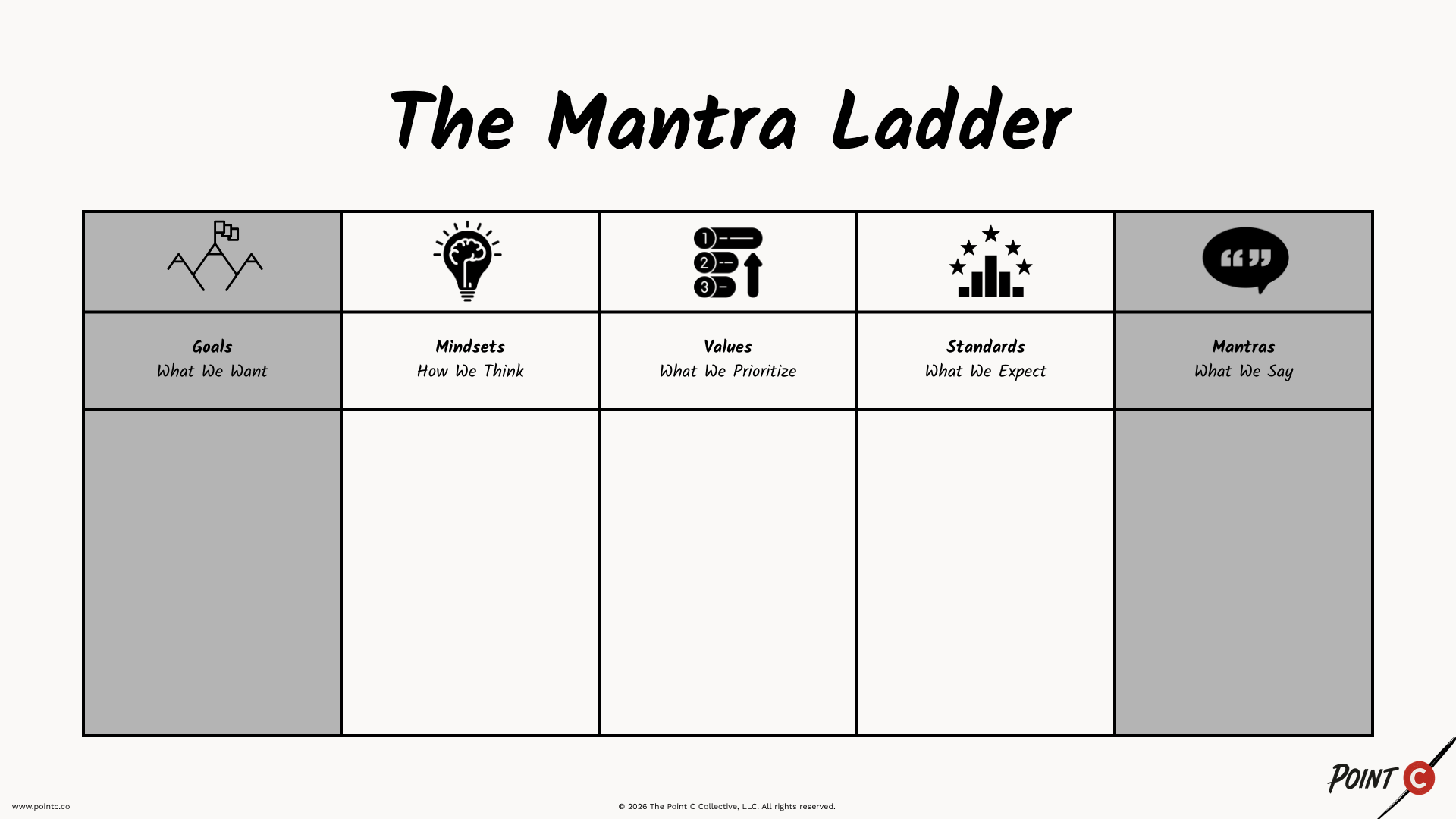
The Mantra Ladder is the tool I use to make sure every mantra has that intention behind it.
It connects all five elements into a single, coherent chain:
Goals lead to Mindsets, which express themselves as Values, which are operationalized as Standards, which are encoded as Mantras.
Or, put more simply:
What We Want shapes How We Think, which clarifies What We Prioritize, which defines What We Expect, which becomes What We Say.
When all five rungs are connected, the mantra carries real weight. When someone on your team says it in a meeting, they're not just repeating a phrase. They're invoking the entire ladder: the goal, the belief system, the tradeoff, and the behavioral expectation.
That's what makes it stick.
A Worked Example: Fail Forward
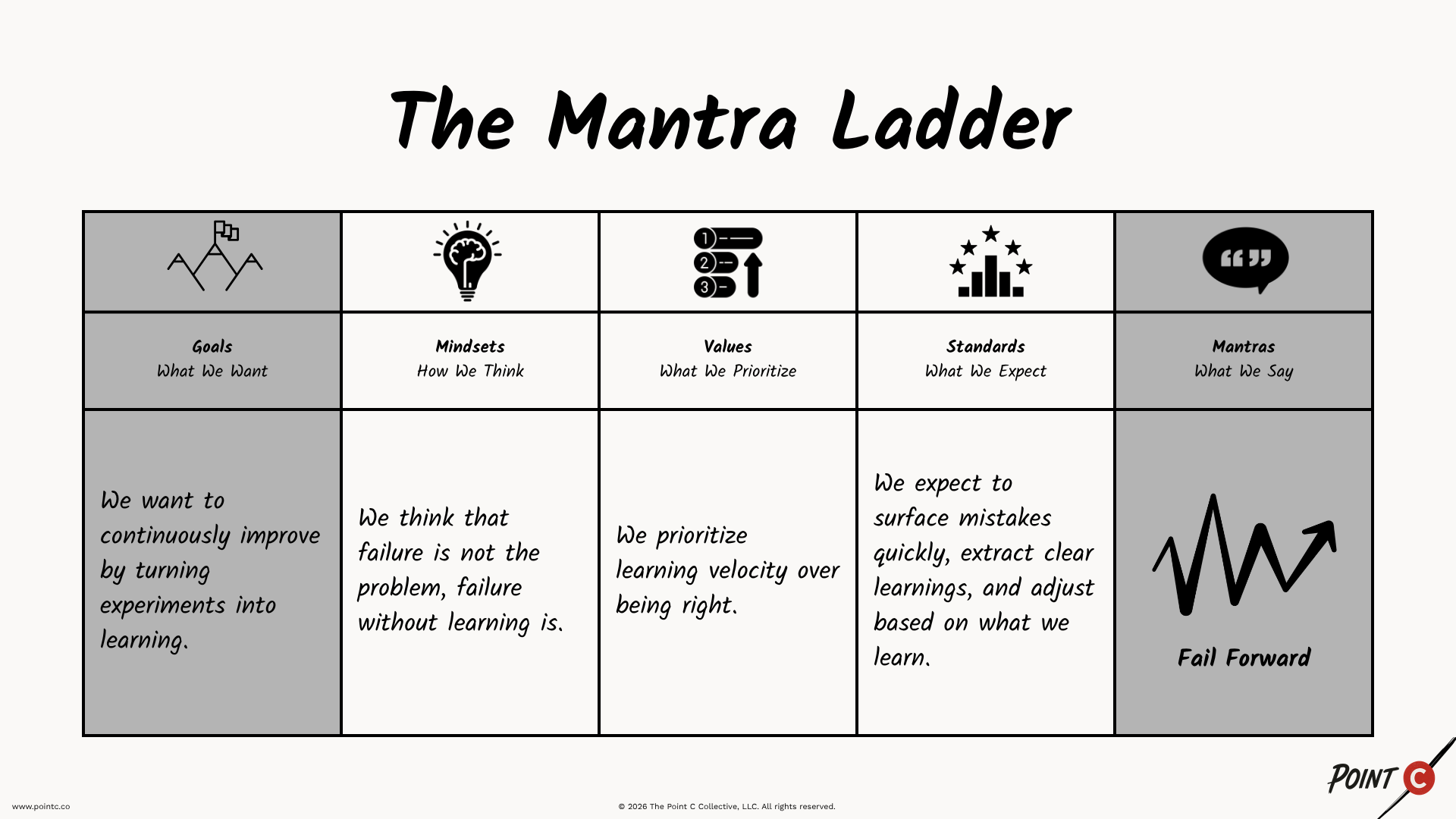
Let me show you how this works by deconstructing one of my own mantras that you are already familiar with: Fail Forward.
Goal (What We Want): We want to continuously improve by turning experiments into learning. We believe that if we can learn faster than everyone else, we win.
Mindset (How We Think): We think that failure is not the problem. Failure without learning is. We're not focused on avoiding mistakes. We're focused on accelerating our learning.
Value (What We Prioritize): We prioritize learning velocity over being right.
Think about what that tradeoff means for a moment. I know many of you work in cultures where being right is the thing. Where being seen as smart is the currency. Where admitting you were wrong feels like a career risk. This value makes a different bet. It says that the team that learns fastest will outperform the team that's most afraid to be wrong.
Standard (What We Expect): We expect people to know that what they have is imperfect, and the best way to make it better is to share it early. We expect people to share early prototypes of their thinking, take risks, extract clear learnings, and adjust based on what they learn.
Mantra (What We Say): Fail Forward.
Two words. But they carry the weight of everything beneath them. When someone on my team says fail forward in a moment of uncertainty, they're invoking all four rungs. They're reminding the room that the goal is learning, that the mindset values experiments over perfection, that the standard is to surface what we learned quickly, and that no one gets punished for being wrong early.
That's the difference between a mantra and a motivational poster.
Why The Ladder Matters
You might be thinking: Do I really need to go through all of this for every mantra? Can't I just come up with a good phrase?
You can. But here's what happens when you do.
A mantra without a ladder tends to float. It sounds good in a town hall but no one knows what behavior it's actually asking for. People nod when they hear it and then go back to doing exactly what they were doing before. Or worse, different people interpret it differently because there's no shared understanding of the standard beneath it.
For example, an older version of fail forward that I used a lot was fail fast. It's a great mantra and I still believe in it but in some circumstances fail fast was misinterpreted as have low standards and do sloppy work. That's clearly not what I was going for. I wanted high standards paired with rapid experimentation and a relentless focus on learning. So I updated the mantra to Fail Forward. To signal the importance of the advancement of learning. And I made sure that everyone understood each part of the ladder that grounded it, especially the goal.
A mantra with a ladder is grounded. When someone pushes back on the behavior the mantra is asking for, you can walk them down the ladder. Here's the goal. Here's why we think this way. Here's the tradeoff we've chosen to make. And here's the specific behavior we expect. The conversation becomes concrete instead of abstract.
The ladder also helps you pressure-test your own thinking. Sometimes when I try to build a ladder for a mantra I like, I realize I can't articulate the standard. I know the phrase feels right, but I can't name what I actually expect people to do differently. That's a signal that the mantra isn't ready yet. It needs more work before it's ready to carry weight in my culture.
How To Build Your Own
When I teach the Mantra Ladder, I tell people: start anywhere. Start with whichever rung is most concrete for you.
Some leaders start with the goal. They know exactly what outcome they want, and they work down from there.
Some start with the standard. They know exactly what behavior they expect, and they work up to find the mantra that encodes it.
Some start with the mantra itself. They have a phrase they've been using and they want to pressure-test it by building the ladder beneath it.
There's no wrong entry point. The important thing is that by the time you're done, all five rungs are connected. Each one should flow naturally into the next. If you find yourself repeating the same idea across multiple rungs, that's a signal to push harder on the distinctions. What do you want? How do you think about it? What do you prioritize over what? What specific behavior do you expect?
One more thing before you start. Don't let the search for the perfect phrase stop you from having any phrase at all. I see this a lot with leaders who are thoughtful about language. They get stuck trying to craft the most elegant mantra and end up with nothing. Here's the truth: a semi-shitty, non-eloquent placeholder mantra that represents your goal is infinitely better than an empty lane. Treat your mantras the same way you'd treat any prototype. Get something down. Use it. See how your team responds. And iterate from there. Some of my mantras are sticky and sharp. Others I'm still workshopping. That's fine. The eloquence comes with repetition and refinement, not with agonizing over the first draft.
Here's the exercise:
- Start with a mantra you already use, or a cultural behavior you want to reinforce.
- Fill in each rung of the ladder. Write one to two sentences for each.
- Read it from top to bottom. Does it flow? Does each rung lead naturally to the next?
- Read it from bottom to top. Does the mantra actually encode the standard? Would someone who heard only the mantra be able to infer the behavior you expect?
- If anything feels disconnected, revise until the chain holds.
Your Challenge This Week
Build one Mantra Ladder using this worksheet:
Pick one mantra you already use with your team, or one behavior you wish your team would adopt. Work through all five rungs. Write it down. It doesn't have to be perfect. Treat it as a prototype.
Then share it with one person. A colleague, a direct report, a thought partner. Ask them: Does this make sense? Does the mantra capture the standard?
Because a mantra that only makes sense to you isn't a mantra yet. It's a note to self. A real mantra is language your team can carry.
Next Week
Next week is a special week. It will be the one year anniversary of launching Point C and The Idea Bucket newsletter! We're going to pull back and take a look at the full Idea Bucket, now filled with 52 half-sheets spanning leadership, strategy, and career.
When we come back from that in two weeks, we'll pick this thread back up because, now that you have the tool to build mantras, the next question becomes: How many do you need? And what categories should they cover?
If you only have mantras for how your team executes, but nothing for how you make decisions or how you value each other's time, you've got blind spots. And blind spots are where culture breaks down.
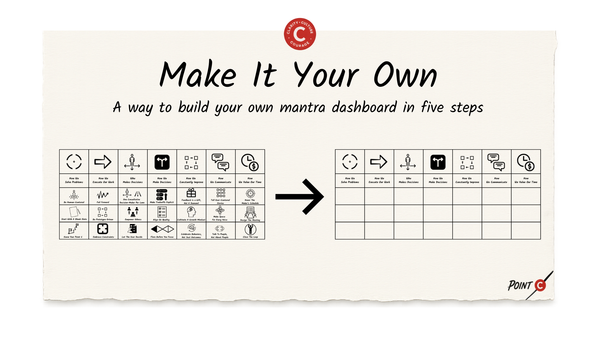
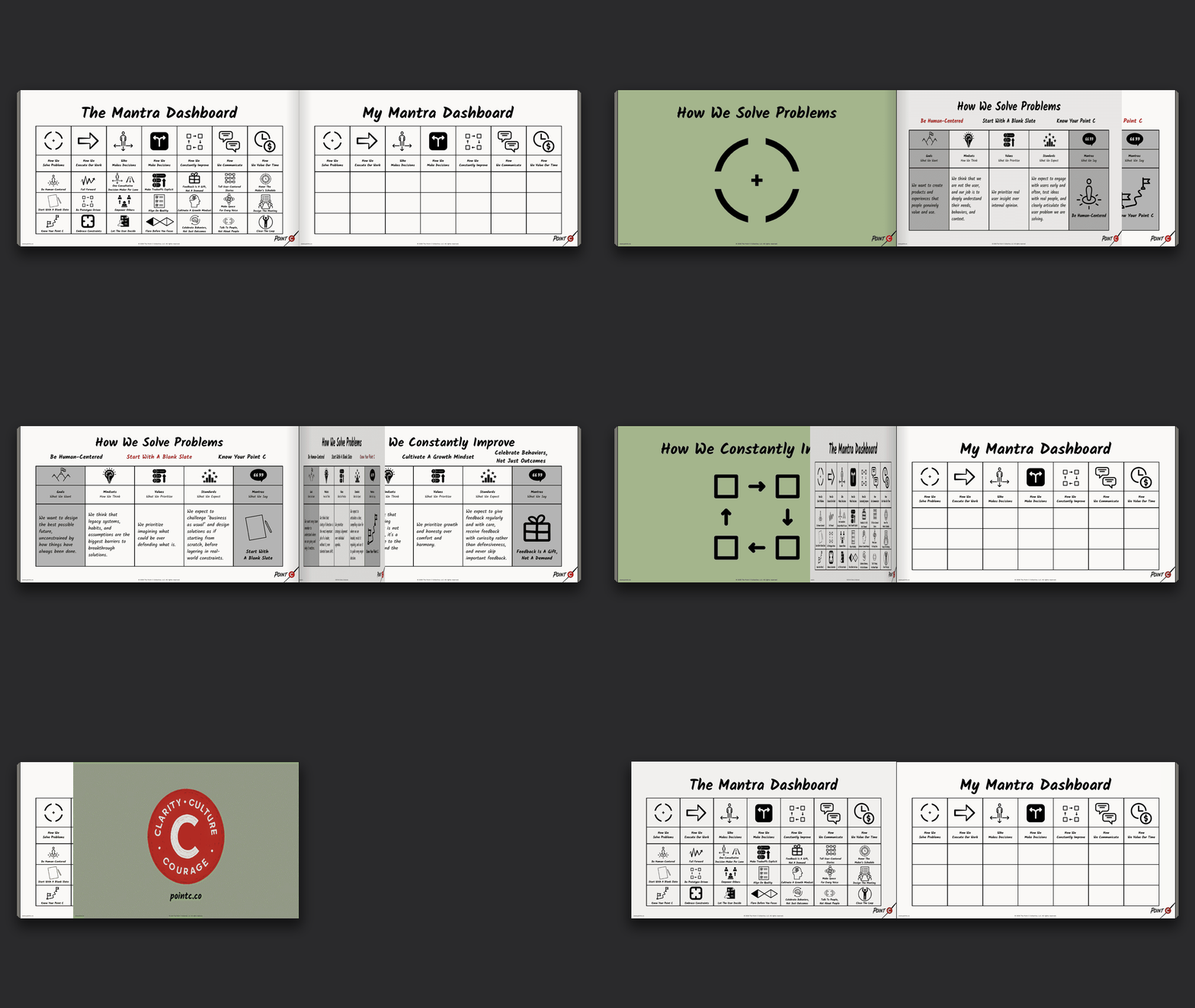
In two weeks, we revisit The Subculture Coverage Matrix, the audit tool I use to make sure my mantras cover all seven essential categories. And this time, I'll share my full, updated matrix: The Mantra Dashboard.
About This Newsletter
The Idea Bucket is a weekly newsletter and archive featuring one visual framework, supporting one act of leadership, that brings you one step closer to building a culture of innovation.
It’s written by Corey Ford — executive coach, strategic advisor, and founder of Point C, where he helps founders, CEOs, and executives clarify their visions, lead cultures of innovation, and navigate their next leadership chapters.
Want 1:1 executive coaching on this framework or others? Book your first coaching session. It's on me.