Align On Quality
A mantra to define what excellence looks like before the work begins

Was this forwarded to you? Subscribe here to get one leadership framework per week.
This is the seventh post in a series where I'm going deep on each mantra in my Mantra Dashboard. Last week, we explored why the best leaders push decisions down and coach rather than direct: Empower Others.
This week's mantra lives in the How We Make Decisions category of my Subculture Coverage Matrix, alongside Make Tradeoffs Explicit and Flare Before You Focus. Those mantras go hand in hand. Because you can't make tradeoffs if you haven't first aligned on what excellence looks like. And you can't align on quality without force-ranking what matters most.
The mantra is: Align On Quality.
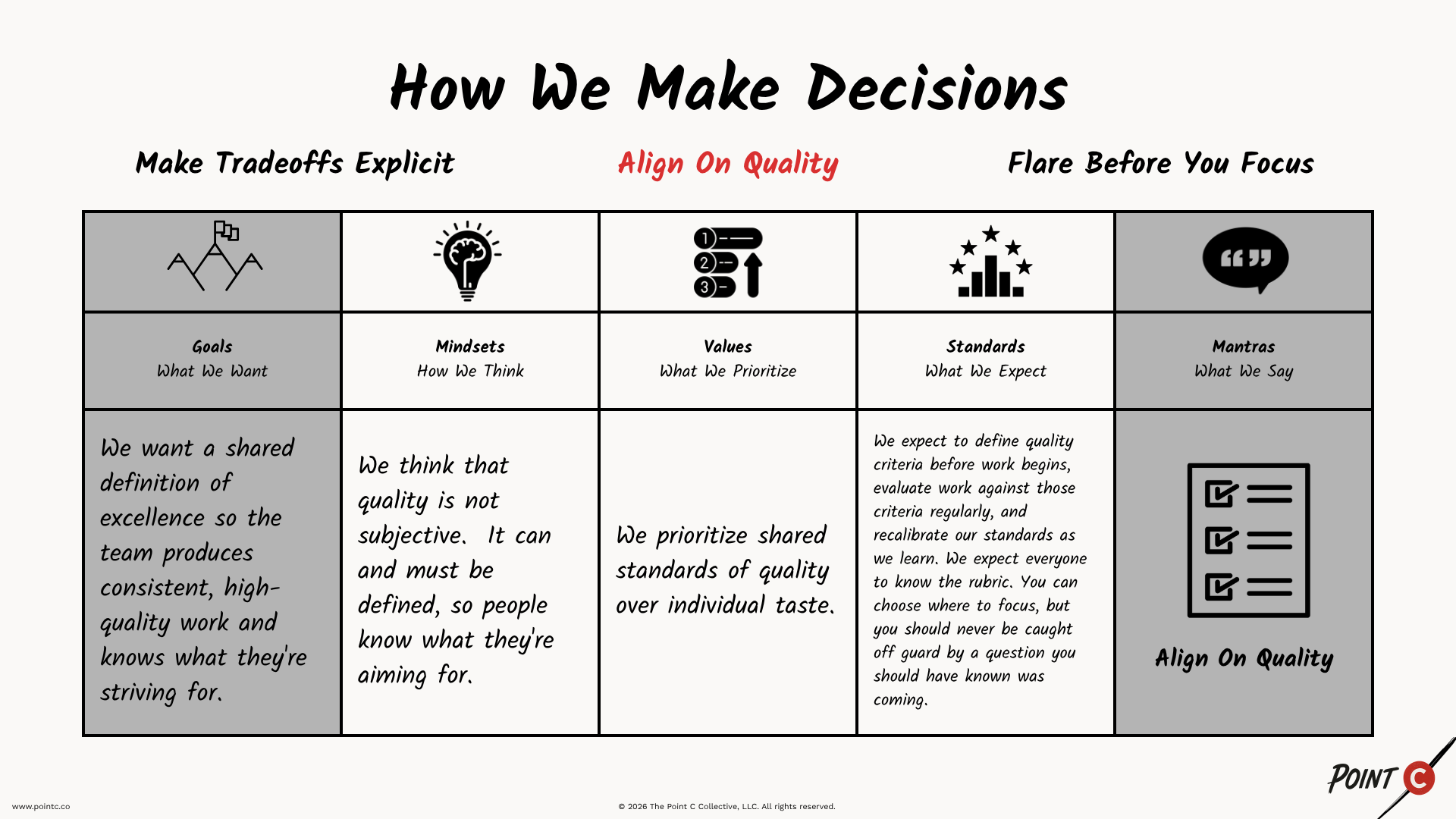
The Mantra Ladder
Here's the full Mantra Ladder for Align On Quality. The rest of this post unpacks it.
Goal (What We Want): We want a shared definition of excellence so the team produces consistent, high-quality work and knows what they're striving for.
Mindset (How We Think): We think that quality is not subjective. It can and must be defined, so people know what they're aiming for.
Value (What We Prioritize): We prioritize shared standards of quality over individual taste.
Standard (What We Expect): We expect to define quality criteria before work begins, evaluate work against those criteria regularly, and recalibrate our standards as we learn. We expect everyone to know the rubric. You can choose where to focus, but you should never be caught off guard by a question you should have known was coming.
Mantra (What We Say): Align On Quality.
Define Excellence Before You Build
Way too often, we don't know what excellent looks like until it's too late. A team spends weeks or months building something, and then at the end, when it's time to evaluate, everyone discovers they had different definitions of success in their heads the entire time. The leader had one standard. The team had another. The stakeholders had a third. And now it's too late to fix it.
This is one of the most common and most preventable failures I see in organizations. High-performing teams shouldn't know the solution they'll come up with at the start of the journey. That's why it's innovation. But they absolutely should know what "excellent" will look like when they get there.
Without that shared definition, "high standards" are often just vibes. And vibes are dangerous. Because without explicit quality criteria, the loudest voice in the room, or the strongest instinct in the culture, becomes the default decider. That's not a quality standard. That's a power dynamic.
This is also why failing forward matters so much. Design reviews, quick prototypes, early testing. When you align on quality upfront, those early checkpoints become meaningful. You're not just getting feedback. You're getting feedback against a shared standard. And the earlier you do that, the faster you learn whether you're on track.
As I teach in my Standards Levers framework: when quality is implicit or assumed, people default to different standards, creating frustration and inconsistency. Make the bar visible. If we have a shared understanding of the standards, then it's not just on the leader to drag people along. You create a shared space where everyone coaches everyone to uphold those standards together.
The Rubric
The framework I teach for aligning on quality is The Rubric.
A rubric is a defined set of quality criteria that the team agrees to before the work begins. It's the list of questions that any strategy, product, or proposal will be evaluated against. It tells your team what excellence includes, so they can find the best way forward. It doesn't tell people how to build. It tells them what matters.
In my work with teams, whether it's a venture design bootcamp, a strategic project, or any initiative that requires alignment, I use a rubric as the foundation. In venture design, my rubric has 21 criteria across three acts. Act I is the bottom-up user journey: who is the user, what is the need, what does the experience look like? Act II is the top-down landscape: what is the market, what are the trends, what is the competitive advantage? And Act III is the team and the plan: who is building this, what are the key risks, and what is the Point C?
The last question in the rubric is the one that forces the real conversation. It asks the person giving feedback: "Would you say 'yes' to the ask? Does your excitement outweigh your hesitations?" That is a gut-check that integrates all the analytical criteria into a single decision. And it's followed by: "What should the innovator do next with their limited time and limited resources?" That is a prioritization decision about which risks need to be reduced first. It connects directly to Make Tradeoffs Explicit.
This is also where your organization's mission and values should live. Not buried in a deck that nobody opens. In the rubric. That's how you make your values live and breathe in the culture. When your values show up as explicit criteria that people are evaluated against in the moments that matter, they stop being aspirational and become operational. I worked with one organization where their values, OKRs, and KPIs were all buried in separate documents that weren't being referenced when it mattered most. So we integrated them into a restructured rubric. We turned static values into active standards.
Building Your Rubric
So how do you actually develop a rubric? It starts with the same principle behind The Selection Stack: understand what each stakeholder cares about most.
Go to each individual stakeholder, one on one. Brainstorm the criteria you think matter. Then test those criteria on them. Let them rearrange, add what you missed, and explain what matters most to them and why. Do this with every key stakeholder independently. At the end, you have a comprehensive rubric for what success needs to look like to meet all of their needs. You can see where they align and where they diverge. You can see the tensions. And you can make those tensions explicit before they become problems.
Once you have the rubric, force-rank it. That force-ranking is the connection to Make Tradeoffs Explicit. The rubric is the list of questions. Making tradeoffs explicit is the force-ranking of those questions.
The rubric should be developed with the audience in mind. Who is ultimately evaluating the strategy? What do they need to see? And you don't want to over-index on any single area. You want to see the big picture.
This is especially important in mission-driven organizations. The mission pitch can be so strong that it's like taking a warm bath. You feel inspired. Everyone believes in the cause. But your strategic senses get dulled. People say they love the idea, but if you ask the hard strategy questions, there's no strategy there. It's all based on good feelings. The strength of the mission creates a halo effect that makes everything else look better than it actually is. A rubric that covers multiple dimensions wakes you up and ensures the mission is complemented by real strategy, real user insight, and real competitive thinking.
And a rubric is not a one-time exercise. It should evolve. As you learn what matters most, as stakeholders refine their thinking, as the market shifts, the rubric should recalibrate. The act of revising the rubric is itself a quality alignment conversation.
The Decision Model Connection
There's another dimension of quality alignment that I want to hint at here, because I'll be writing about it in a future post: The Decision Model.
A decision model is the quantitative version of a rubric. It's a spreadsheet that connects your variables to your goals through equations, so you can run scenarios and make better decisions. The model doesn't make the decision. It makes the decision visible.
What I see too often is people making up numbers because "a good goal needs to be measurable." They pick an arbitrary number, execute against it, and then evaluate whether they hit it or not. That's not quality. That's guessing. A decision model breaks everything down so that each person on the team can see where they fit in the overall picture. They know why their number matters. They know how it connects to the goals of the organization. And when one role's numbers shift, the model shows exactly how the other levers are affected. That's not micromanagement. That's a conversation the whole team can have with open eyes.
The decision model turns "me" into "we." It transforms individual metrics into a shared understanding of what success looks like, measured and connected. It's a measure of excellence that everyone can see. More on this soon.
The Design Review
A rubric only works if it lives in a ritual. Otherwise, it's just a poster on the wall.
That ritual is The Design Review. The Design Review is a recurring session where work is presented, evaluated against the rubric, and iterated on. It's the mechanism that turns quality standards into a living practice.
What makes The Design Review powerful is that it creates a space where you can hold high standards and high psychological safety at the same time, the combination that defines The Learning Zone. The presenter shares their work and then listens. They don't defend. They don't explain. They can only say "Thank you." The feedback is grounded in the rubric, not personal taste. And the leader goes last, so the team builds its own muscles for identifying risks and quality gaps.
And this is where the coaching connection from last week's post on Empower Others comes alive. When you run Design Reviews consistently, you build your teammates into leaders who ask the hard questions before you have to. You look around the room and your team is already naming the risks, already pushing each other to a higher bar. That's leadership leverage. If you consistently hear your team raising the right issues before you do, that's not redundancy. That's proof that your quality standards have become the team's quality standards.
This connects to the prototyping mentality I wrote about in Let The User Decide and Be Prototype-Driven. You want to test early and often, well before the work is finished. The Design Review gives you that rhythm. It forces your stakeholders to really articulate what they're looking for. And as they do, the rubric gets sharper. The team's shared understanding of excellence gets clearer. And the quality of the work goes up.
The Standard This Sets
We expect to define quality criteria before work begins. We expect to evaluate work against those criteria regularly, not just at the end. We expect to recalibrate our standards as we learn. And we expect everyone to know the rubric. You can prioritize the questions that matter most for your stage, but no one should walk into a design review surprised by what's on it.
Before work begins, the team agrees on what excellent looks like. Quality debates happen upfront, not after someone has already built something. "Is this good enough?" is answered by criteria, not opinion.
This is not about micromanaging people's work. In fact, it can be used in the opposite way. It's about making quality visible. When everyone knows the criteria, they don't need someone looking over their shoulder. They can self-evaluate. They can coach each other. They can aim higher together.
Where might vague expectations be lowering the quality of work on your teams? Where are people guessing what excellent looks like? That's where this mantra needs to go to work.
Your Challenge This Week
Start building your rubric. Pick a project your team is currently working on. Brainstorm the criteria you think matter most. Then go to each key stakeholder, one on one. Test those criteria on them. Let them rearrange, reprioritize, and add what you missed. Force-rank the criteria together. Then synthesize what you learn across all the conversations into a rubric and share it with your team.
Once you have it, put it to work. The next time someone is presenting that project for feedback, display the rubric where everyone can see it. Read each question out loud. Have people mark their grades. Then give feedback and discuss. Make sure the rubric isn't missed. Make sure every evaluation is grounded in the criteria, not in personal taste. Watch how it changes the conversation.
Next Week
We've gone deep on seven mantras across my Mantra Dashboard. Every one of them asks your team to push harder, think deeper, and hold a higher bar. But what happens when the resources aren't there? When the budget gets cut, the timeline shrinks, or the team is half the size you need? The best innovators don't just survive constraints. They use them as fuel.
Next week: Embrace Constraints.
Know someone who would find this useful? Forward this email to them. They can subscribe here to get their own weekly half sheet.
About This Newsletter
The Idea Bucket is a weekly newsletter and archive featuring one visual framework, supporting one act of leadership, that brings you one step closer to building a culture of innovation.
It’s written by Corey Ford — executive coach, strategic advisor, and founder of Point C, where he helps founders, CEOs, and executives clarify their visions, lead cultures of innovation, and navigate their next leadership chapters.
Want 1:1 executive coaching on this framework or others? Book your first coaching session. It's on me.