Empower Others
A mantra to push decisions down and let your people own the outcome

Was this forwarded to you? Subscribe here to get one leadership framework per week.
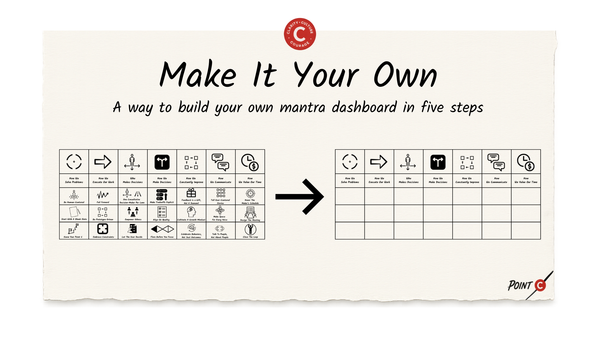
This is the sixth post in a series where I'm going deep on each mantra in my Mantra Dashboard. Last week, we explored why "everything is important" is lazy leadership and why force-ranking your priorities early and often is one of the most important things you can do: Make Tradeoffs Explicit.
This week's mantra lives in the Who Makes Decisions category of my Subculture Coverage Matrix. Because once you've made tradeoffs explicit and your priorities are clear, the question becomes: do you trust your people to act on them? Or are you still holding all the decisions yourself?
The mantra is: Empower Others.
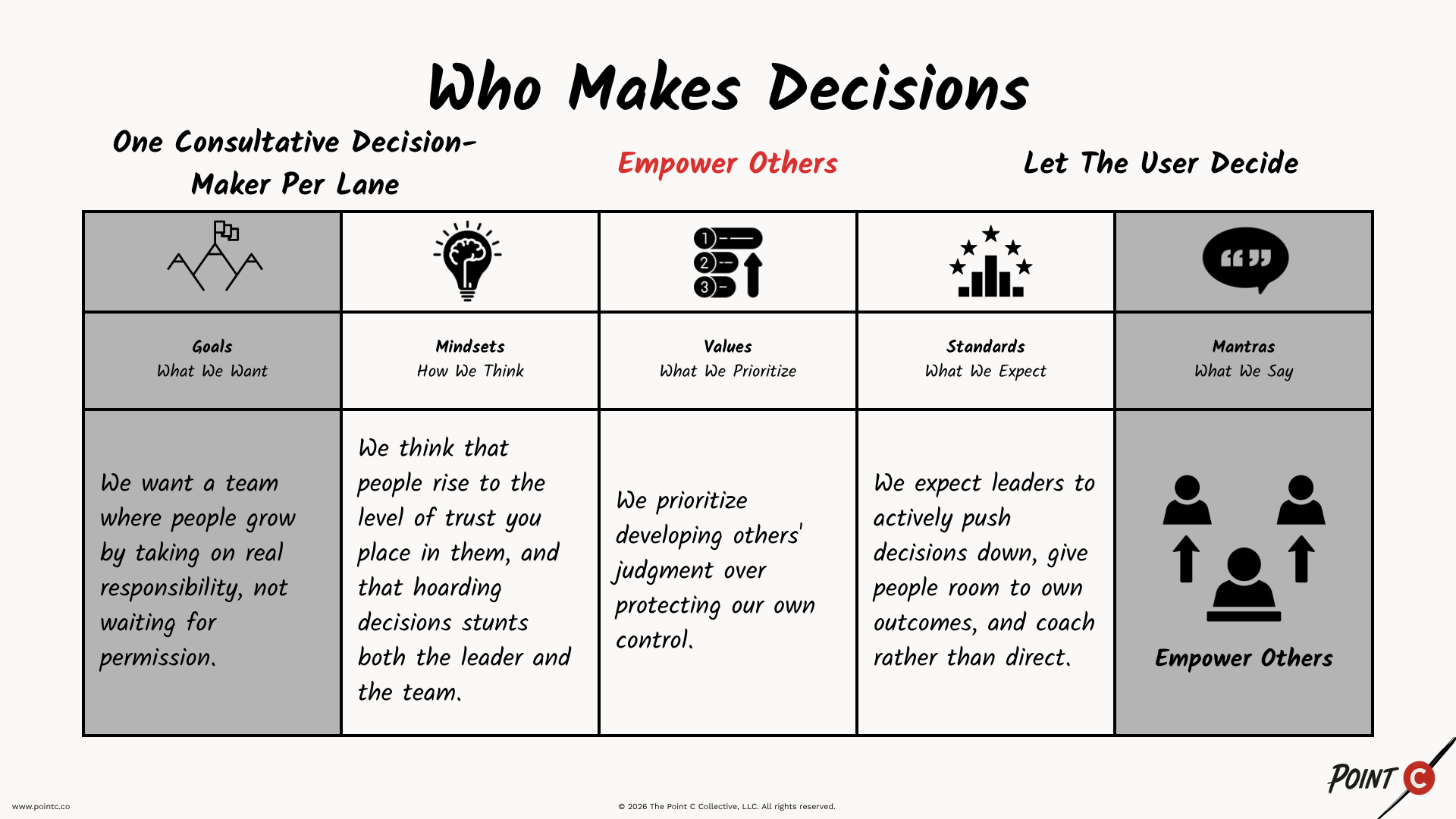
The Mantra Ladder
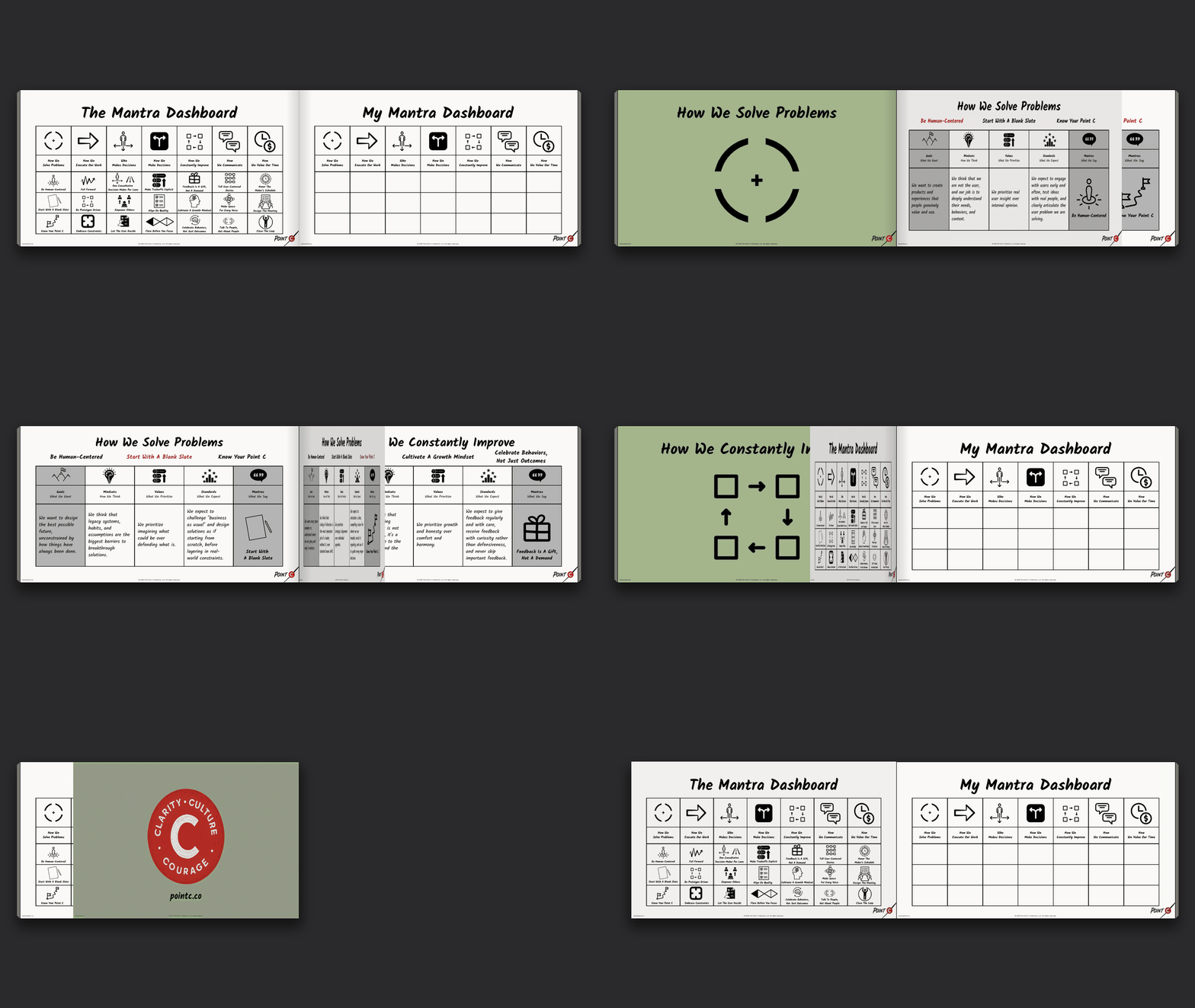
Here's the full Mantra Ladder for Empower Others. The rest of this post unpacks it.
Goal (What We Want): We want a team where people grow by taking on real responsibility, not waiting for permission.
Mindset (How We Think): We think that people rise to the level of trust you place in them, and that hoarding decisions stunts both the leader and the team.
Value (What We Prioritize): We prioritize developing others' judgment over protecting our own control.
Standard (What We Expect): We expect leaders to actively push decisions down, give people room to own outcomes, and coach rather than direct.
Mantra (What We Say): Empower Others.
The Question Every Leader Needs To Ask
There's a simple diagnostic for any organization: Are your leaders focused on accumulating control, or on empowering the people around them?
Too many people in positions of power are overly focused on themselves. They hoard decisions. They micromanage. They grab power. And the people around them suffer for it. Those employees wait for direction instead of taking initiative. They bring problems instead of solutions. They ask "now what?" instead of saying "here's what I think we should do."
That is not leadership. That is control. And it creates dependency, not growth.
The best leaders I know operate from the opposite instinct. As I wrote in One Consultative Decision-Maker Per Lane: "Your job isn't to make all the decisions. It's to build the system that enables others to make great ones." That single sentence captures the entire mindset of this mantra.
The Hit By The Bus Problem
Every founder discovers this at some point. I certainly did.
You build something in a scrappy way. You're involved in everything. You're the person who knows how it all works, the person everyone comes to, the lynchpin that holds the whole thing together. And for a while, that's fine. It's how things get off the ground.
But at some point, successful leaders need to make a transition. They need to solve what I call "the hit by the bus problem": could your organization run without you? If you were hit by a bus tomorrow, would everything fall apart? Or have you built the culture, the systems, and the people around you so that things would be fine?
That is actually what successful leadership looks like. Not having the company depend on you. Having it be able to run on its own because of what you've built.
That's a hard shift for a lot of people. Because being the person everyone depends on feels like power. It feels like job security. But it's actually a trap. You can't grow, you can't take on new challenges, you can't move up in the world if everything would collapse in your absence. The leaders who build teams where multiple people could replace them when the time is right are the leaders who actually move forward. That's not a threat. That's success.
And in the right culture, a leader who doesn't build other leaders around them isn't someone you retain. They're someone you replace. If your definition of leadership success is making yourself indispensable, you have it backwards.
Surround Yourself With People Better Than You
This starts with hiring. And the hiring principle is simple: surround yourself with people who are better than you.
Too many leaders think that if they're in charge, they need to have all the answers. They need to be the expert in everything. They need to be the smartest person in the room. This is the mind of an underdeveloped leader. Leaders get into a lot of trouble when they think they have to be the smartest person in the room on everything and then hire people who won't be threatening to them.
A great leader has the humility to surround themselves with people who have more expertise, more experience, or more talent in their specific domains. And then they conduct the orchestra. They ask questions. They stay curious. They resist the urge to prove that they're smart. And they absolutely do not protect themselves from the possibility that someone on their team could eventually replace them.
As I wrote in Lead With Vulnerability: vulnerability is the willingness to say "I don't know," "I might be wrong," or "I need your input," especially when the pressure to appear certain is highest. That's not weakness. That's the foundation of empowerment. Because if you can't be honest about what you don't know, you'll never create the space for others to step up and own what they do know.
If you've built your team well, you've surrounded yourself with people who are better than you at their craft. As I wrote in One Consultative Decision-Maker Per Lane: your job is to trust them to run their lane and ensure that all lanes are moving in the same direction.
Coach, Don't Direct
Once you have the right people, the question becomes: how do you lead them? And the answer is deceptively simple. Coach them. Don't direct them.
In a framework I call The Ritual Ladder, which I'll be writing about soon, I break down one-on-one meetings into three possible modes. You can direct: giving instructions, making decisions for someone, telling them what to do. You can manage: tracking tasks, checking status, holding accountability. Or you can coach: asking questions, developing their thinking, letting them work through problems and come to their own conclusions.
Most leaders default to directing or managing. The empowering leader defaults to coaching.
The single most powerful question a coaching leader can ask is: "What do you think we should do?" When someone brings you a problem, resist the urge to solve it for them. Ask them what they think. Let them propose a direction. And then have the conversation. Not "here's what you should do," but "here's what I'm thinking about, here are the questions on my mind, and you own the decision."
I coached a leader on this recently. His direct reports were executing instructions well, but then coming back and asking "now what?" every time. They had become dependent on him for direction. They couldn't move without his input. So we shifted his approach. Instead of giving them the plan, he started asking them to bring him the plan. Not asking permission. Owning the direction. And over time, they stopped asking "now what?" and started saying "here's what I'm going to do." And, guess what? That freed up his precious time to focus on the deep strategy, leadership, and culture work he needed to focus on.
When They Don't Do It Your Way
There is a specific moment that defines whether you are truly empowering someone or just paying lip service to it. It happens when your direct report makes a decision that is not what you yourself would have done.
This is the real test. Because real empowerment means saying: "That's not what I would have done. But you own the decision. Here's what I'm thinking about. Here are the questions I'd want you to consider. But ultimately, it's yours."
That's fundamentally different from: "I don't agree. You haven't convinced me yet. If you can convince me, I'll go with it. But I'm not convinced yet." In that second version, you're still holding the decision. You've created the illusion of empowerment while keeping the power for yourself.
The critical balance is this: I want you to seek out my feedback and the feedback of others, because your plan will get better. As I wrote in Feedback Is A Gift, Not A Demand, the goal of feedback is to make each other's work stronger, not to take it over. And I don't want you to avoid that feedback because you think I'm going to hijack the decision. If people feel like bringing you their thinking will result in you taking over, they'll stop bringing you their thinking. And that is the beginning of the end for any empowered culture.
The Standard This Sets
We expect leaders to actively push decisions down, give people room to own outcomes, and coach rather than direct. We hire leaders who develop others rather than just direct them. And we let go of leaders who micromanage or create dependency.
That is a high bar. And it should be. Because when empowerment works, the feeling on the team is unmistakable. People feel trusted. They feel stretched. They feel like their leader believes in them more than they believe in themselves. And that makes them rise.
The default on an empowered team is "you decide," not "let me decide." When someone brings a problem, the first response is "what do you think we should do?" In meetings, the leader speaks last, not first. The decision-maker is often not the most senior person in the room.
And in every one-on-one, the question that matters most: "What decision are you avoiding? What would you do if it were entirely yours?"
Your Challenge This Week
In your next one-on-one, shift from directing to coaching. When your direct report brings you a problem, don't solve it. Ask: "What do you think we should do?" Let them propose a direction. Ask questions. Share what's on your mind. And then let them decide.
Pay attention to what happens. Do they light up? Do they hesitate? Do they look surprised that you're asking? Their reaction will tell you a lot about the culture you've been creating. If they're used to being directed, this will feel unfamiliar. Stay with it. The more you do this, the more they'll start coming to you with proposals instead of problems. And both of you will benefit from that. That's the shift.
Next Week
You've built your Point C. You've grounded it in a real user story. You've learned to let the user break the deadlock. You've made your tradeoffs explicit. And you've empowered your team to act. But empowered teams still need to know what "excellent" looks like. Without shared quality standards, empowerment becomes chaos.
Next week: Align On Quality.
Know someone who would find this useful? Forward this email to them. They can subscribe here to get their own weekly half sheet.
About This Newsletter
The Idea Bucket is a weekly newsletter and archive featuring one visual framework, supporting one act of leadership, that brings you one step closer to building a culture of innovation.
It’s written by Corey Ford — executive coach, strategic advisor, and founder of Point C, where he helps founders, CEOs, and executives clarify their visions, lead cultures of innovation, and navigate their next leadership chapters.
Want 1:1 executive coaching on this framework or others? Book your first coaching session. It's on me.