Tell User-Centered Stories
A mantra to ground your team’s strategies in real customer needs

Was this forwarded to you? Subscribe here to get one leadership framework per week.
Last week in The Idea Bucket, we went deep on the mantra at the foundation of everything I do: Know Your Point C. I said that your Point C is only as powerful as the story you tell about it.
This week, we stay in that thread. Because the best leaders don't just have a vision. They ground it in the real human context of the people they serve.
The mantra is: Tell User-Centered Stories.
The Mantra Ladder
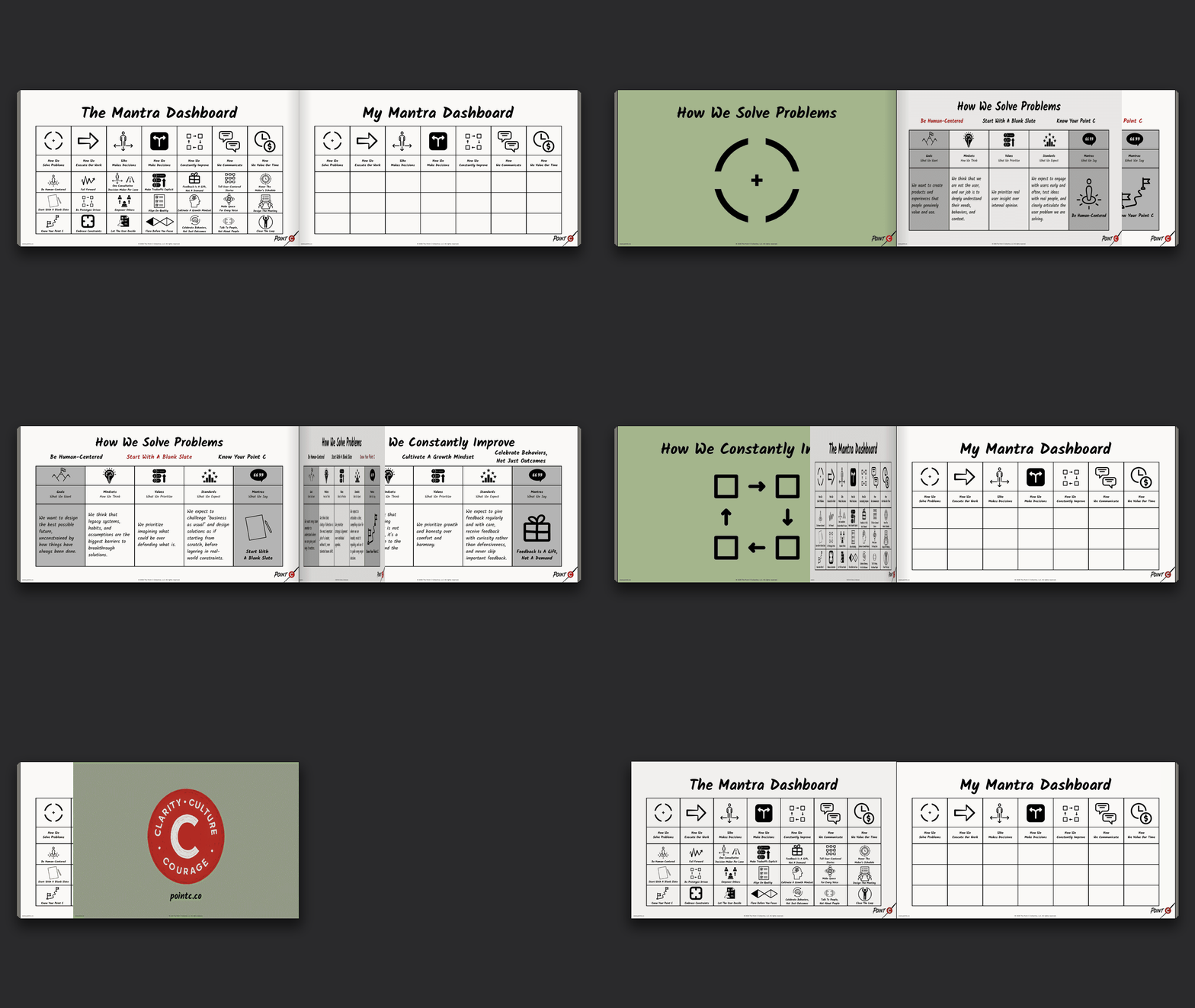
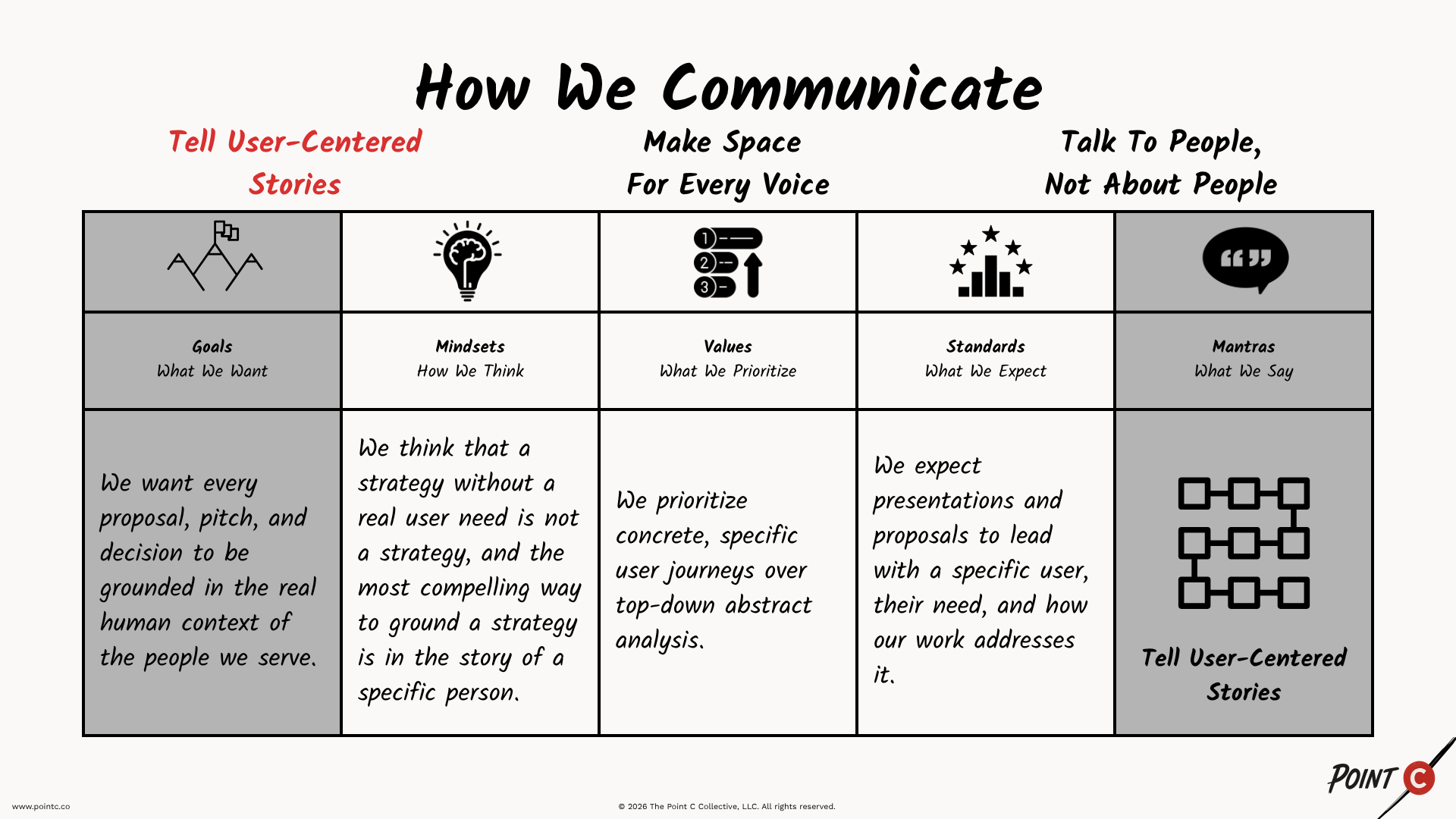
Here's the full Mantra Ladder for Tell User-Centered Stories. The rest of this post unpacks it.
Goal (What We Want): We want every proposal, pitch, and decision to be grounded in the real human context of the people we serve.
Mindset (How We Think): We think that a strategy without a real user need is not a strategy, and the most compelling way to ground a strategy is in the story of a specific person.
Value (What We Prioritize): We prioritize concrete, specific user journeys over top-down abstract analysis.
Standard (What We Expect): We expect presentations and proposals to lead with a specific user, their need, and how our work addresses it.
Mantra (What We Say): Tell User-Centered Stories.
The Empathy Antenna
When I run my venture design bootcamps, the very first thing I do is partner people up. Their first challenge is to design something meaningful for their partner. We don't start with a generic market segment. We start with the actual person sitting across from them. We don't start with an idea. We start by discovering a need to solve for.
Through that exercise, something shifts. They start to feel what empathy actually means in practice. They listen differently. They notice things they wouldn't have noticed. And that lesson never leaves them. Because empathy is the fuel for creativity. The visceral experience of sitting with a real person, hearing their story, feeling their frustration, sensing their ambitions. That is what sparks the ideas that matter. Without it, you're just staring at a blank sheet of paper.
From there, I lead them through a three-day process of building a new venture from scratch. At the center of it is a real person that they end up designing for. Not a persona. Not a profile. A specific human being whose story they can tell, whose pain they've felt, and whose needs guide every decision they make.
Here's what happens next. When they go back to their real jobs, one of the first things that changes is the antenna they have in meetings. They start to notice when colleagues are talking about their ideas, their features, their internal priorities, and completely missing the user perspective. Someone pitches a strategy, and the person who has gone through my training can't help but ask: Who is the user? What need are we solving? What moment in their life are we targeting?
It becomes an inherent high standard for what a good strategy looks like: If your strategy is missing a user story and a user journey, something is wrong. We will ask you about it. That's the mantra at work. Once you see what being human-centered really means, you can't unsee the gaps when it's missing.
Character-Driven Strategy
If you've been following The Idea Bucket from the beginning, you've already seen this mantra in action. The entire first act of The Venture Story is built bottom-up from a specific user POV. It's character-driven narrative applied to strategy.
In Scene 1: The Pain Point, you meet a real person with a real need. You take your audience into a concrete moment in their life: the time of day, the location, the frustration they're facing, the options they've tried that aren't working, and the key insight your team would only have discovered by talking to real people. In Scene 2: The User Journey, you walk through what happens when that person discovers your solution, uses it for the first time, comes back, and forms a habit. And in Scene 3: Becoming Essential, you show how your solution moves from "that was useful" to "I can't imagine living without this," all the way through to the identity shift that occurs when someone truly adopts what you've built.
That's three full scenes. Eighteen beats. All anchored in one specific person. And the reason I structure it this way is because of something I learned making documentary films before I ever entered the world of business: you don't explain a complex topic, you tell the story of a specific person and let the topic reveal itself. It's called character-driven narrative, and it's the magic storytellers use to take abstract, complex topics and turn them into simple, sticky stories. As I wrote in The Venture Story: you must earn the right to go abstract. Start concrete. Anchor your audience in a shared reality. Then zoom out.
That principle applies far beyond the pitch deck. It applies to every strategy presentation, every proposal, every time you need to align a team around where you're headed. Lead with the person you're serving. Tell their story. Then build the strategy around it.
What This Looks Like In Practice
When I do strategy work with teams, especially in media, one of the first things I ask them to do is interview two types of people. First, someone they consider to be their target current user. Second, someone they consider to be their target growth user. In media companies, these are almost always different people. The person you're trying to retain and the person you're trying to attract often have very different needs, contexts, and behaviors.
I also ask them to bring a short video clip of that person's story to share with the rest of the team. And what happens next is remarkable. All of a sudden, everyone is talking about this person. She starts showing up in pitches and references. People say her name. They design for her. They argue about what she would want. The dynamic in the room shifts from they probably made this up to oh, I am meeting a real person. It is very grounding.
That is what it means to tell user-centered stories. It's not about creating a generic persona deck. It's about having a real person at the center of your strategy so vivid that your team can't stop thinking about her.
And technology makes this so much easier than it used to be. You can interview your growth user over Zoom or Riverside.fm. You can capture the transcript in Granola. You can cut up the interview highlights in Descript. And you can bring those real user interview clips to your next team meeting. In the last couple of months, tools like Claude with MCP connectors and Granola have made it possible to synthesize a growing corpus of user interviews in real time, turning them into not just something more accessible and useful for you and your team, but a growing knowledge base that compounds over time. The barrier to doing this well has never been lower.
Real People, Not Generic Personas
When I talk about telling user-centered stories, I am not talking about personas. Personas are so overused and so closely associated with user research that people assume they're the same thing. They're not. What I'm describing is something different: more specific, more authentic, and far more useful.
Here's what I see over and over again. A team does some quantitative research, identifies a few demographic segments, and then builds an amalgamated profile: "millennial women in urban markets who value convenience." They give her a name, maybe a stock photo. And then they shove their unvalidated assumptions into that persona to justify decisions they've already made. The persona becomes a vehicle for confirmation bias, not for empathy.
These personas are bland. They are uninspiring. They feel fake, which means people ignore them. And worst of all, they allow the team to live in the abstract rather than force the specificity needed to execute against something concrete. Who should we design for? Well, let's design for all of them and just shove what we learned into one unrealistic person. That's not a point of view. That's a way to avoid having one.
Having a point of view means being sharp and making tradeoffs about what you do not do. It means choosing a specific person, not a bucket that fits everyone. As I wrote in The Pain Point: once you make it a fake person, you allow your team to fill that persona with their own agendas. A real person keeps you honest.
Can your choice be backed up by quantitative research? Absolutely. It should be. But the quantitative research needs to point to a real, live example of who you should be targeting. Because at the end of the day, empathy is the fuel for creativity. And you can't empathize with a spreadsheet.
You may have multiple users you care about. That's fine. I sometimes describe it as "a constellation of stars, but one always has to shine the brightest." That's the person your team defaults to when push comes to shove. That's the person whose story anchors your Venture Story. The idea of force-ranking and tradeoffs applies to your customers just as much as it applies to your priorities. We'll go deeper on that concept in a future post.
The Standard This Sets
We expect presentations and proposals to lead with a specific user, their need, and how our work addresses it. This is a high bar, and it should be.
When someone presents a strategy to your team and there's no user story, no user journey, something is wrong. It means the strategy is anchored in what the team wants to build rather than what the user needs. And your job as a leader is to notice that gap and ask the question: Who is this for?
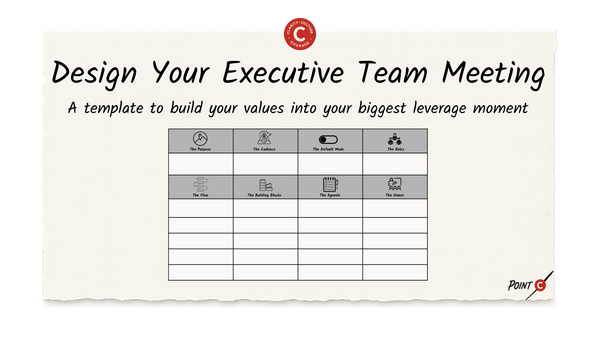
One practice I recommend is building this into the structure of your meetings. Imagine opening every weekly team meeting with a five-minute block called "Meet A User". One team member shares a brief, specific story about a real user. Something they heard, saw, or learned that week. Not a metric. A person. The meeting opens with the people we serve, not the org chart.
When you do this consistently, user-centered storytelling stops being a special skill reserved for the pitch deck. It becomes the way your team thinks, communicates, and makes decisions every day.
Your Challenge This Week
- Think about the last strategy presentation you gave or sat through. Did it lead with a specific user and their need? Was everyone looking at the same concrete vision, or was it so abstract that you were all forced to fill in the blanks in your heads, slowly diverging into different stories while thinking you were on the same page?
- Identify one person who represents your target user. Not a persona. A real human being. If you can, interview them this week. Record it over Zoom or Riverside.fm. Ask them to walk you through their day. Go deeper on the moments that matter. Get them to tell you a story. Probe for aspirations. Explore feelings. Capture it on video.
- Share that person's story in your next team meeting. Watch what happens when your team has a real face and a real name to design for. Watch the room shift from abstract strategy to concrete empathy. That's the power of this mantra.
Next Week
You've built a clear Point C. You've grounded your strategy in a real user story. But what happens when the team disagrees about what to do next? When the data says one thing and the loudest voice says another? The best teams have an answer: go ask the user.
Next week: Let The User Decide.
Know someone who would find this useful? Forward this email to them. They can subscribe here to get their own weekly half sheet.
About This Newsletter
The Idea Bucket is a weekly newsletter and archive featuring one visual framework, supporting one act of leadership, that brings you one step closer to building a culture of innovation.
It’s written by Corey Ford — executive coach, strategic advisor, and founder of Point C, where he helps founders, CEOs, and executives clarify their visions, lead cultures of innovation, and navigate their next leadership chapters.
Want 1:1 executive coaching on this framework or others? Book your first coaching session. It's on me.