Make Tradeoffs Explicit
A mantra to force-rank your priorities early, often, and out loud

Was this forwarded to you? Subscribe here to get one leadership framework per week.
This is the fifth post in a series where I'm going deep on each mantra in my Mantra Dashboard. Last week, we explored how the best teams break deadlocks by testing with real users instead of debating endlessly: Let The User Decide.
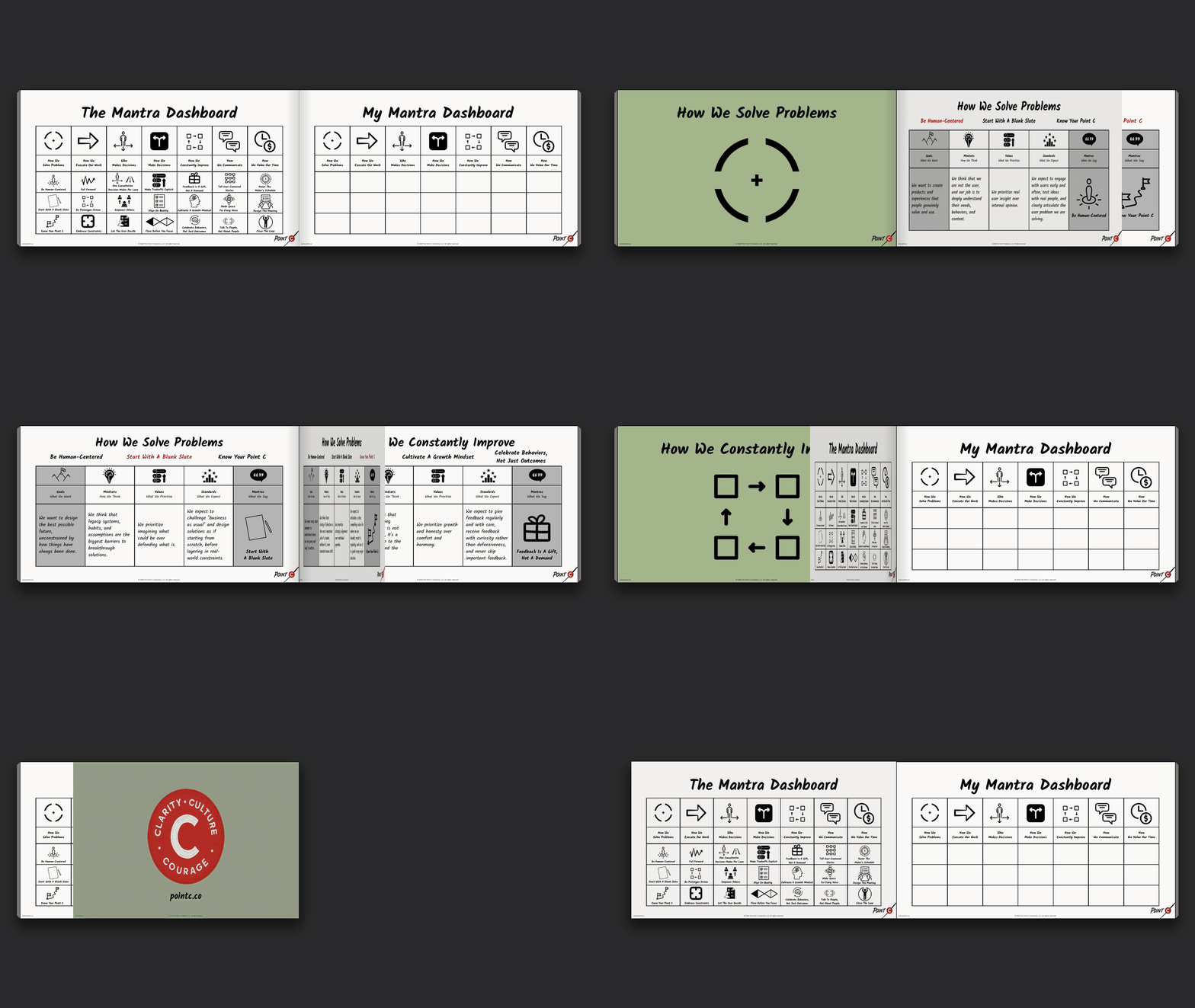
This week's mantra lives in the How We Make Decisions category of my Subculture Coverage Matrix. It's about something every team struggles with: prioritization. Not the kind where you make a list and check boxes. The kind where you force-rank what matters, name what you're choosing not to do, and have those conversations early enough and often enough that your team can actually move fast.
The mantra is: Make Tradeoffs Explicit.
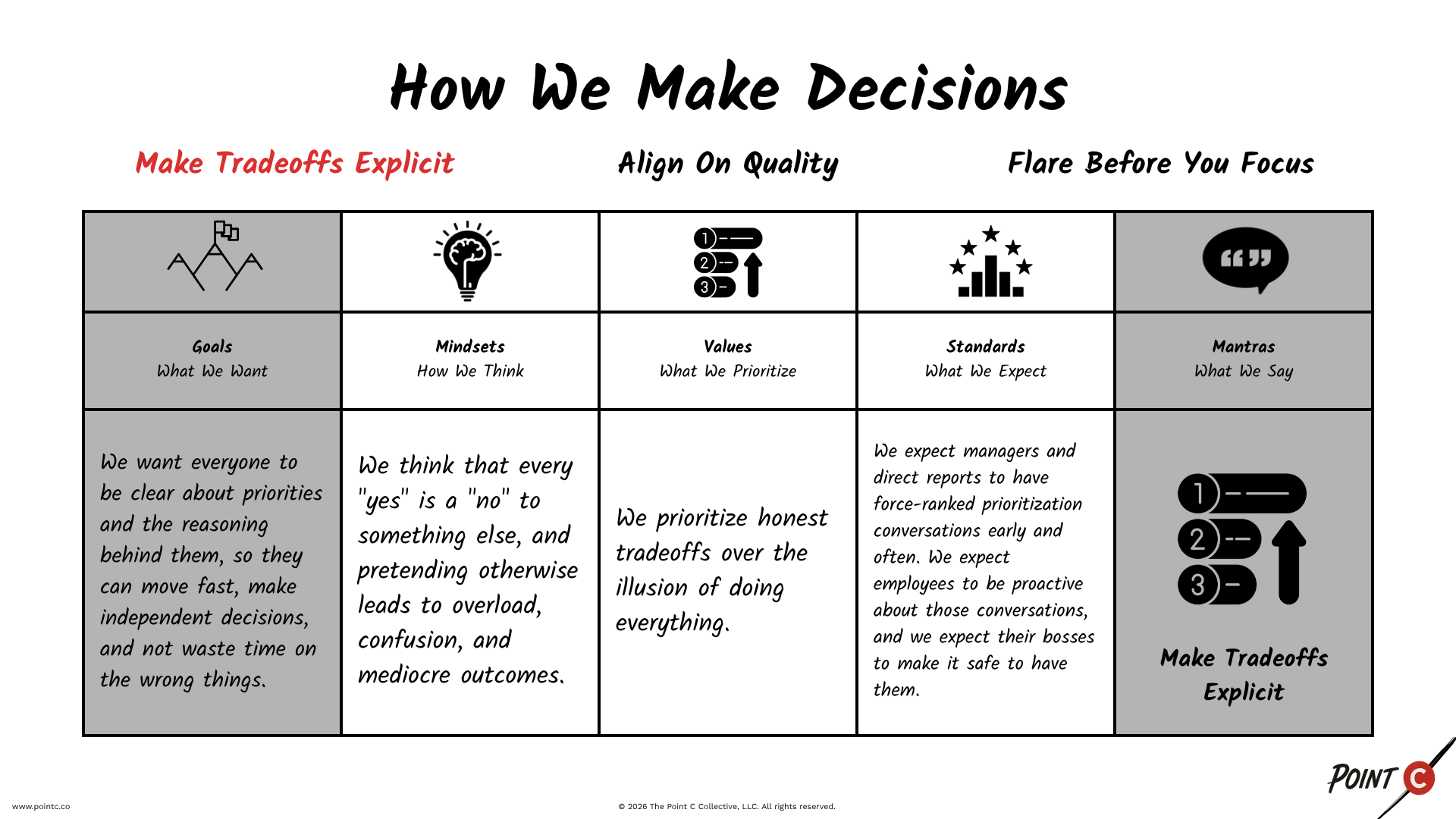
The Mantra Ladder
Here's the full Mantra Ladder for Make Tradeoffs Explicit. The rest of this post unpacks it.
Goal (What We Want): We want everyone to be clear about priorities and the reasoning behind them, so they can move fast, make independent decisions, and not waste time on the wrong things.
Mindset (How We Think): We think that every "yes" is a "no" to something else, and pretending otherwise leads to overload, confusion, and mediocre outcomes.
Value (What We Prioritize): We prioritize honest tradeoffs over the illusion of doing everything.
Standard (What We Expect): We expect managers and direct reports to have force-ranked prioritization conversations early and often. We expect employees to be proactive about those conversations, and we expect their bosses to make it safe to have them.
Mantra (What We Say): Make Tradeoffs Explicit.
"Everything Is Important" Is Lazy Leadership
I hear it all the time. A leader is asked to prioritize and they respond: "Everything is important. We need to get all of these done."
That is not a high-quality leadership move. It is a way of avoiding the hard work of actually leading. Because even if everything on the list matters, your team will inevitably have to make tradeoffs with their time, their resources, and their focus. They will have to choose what gets their best energy today and what waits until tomorrow. If you haven't created the space for those tradeoff conversations, your people will make them on their own. Silently. And they will almost certainly make them differently than you would have.
Multitasking, quite frankly, is a myth. We live in an age of distraction where the ability to focus deeply on the right things is one of the most valuable skills a team can have. And that ability doesn't start with a memo from the top. It starts with a dialogue between leaders and their teams about what matters most and why.
That doesn't mean the ranking is permanent. Priorities are dynamic. They should live in a dynamic environment, not buried in a slide deck from last quarter. But at any given moment, there should always be a default force ranking that everyone understands. It can change tomorrow. But today, this is where we stand.
The Yes-People Trap
Here is what happens when leaders refuse to make tradeoffs explicit. Their employees become yes-people.
I see this pattern constantly. An employee gets asked to take on a new project. They already have a full plate. But they don't feel like they have permission to push back. They don't feel like they can say: "I can do this, but here's what I would need to deprioritize." So they say yes. They say yes to everything. They become yes-people. And for a while, it looks like it's working.
But then the cracks appear. Deadlines slip. Quality drops. The employee starts making tradeoffs on their own, without telling anyone, because they have no other choice. They become passive-aggressive about priorities. Or worse, they make the wrong tradeoffs because they were forced to make them in the dark, without the context their boss has about what actually matters most. And when the boss finally sees that the employee has overpromised and underdelivered, or made the wrong tradeoff decisions, they lose trust. But the employee was never set up to succeed in the first place.
This is devastating over the medium and long term. And it starts with a leader who says "everything is important" instead of doing the hard work of force-ranking.
I frequently hear employees tell me that they aren't allowed to push back. That presenting tradeoffs to their boss would make them look lazy or uncommitted. That the expectation is to say yes and figure it out. If that is the culture you've built, you have a problem. Because your people are spinning their wheels on priorities underneath you, and they are afraid to bring it up.
Force-Rank Everything
The fix is simple in concept and hard in practice: force-rank everything. Always. We should know our force-ranked priorities at all times.
Force-rank your strategic priorities for the year. Force-rank the projects on your plate this quarter. Force-rank the three things you need to get done this week. No ties. No "they're all important." One has to go at the top.
Force-ranking is powerful because it doesn't just clarify priorities. It surfaces the why behind the priorities. When you force someone to say "this is above that," the natural next question is: why? And in those whys lie the real insights about strategy, about values, about what you're actually trying to accomplish. As I wrote in The Personal Selection Stack: in those whys lie the true insights for what you are trying to manifest.
And force-ranking isn't just top-down. In fact, the most powerful version of this is bottom-up. I encourage direct reports to proactively bring their current force-ranked assumptions on priorities to their boss. Think of it as a priority prototype. Not asking permission. Checking assumptions. "Here's how I'm thinking about my priorities this week. Number one is this, number two is this, number three is this. Does that match how you'd rank them?"
That conversation is gold. Because sometimes the boss agrees. And sometimes they say: actually, I'd flip two and three. And in that moment, the employee learns something important about how their boss thinks about the business. Something the boss might not have even articulated to themselves yet, because nobody had forced them to make the tradeoff. But now the tradeoff is explicit. And both people walk away with more clarity.
This is where employee agency matters. The best teams don't wait for priorities to be handed down. They come to the table with a point of view. They prototype their priorities, test them with their boss, and iterate. The same design thinking we apply to building products applies to how we manage our own work.
Make It Visual
One more practical insight. I was recently facilitating a prioritization session with a leadership team. They were talking about priorities verbally. They had detailed slide decks. But there was no persistent, shared, modifiable visual of what the actual priorities were and how they stacked up against each other.
So I created a simple board with three big post-its at the top representing their strategic priorities and smaller post-its underneath representing the projects that supported each one. It completely changed the focus of the meeting. Instead of talking past each other with competing slide decks, everyone was looking at the same wall. They could see what was connected to what, where the gaps were, where things were overloaded. And it forced prioritization.
And because the board was persistent and changeable, not a static slide, they could start every subsequent team meeting with it. They could move things around as priorities shifted. It became a living document that made their tradeoffs visible to everyone, all the time.
If your priorities only exist in a PowerPoint that was last updated three months ago, you don't have priorities. You have a historical record. Force-ranked priorities need to be visible, dynamic, and something your team interacts with regularly.
The Selection Stack
So how do you build a culture where these conversations happen? You need a ritual. And the ritual I teach for this is The Selection Stack.
The Selection Stack is a structured process for getting everyone aligned on what success looks like before you start evaluating options. You begin by flaring: brainstorming all the criteria that should drive the decision. Then you force-rank those criteria. No ties. Then you invite others to build their own stacks independently, before comparing. And then you overlay them and have the conversation: Where are we aligned? Where do we diverge? What tensions are surfacing? What are we willing to trade off?
Most teams don't fail because they chose the wrong idea. They fail because they never got clear on what success meant to the people who mattered most. The Selection Stack surfaces those misalignments before they become problems.
The standing question for every prioritization conversation: "What are we saying no to?"
The Standard This Sets
We expect force-ranked prioritization as a standard. At all times. We expect to use clear criteria when making prioritization decisions. We expect to communicate what we are choosing not to do and why. And we expect leaders to create the environment where these conversations are safe.
This connects directly to the work I teach on psychological safety. If your employees don't feel safe bringing tradeoffs to you, they won't. And you'll never hear about the priorities they're struggling with until it's too late. Making tradeoffs explicit requires a leader who actively invites those conversations and rewards people for having them. "We can't do everything" should be a statement of strength, not defeat.
It also connects to the performance standards side of the equation. This is the third Standards Lever in my framework: when leaders make tradeoffs without explaining them, teams experience those decisions as arbitrary. Naming the tradeoff, naming what you're choosing and what you're giving up, builds understanding and buy-in. Without it, teams default to opinions, hierarchy, and whoever speaks the loudest.
The question I ask in one-on-one coaching: "What are you saying no to this week so you can say yes to what matters most?" If your direct report can't answer that question, you have work to do.
Your Challenge This Week
- Create the space for a force-ranking conversation with your team this week. Not a status update. A real dialogue about priorities. Ask your direct reports to each bring their own force-ranked list of what they think matters most right now. Then share yours. Look at where you align and where you diverge. The gaps are where the insights live.
- Pay attention to how the conversation feels. Do your people feel safe naming tradeoffs? Do they feel comfortable saying "I can't do all of this, and here's what I think should give"? If not, that tells you something important about the culture you've created. Your job is to make it safe.
- Make the results visible. Put the force-ranked priorities on a Miro board, a shared doc, or a wall that the team sees every day. Not a slide deck. Something persistent and changeable. Start your next meeting with it. Watch how it changes the conversation when tradeoffs are visible to everyone, all the time.
Next Week
You've built your Point C. You've grounded it in a real user story. You've learned to let the user break the deadlock. And you've made your tradeoffs explicit. But none of this matters if your people don't feel trusted to act on what they know. The best leaders don't just set clear priorities. They give their teams the autonomy to execute against them.
Next week: Empower Others.
Know someone who would find this useful? Forward this email to them. They can subscribe here to get their own weekly half sheet.
About This Newsletter
The Idea Bucket is a weekly newsletter and archive featuring one visual framework, supporting one act of leadership, that brings you one step closer to building a culture of innovation.
It’s written by Corey Ford — executive coach, strategic advisor, and founder of Point C, where he helps founders, CEOs, and executives clarify their visions, lead cultures of innovation, and navigate their next leadership chapters.
Want 1:1 executive coaching on this framework or others? Book your first coaching session. It's on me.