The Two Rails of Leadership
A framework to lead by designing and aligning culture and strategy

Was this forwarded to you? Subscribe here to get one leadership framework per week.
After a year and a half of writing one leadership framework a week, I just realized I've never actually written down the one sentence all of them hang on. Here it is: leadership is designing two things at once, the culture and the strategy, and keeping them aligned. Culture is how we work together to get there, and how we find out where to go next. Strategy is where we're going and why.
That sounds obvious until you watch how leaders actually spend their time. Many of the leaders I meet aren't designing either one. They're managing. The strategy is whatever the last plan said, the culture is whatever it was when they arrived, and the week goes to the hundred things that keep both from breaking. That's the manager's job, and it's a real job. It just isn't leadership.
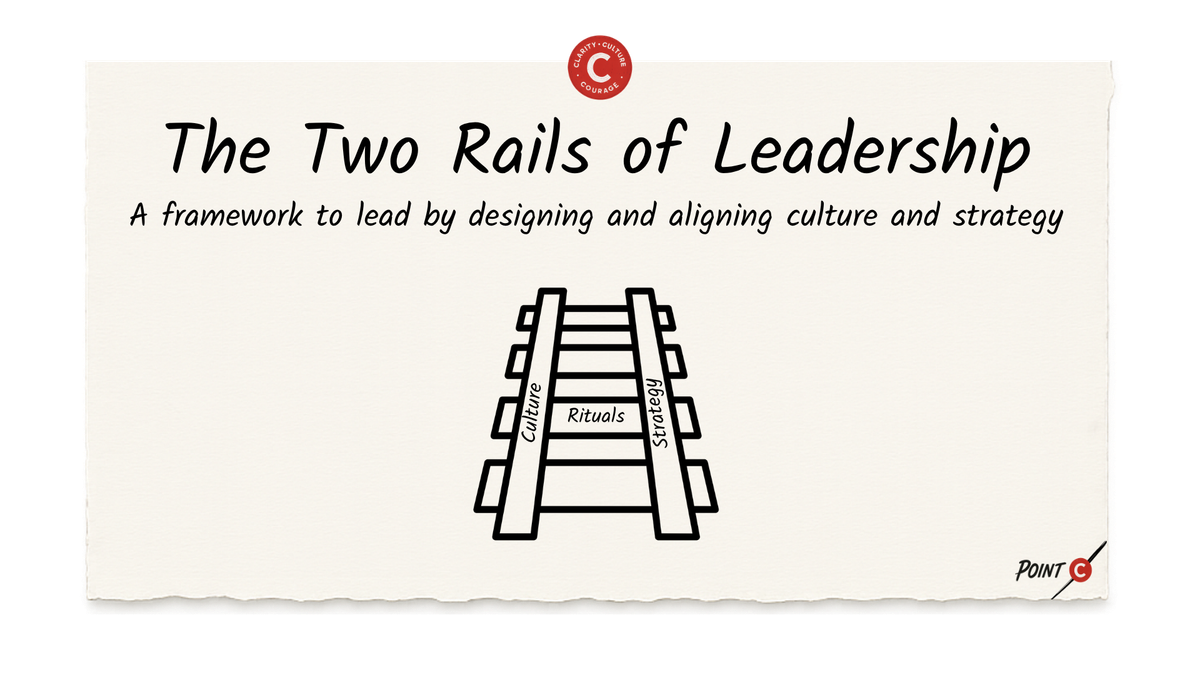
This week, instead of a new tool, I want to draw the picture everything else in this newsletter sits on: The Two Rails of Leadership.
Two Rails
Picture a train. It needs two rails, laid in parallel, the same distance apart the whole way, pointed at the same place. Pull one up and the entire train derails.
The first rail is culture. Culture is the set of behaviors a group consistently rewards, tolerates, and punishes. It's how it feels to work somewhere, and it's being built every day whether you design it or not. The part you can shape is the subculture around you: the goals, mindsets, values, and standards your team actually operates by, the few phrases you say to give your team a shortcut to all of that, the practices you repeat, and who you hire and fire. The process your team uses to find and test ideas belongs on this rail too. A process is a practice, something a team does on a rhythm, and it's culture that decides whether the team actually runs it.
The second rail is strategy. Where are we going, why does that matter, and how does it track with where the rest of the world is headed? Miklos Sarvary, who teaches strategy to my Sulzberger fellows at Columbia, defines it as "an integrated set of actions to achieve a goal", and I'd add what the goal has to look like for a team to act on it: a concrete destination they can see, the story that explains who it's for and how it works, and the decisions, made in the open, about what you'll do and what you'll stop doing to get there. Many leaders would say this is the job, and they're half right.
Culture comes first, especially in a world where change keeps accelerating, because the culture rail is the one that produces the other. A team that is human-centered and prototype-driven, that puts imperfect work in front of people early and fails forward, keeps generating the next strategy and correcting the current one. Its strategy is never a snapshot. A strategy laid without that culture starts drifting the day it's written, because nothing in the organization is built to notice.
Leadership is laying both rails on purpose, and checking that they're the same distance apart and pointed at the right place. Culture and strategy are the two things a leader is responsible for designing; everything else is delegable. You can have a great strategy, and if the culture can't carry it, it doesn't matter. You can have a great culture, and if it doesn't produce a strategy, it doesn't matter either.

The Entropy Of Business As Usual
Here's why the manager's version of the job fails, even when it's done well.
The goal of innovation is to get three circles to overlap. What you offer has to be desirable, meeting a real need in someone's life. It has to be feasible, something you can build with technology that exists or is emerging. And it has to be viable, with a sustainable and defensible business model. At some point every durable organization figured out how to get all three to overlap.
The newspaper did. It met the need, the printing press was the technology, and for as long as the press was the technology, it was about as defensible and profitable as a business gets. Then the world changed and the company didn't change with it.
Here is the mistake underneath: somewhere along the way the company started defining itself by the solution it offered instead of the need it solved for. "A newspaper." A noun, fixed in time, instead of a verb that keeps evolving with the need. The circles drift apart slowly enough that nobody inside notices on any given day, and the manager's job, as the organization defines it, is to keep the train running on the track that was laid when the circles overlapped.
That's the curse. The better you manage, the longer you run a train toward a destination that no longer exists.
As I've written about before, that's the entropy of business as usual, and it's where any organization drifts if nobody is designing the culture and the process that keep the track bending toward where the world is going. The goal of internal innovation is to bring the circles back together, and then to keep doing it, because the world won't stop moving.
Your job as a leader isn't to come up with the next big thing. It's to build the culture, the people, and the process that can continually do this: a team whose velocity of learning outruns the pace of change. That capability lives on the culture rail. The strategy is what it produces.
The Default Track
Every organization already has both rails. There's a strategy, even if it's only the last plan or the way things have always been done, and there's a culture, even if nobody chose it. So the question is not really whether you have the two rails. It's whether anyone is designing them, and whether they still point where the world is going.
The default, in the organizations I walk into, is that nobody is designing either one. The rails were laid by someone else, years ago, and the pressure of quarterly results keeps a leader maintaining them, because maintaining is what gets measured this quarter and redesigning doesn't pay off until a few years down the line. That's how capable managers stay on the default track until it's too late to switch.
When a leader does start designing, it's usually one rail at a time, and I see two shapes. The first is a new strategy on a default culture. The culture a leader inherits was usually optimized to execute the last strategy: command and control, decisions made in small rooms and announced, feedback that arrives as a demand, lanes protected instead of shared early. That works as long as the strategy is right and the world holds still. When the world moves and the leader lays a new destination, the same culture that executed so well becomes nearly impossible to steer, because nothing in it was built to question the plan, surface what's changed, or learn its way to the next one. The leader reads the gap between the new plan and the old behavior as a people problem, and it's a rail problem.
It's also why I spend so much of this newsletter on what it takes to build a subculture of innovation: a culture that changes with the world is the only kind that can carry a strategy that has to.
The second shape is a culture with a default strategy: the team is close, the norms are real, people like working there, and nobody can tell you in one sentence where it's going. In the absence of a destination, the structure becomes the strategy, the loudest priority wins the week, and the energy a good culture produces gets spent in every direction at once.
Both come from the same mistake, which is treating one rail as the job and the other as a condition of the job. The strategy leader thinks culture is HR's. The culture leader thinks strategy is the board's. Both have redesigned one rail and left the other where they found it.
The Ties
What keeps two rails aligned is the ties between them, and in a team the ties are the rituals: the recurring moments where the strategy and the culture show up in the same room at the same time.
A design review is one. Someone presents a strategy that isn't finished, which is the strategy rail, and the room practices feedback as a gift, failing forward, and one consultative decision-maker per lane, which is the culture rail. Both get stronger in the same thirty minutes. Your executive team meeting, your one-on-ones, and your all-hands are ties too, if you design them that way: a block where the destination gets restated, a block where the behaviors get celebrated, a block where the team says what it heard. The Venture Story ends the same way, with an act about how we'll get there, because a strategy that doesn't say how the team will reach the destination is just hope.
This is why I say leaders are leverage. You can't lay each tie yourself. You can design the handful of moments where both rails are visible, run them on a cadence the team can count on, and let the people in those rooms carry the alignment into every room you're not in. Default or design. The rails get laid either way.
Designing And Aligning Your Rails
If this is the first post of mine you've read, most of what came before it sits on one of these two rails, and the picture above is the map.
For the culture rail, start with Design Your Subculture, then The Learning Zone for what a culture of innovation requires, The Mantra Ladder for what you say, and The Ritual Ladder for what you practice.
For the strategy rail, start with Know Your Point C, then The Venture Story.
For a tie, The Design Review, the one ritual where both rails are visible in the same thirty minutes. The rest, one half sheet a week since May 2025, is here.
Your Challenge This Week
Pick one post from each rail and read them back to back. Know Your Point C and The Mantra Ladder is a good pair; so is The Venture Story and The Design Review. Then measure the distance between your rails. Write your team's destination in one sentence. Underneath it, write the one phrase and the one practice your team would point to as the way you get there. Now read the two lines together and ask whether a new hire could see how the second produces the first.
If they line up, your rails are the same distance apart. If one line is blank, or the two have nothing to do with each other, you've found the rail nobody has designed, and you know which posts to read next.
Next Week
You can run the audit on yourself, and next week I'll show you how I run it for a leadership team, one person at a time, with no one to blame and nothing to hide: The Blameless Cultural Audit.
Know someone who would find this useful? Forward this email to them. They can subscribe here to get their own weekly half sheet.
About This Newsletter
The Idea Bucket is a weekly newsletter and archive featuring one visual framework, supporting one act of leadership, that brings you one step closer to building a culture of innovation.
It’s written by Corey Ford — executive coach, strategic advisor, and founder of Point C, where he helps founders, CEOs, and executives clarify their visions, lead cultures of innovation, and navigate their next leadership chapters.
Want 1:1 executive coaching on this framework or others? Book your first coaching session. It's on me.