The Subculture Flywheel
A way to turn goals into rituals through mantras

Was this forwarded to you? Subscribe here to get one leadership framework per week.
For the past two months this newsletter has been about rituals: the practices a team repeats on a cadence, on purpose, so that the culture its leader talks about shows up somewhere people can see it. The executive team meeting, the one-on-one, and the all-hands are the three I've written about, each designed block by block. Underneath all three sit two ladders from earlier this year. The Mantra Ladder turns a goal into the words your team says. The Ritual Ladder turns those words into the practices your team repeats. Last week I promised to draw the whole thing in one picture.
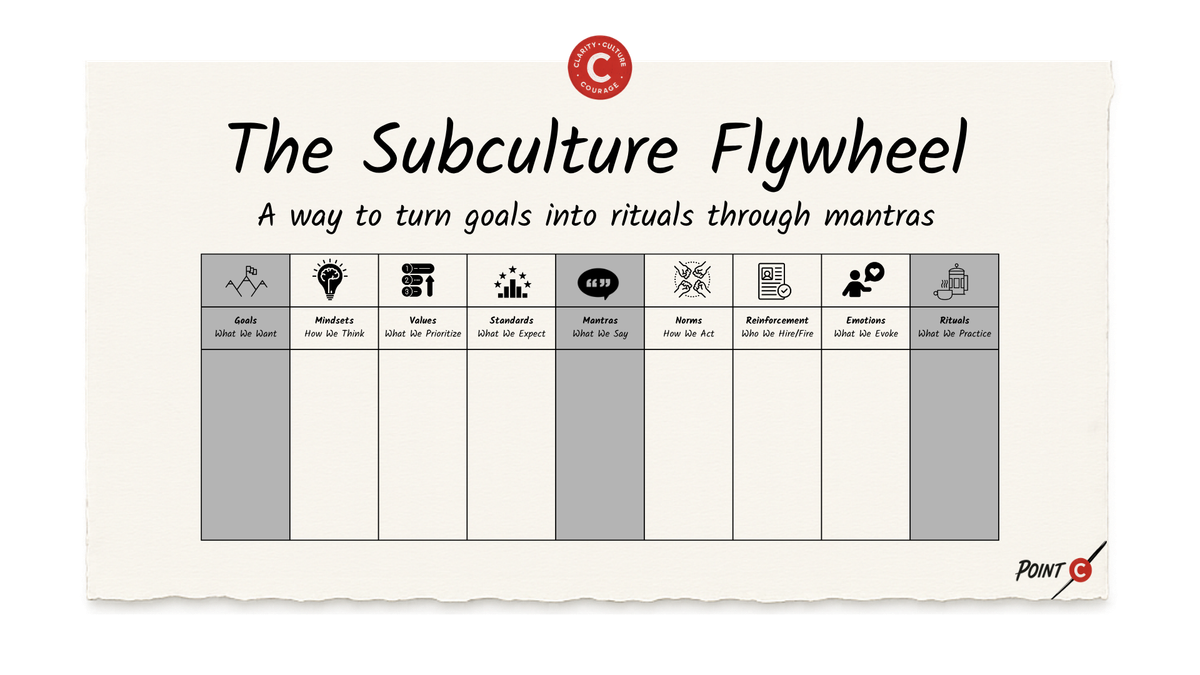
Here it is. The two ladders share a rung, and when you put them end to end you get one system: nine rungs from a goal to a ritual your team repeats to put it into action. I call it The Subculture Flywheel, and every post in this series has been one piece of it.
The Nine Rungs
Here are all nine in a row, with the label from the half sheet and one sentence on what each one asks of you.
Goals: What We Want. The outcomes you're trying to create, and the reason any of the other eight rungs exist.
Mindsets: How We Think. The beliefs and assumptions that shape how your team interprets problems and makes decisions.
Values: What We Prioritize. What you choose when you can't have both, written as a tradeoff: this over that.
Standards: What We Expect. The level of quality and behavior you consistently expect and enforce.
Mantras: What We Say. The short, repeatable phrase that carries the four rungs before it, and the rung the two ladders share.
Norms: How We Act. The observable behaviors someone would see if they watched your team for a week.
Reinforcement: Who We Hire/Fire. The people decisions that sustain the culture: who you hire, who you promote, and who you let go.
Emotions: What We Evoke. The feelings created by how you work together.
Rituals: What We Practice. The practice your team repeats, on a rhythm they can count on, where the other eight rungs become something a person can watch happen.
Your team already has all nine of these, whether you’ve written them down or not. It has a goal, a way of thinking, things it prioritizes, phrases people repeat, ways people act, people it keeps and people it lets go, a feeling on Monday morning, and practices it repeats every week. The question isn’t whether you have them. It’s whether they agree with each other. A culture is what you get when all nine line up, and when they don’t, your team doesn’t read the values on the wall. They read the gap. The flywheel is how you check.
Drawn flat like this, it reads as a ladder, and the first five rungs are one ladder and the last five are the other. Bend the row into a circle so the last rung touches the first, and you have the wheel.
One Mantra, Nine Rungs
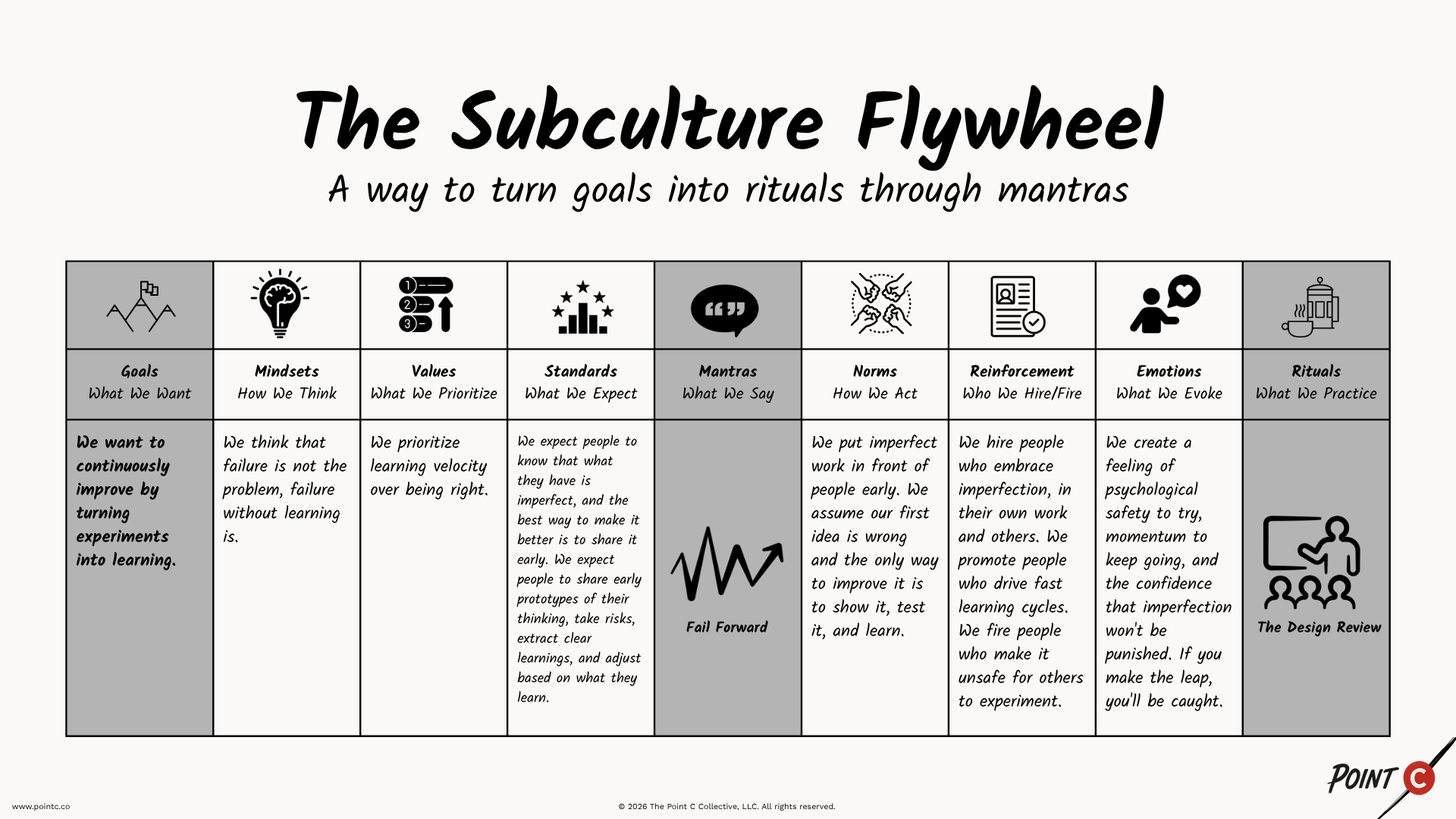
Let's see this in action by running my favorite mantra through the flywheel: Fail Forward.
Goals (What We Want): We want to continuously improve by turning experiments into learning.
Mindsets (How We Think): We think that failure is not the problem, failure without learning is.
Values (What We Prioritize): We prioritize learning velocity over being right.
Standards (What We Expect): We expect people to know that what they have is imperfect, and the best way to make it better is to share it early. We expect people to share early prototypes of their thinking, take risks, extract clear learnings, and adjust based on what they learn.
Mantras (What We Say): Fail Forward.
Norms (How We Act): We put imperfect work in front of people early. We assume our first idea is wrong and the only way to improve it is to show it, test it, and learn.
Reinforcement (Who We Hire/Fire): We hire people who embrace imperfection, in their own work and others. We promote people who drive fast learning cycles. We fire people who make it unsafe for others to experiment.
Emotions (What We Evoke): We create a feeling of psychological safety to try, momentum to keep going, and the confidence that imperfection won't be punished. If you make the leap, you'll be caught.
Rituals (What We Practice): The Design Review.
A design review is a ritual where one person presents a strategy that isn't finished yet, the group scores it against a shared rubric and offers feedback, and the presenter can only listen and take notes. The feedback is a gift, not a demand: the presenter owns the lane and decides what to do with it, and the room trusts them to. It sits at the heart of the innovation process I run at Sulzberger and ran at Matter: every team presents its work while there's still time to change it, on a rhythm they can count on. On my executive team template it's a rotating thirty-minute block every week, so everyone on the team knows when their turn is coming and brings their imperfect work to it.
So that's the whole wheel, from a goal to a practice. Read the first four rungs and you know why I say fail forward. Read the last four and you know what saying it commits me to: what I have to make room for, who I have to hire and let go, what the room has to feel like. And the ninth rung is where the words stop and the practice begins. A goal that started on a whiteboard in a planning session ends as something a team does together, over and over, at a rhythm that no longer needs a reminder.
That's the test for your own version. If you can run a mantra through all nine rungs and the ninth one is a practice with a rhythm and an owner, the mantra is real. If the last box stays empty, you have a slogan.
What Turns The Wheel
A ladder has an end. You start at a goal, you arrive at a ritual, and the design work is done. But a culture isn't something you finish. A mantra with no ritual behind it is a slogan. A ritual with no mantra inside it is a habit nobody can explain. And a ritual that runs once is a story people tell about that one time.
The reason I call it a flywheel is what happens after the ritual runs the first time. Every design review puts imperfect work in front of people early, which is the norm. It gives everyone on the team practice at sharing unfinished thinking and getting better from the feedback, which is the behavior the reinforcement rung says we hire for and promote. It produces, in the person who presented, the feeling the emotions rung describes, and a little more of it each time. And it gives the mantra proof, because now there's a practice everyone can point to. Every time the ritual runs, the mantra gets more real and the goal gets closer. The ritual is what turns the wheel. A culture where what you say and what your team does are the same thing is what it produces.
The other reason is that a wheel has no fixed starting point. You can start anywhere. You might not have a goal in mind. You might have a feeling you want on the team, or a hiring call you got wrong last year, or a practice that's already working for reasons you've never written down. Pick the box you have and push it through the other eight to make sure everything connects. The box you can't fill is the rung your culture is running on default. The box that’s filled but disagrees with the others is the one your team has already noticed.
One more thing you'll notice once the wheel is turning: the ninth rung repeats. Run several mantras through the flywheel and the same ritual keeps showing up at the end, which is the point. The design review alone carries thirteen of my twenty-one mantras, something I wrote about in The Ritual Ladder. A ritual contains multiple mantras. So you don't need twenty-one wheels. You need a few rituals designed well enough that every time they run, a whole column of your Mantra Dashboard turns with them.
Your Challenge This Week
Fill out The Subculture Flywheel:
Start anywhere. Pick the box you already have: a goal you've set, a mantra you already say, a feeling you want on the team, a hiring call you got wrong, or a practice your team already repeats. Write it down, then work your way around the circle until all nine boxes are filled. One line per box. Write the value as a tradeoff. Write the reinforcement rung three ways: who we hire, who we promote, who we let go. Write the emotions rung in feeling words, not business words. And when you get to the ritual, don't stop at naming it. Say what the practice is, how often it repeats, and who owns it.
The box you can't fill is the one to pay attention to. If it's the ritual, don't invent a new one from scratch. Look at the practices your team already repeats and ask which one this mantra should be turning. Then put it there, and run it this week.
Next Week
That closes the arc that started with The Ritual Ladder in September: two ladders, three moments of impact, and now one wheel that holds them together. Next week I step out of the meeting room for a while and write about something from a different part of the leadership playbook.
Know someone who would find this useful? Forward this email to them. They can subscribe here to get their own weekly half sheet.
About This Newsletter
The Idea Bucket is a weekly newsletter and archive featuring one visual framework, supporting one act of leadership, that brings you one step closer to building a culture of innovation.
It’s written by Corey Ford — executive coach, strategic advisor, and founder of Point C, where he helps founders, CEOs, and executives clarify their visions, lead cultures of innovation, and navigate their next leadership chapters.
Want 1:1 executive coaching on this framework or others? Book your first coaching session. It's on me.