Design The Meeting
A mantra to value our time and leverage our moments of impact

Was this forwarded to you? Subscribe here to get one leadership framework per week.
This is the eleventh and final mantra deep dive in a series where I'm going deep on each mantra in my Mantra Dashboard. Last week we took a detour inside the Sulzberger Program as applications opened. Now back to the series. Two weeks ago, we explored why follow-through is the discipline that holds trust together: Close The Loop.
This week's mantra lives in the How We Value Our Time category of my Subculture Coverage Matrix, alongside Honor The Maker's Schedule and Close The Loop. And I've saved it for last on purpose. Because this is the mantra where all the others come together in one place.
The mantra is: Design The Meeting.
The Mantra Ladder
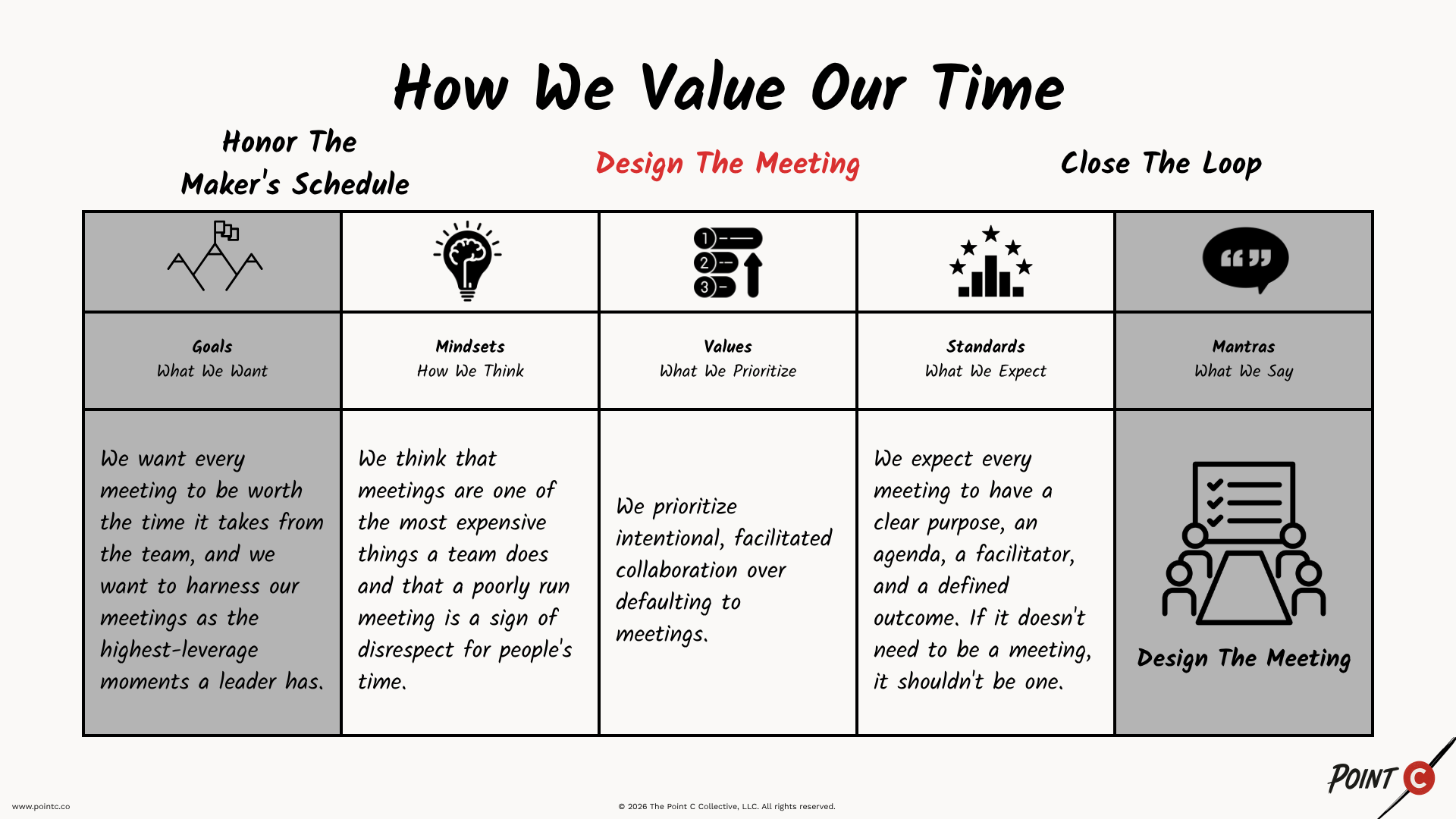
Here's the full Mantra Ladder for Design The Meeting. The rest of this post unpacks it.
Goal (What We Want): We want every meeting to be worth the time it takes from the team, and we want to harness our meetings as the highest-leverage moments a leader has.
Mindset (How We Think): We think that meetings are one of the most expensive things a team does, and that a poorly run meeting is a sign of disrespect for people's time.
Value (What We Prioritize): We prioritize intentional, facilitated collaboration over defaulting to meetings.
Standard (What We Expect): We expect every meeting to have a clear purpose, an agenda, a facilitator, and a defined outcome. If it doesn't need to be a meeting, it shouldn't be one.
Mantra (What We Say): Design The Meeting.
Your Biggest Leverage Moment
Not all moments in a leader's week are created equal. A few of them carry many times the leverage of all the rest, and the leaders who move their organizations are the ones who find those moments and design for them. I call them moments of impact, a phrase I picked up from my friend and former collaborator Lisa Kay Solomon, who co-wrote a book by that name. And if I had to pick the single biggest one, it's this: when your key people, your direct reports, are all in the room together.
That's your executive team meeting. It is your single biggest leverage moment as a leader. It's the one forum where you can align your team, model the culture you want, make the calls only that group can make, and say something once so everyone hears the same thing. What happens in that room cascades to every team each of your people leads.
It's not the only moment of impact worth designing. Your one-on-ones are your biggest leverage moment to develop your leaders. Your all-hands is your biggest leverage moment to align the organization. Both deserve the same design attention, and each will get its own deep dive in a future post. But in order of priority, the executive team meeting comes first.
And yet I come across so many leaders who have never designed it. They show up. The meeting is whatever it has always been, because that's what they've seen and that's what's been done. I see CEOs do this especially. Many of them think their time is too valuable to spend thinking about the team meeting, so they delegate it to somebody else and never take responsibility for its design. They're giving away their biggest point of leverage.
Even more surprising, many of these same executives will tell you their own meetings feel somewhat useless. They just never connect the dots to see that they are the ones responsible for it. It's as if the meeting is a show being performed for them, and they show up as the guest of honor.
Here's the pattern underneath it. If you're the boss, you think you're too important to design the meeting. If you're an employee, you think you're too small to change the way things have always gone. So nobody designs it. Everyone just shows up on autopilot, week after week, to a meeting nobody chose.
Throw that out. Start with a blank slate. Your meetings are among the most expensive things your organization does. Count the salaries in the room. A poorly designed meeting is not just wasted money. It's a signal of disrespect for people's time. And a well-designed one is the strongest culture-building tool you have. As a leader, that design is yours. You can get help executing it, but you are responsible for the flow of that room.
The Default Mode
I ran a retreat for the senior executives of a large company and a group of their most important business partners. The relationship between the two groups had gotten rough. Every time they came together, the meeting behaved like a negotiation. Both sides showed up with their armor on, ready to defend their positions. And nobody liked it.
In a session, I showed the room six modes of collaboration. When we meet, we can meet to inform, to debate, to advocate, to negotiate, to partner, or to listen and iterate. There's no right or wrong mode. But every meeting has a default mode whether you chose it or not. So I asked the room: what would you like your default mode to be?
Ninety-eight percent of them said to listen and iterate.
Think about that. A room full of people who had been negotiating with each other for years, and nearly all of them wanted the same thing: a mode where everybody's feedback in the room is valuable, where feedback is a gift, not a demand, and where everyone works on the problem together to get to better results. They didn't want to fight. They wanted to build together. But nobody had ever named the mode, so everyone defaulted to armor.
That's the power of a single design choice. The default mode of your meeting, the way people expect to show up before the first agenda item is even read, shapes everything that happens in the room. If your team expects a performance review, they'll perform. If they expect a negotiation, they'll posture. If they expect to listen and iterate, they'll bring their imperfect work and their honest reactions. Most teams have never had the conversation. Have it. You may find, like that room did, that the mode everyone wants is not the mode everyone is stuck in.
The Seven Elements
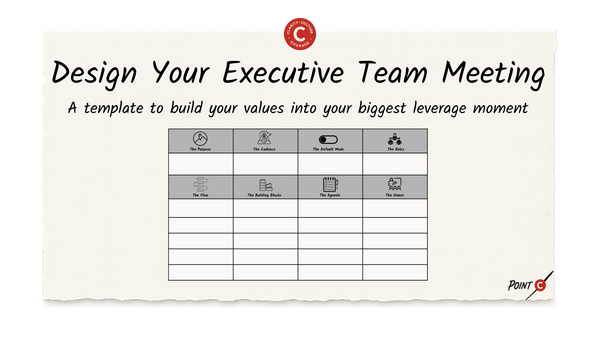
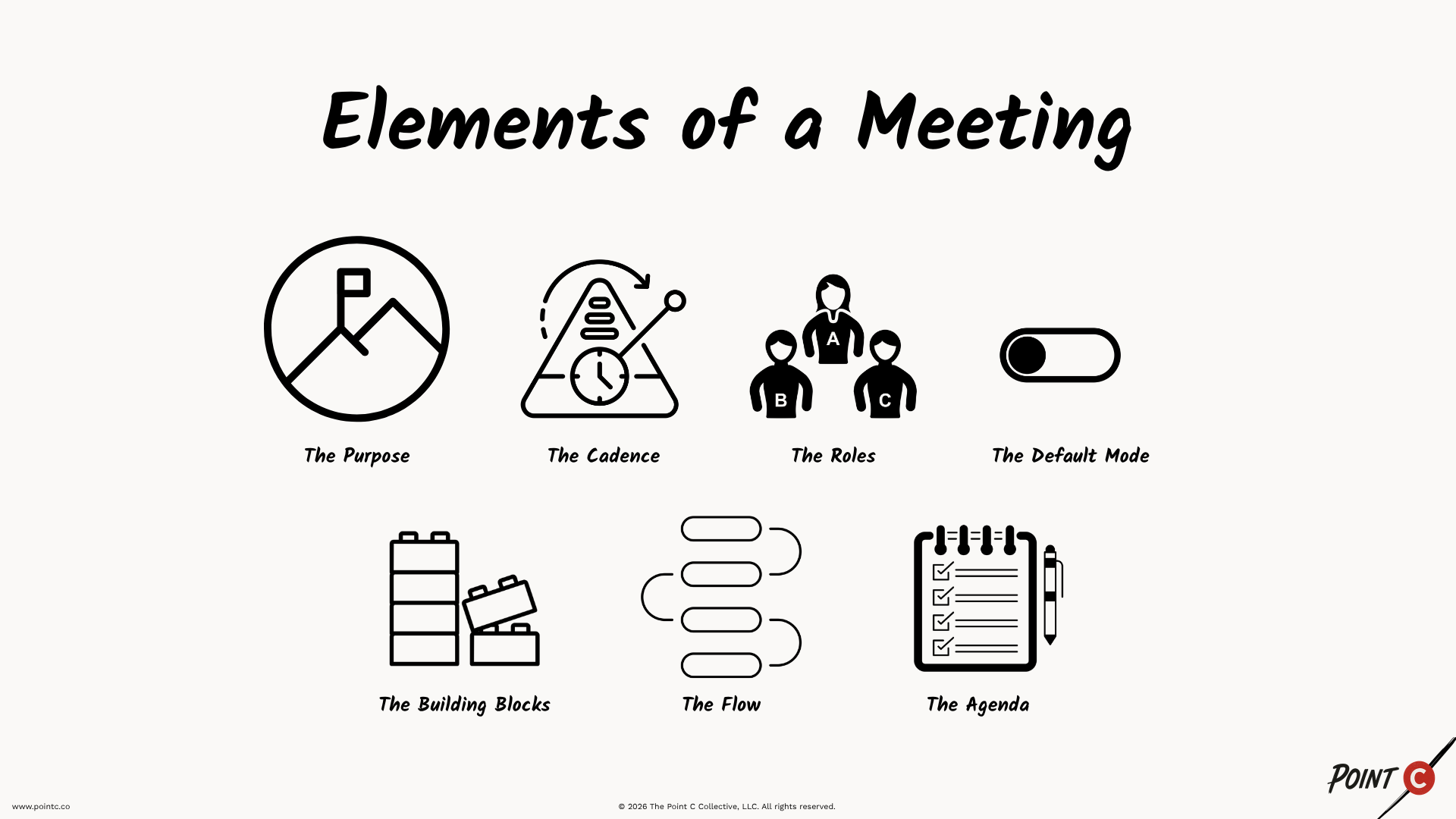
When I say design the meeting, I mean something specific. A meeting is not an agenda. An agenda is just one of seven elements, and honestly, it's the one most people jump to first when it should come last. When I work with leaders on redesigning their meetings, we work through all seven:
The Purpose. Why we're here. The unique value that this meeting, with these specific people, creates that no other forum can. If you can't articulate what happens when these people come together synchronously that couldn't happen any other way, you haven't gotten the basics down yet. And if there's no answer at all, it shouldn't be a meeting.
The Cadence. When and how often. Weekly, biweekly, monthly, quarterly. The cadence should match the purpose, not the calendar default.
The Default Mode. How we show up. Inform, debate, advocate, negotiate, partner, or listen and iterate. This is the most important intentional choice in the design, and the one most teams never name.
The Roles. Who owns what. Who designs the meeting, who facilitates it, who sources the agenda, who makes the decisions. These are different jobs, and they don't all belong to the most senior person in the room.
The Building Blocks. What's inside. A meeting is really a series of mini meetings, and each one has its own job to be done. A block for closing loops. A block for design reviews. A block for gift exchanges. Each block has its own purpose, mode, and flow.
The Flow. In what order. Energy matters. Flaring and focusing must be separated. The arc of the meeting is a design decision, not an accident.
The Agenda. What's on deck this week. Only after everything above is designed does the agenda mean anything. An agenda without a purpose, mode, and roles is just a list.
I'll go deeper on the building blocks and share full meeting templates in future posts. For now, the headline is this: every one of these seven elements is a choice. You're making all seven choices whether you know it or not. Design the meeting means making them on purpose.
Where Every Mantra Lives
Here's why this mantra closes the series.
Over the past eleven weeks, we've gone deep on mantras about how we solve problems, execute work, make decisions, improve, communicate, and value time. Each one comes with norms and rituals. And nearly all of those rituals live inside one recurring moment: the meeting.
Think about where the mantras actually happen. Make Space For Every Voice happens in how your facilitator runs the room. Flare Before You Focus happens in how you separate exploration from decision-making. Close The Loop happens in a standing block where last week's decisions get their status. Feedback Is A Gift happens in the design review. Celebrate Behaviors, Not Just Outcomes happens in a five-minute spotlight. Talk To People, Not About People is protected by what you refuse to let happen in the room when someone isn't there.
A well-designed meeting is where your subculture becomes visible. It's the one place your whole team watches you make choices, week after week, about what gets time, what gets celebrated, what gets decided, and how people get treated. When you design that moment deliberately, every mantra on your dashboard has a home. When you don't, your culture is whatever happens by default. And as we've seen throughout this series, the absence of a signal is itself a signal.
The Standard This Sets
We expect every meeting to have a clear purpose, an agenda, a facilitator, and a defined outcome. If it doesn't need to be a meeting, it shouldn't be one. Before the invite goes out, we ask the question I ask before every retreat I design: if you waved a magic wand and this meeting worked, where would people be walking in, and where would they be when they walk out? What does winning look like? If you can't name the place you're moving people to, you're not ready to bring them together.
We hire people who run effective meetings and respect others' time. And we let go of people who consistently waste the team's time with unstructured, unnecessary meetings.
The feeling on a team that lives this mantra is distinct. When we meet, it matters. You walk out of the room knowing what was decided, who owns what, and why your time was worth it. Our time together is too valuable to waste. And that feeling compounds, because a team that trusts its meetings brings its best thinking to them.
Your Challenge This Week
Pick your most important recurring meeting. Not your one-on-ones. The meeting where your direct reports are all in the room together as a team. If you don't have one, that's your first finding. Now audit it against the seven elements. What's the purpose that only this group can serve? What's the default mode people are actually showing up in? Who really owns the design?
Then ask your team the question I asked that retreat: what mode are we defaulting to, and what mode do we want? Don't be surprised if the answers are far apart. That gap is your redesign brief.
And if you want to go one step further: take one meeting on your calendar this week that has no clear purpose, and cancel it. Notice what happens. Usually, nothing. That's the point.
Next Week
That's the dashboard. Twenty-one mantras, seven categories, and now a deep dive behind every single one.
But a list of mantras is not a culture. Culture is how it feels to work somewhere. It's the invisible operating system for the decisions people make when nobody is watching. So before we close the book on this series, I want to take you somewhere.
Next week, I take you inside a team where all twenty-one mantras are alive at once, and show you what it actually feels like.
Know someone who would find this useful? Forward this email to them. They can subscribe here to get their own weekly half sheet.
About This Newsletter
The Idea Bucket is a weekly newsletter and archive featuring one visual framework, supporting one act of leadership, that brings you one step closer to building a culture of innovation.
It’s written by Corey Ford — executive coach, strategic advisor, and founder of Point C, where he helps founders, CEOs, and executives clarify their visions, lead cultures of innovation, and navigate their next leadership chapters.
Want 1:1 executive coaching on this framework or others? Book your first coaching session. It's on me.