Design Your Subculture
A mantra to design how it feels to work on your team rather than accept the default

Was this forwarded to you? Subscribe here to get one leadership framework per week.
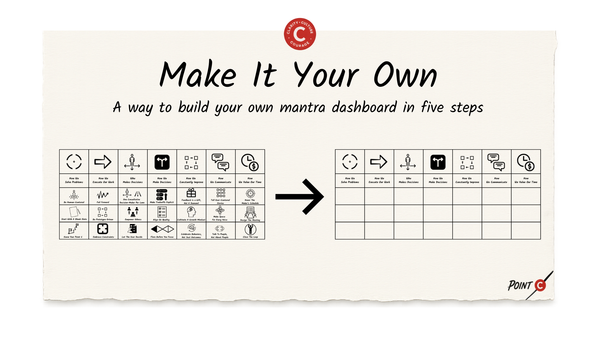
Over the past eleven weeks, we've gone deep on every mantra in my Mantra Dashboard. Twenty-one mantras across seven categories, each with its own ladder, its own norms, and its own rituals. Last week we finished the set with Design The Meeting, and I promised to take you somewhere before we close the book on this series.
Here's why. A dashboard is not a culture. A list of mantras is not a culture. You can pin all twenty-one to the wall and still run a team that people quietly want to leave. So before we wrap, I want to show you what the dashboard is actually for. It's a reminder that with every action you take as a leader, you make your subculture come alive. Every time you speak a mantra, the culture lives and breathes. And what all of it produces, the thing the dashboard is really for, is the feeling.
What A Culture Actually Is
When I teach culture, I define it like this: culture is the set of behaviors a group consistently rewards, tolerates, and punishes. It's how it feels to work somewhere. It's the invisible operating system for the decisions people make when nobody is watching.
Notice what's not in that definition. Culture is not your values poster. It's not your mission statement. It's not what leadership says on stage at the all-hands. It's what actually gets rewarded, what actually gets tolerated, and what actually gets punished, as experienced by the people doing the work. Your team already knows your real culture. They feel it every day.
And there are two levels to it. There's the dominant company culture, which is very hard for any one person to change, even the CEO. And there's your subculture: the team around you, where you have direct influence. Trying to change the whole company overnight puts you in the danger zone. Building a healthy subculture and expanding it outward, team by team, keeps you in the learning zone. That's why I've spent this entire series talking about subcultures. Leadership is an act, not a title, and anyone who leads a team, formally or not, is already shaping one. The only question is whether you're shaping it on purpose.
The best way I know to show you the difference is through contrast. So let me tell you about two professional experiences in two different subcultures. Both are composites, but nothing in them is invented. Every moment below is something I have watched happen: the first job is stitched from the dysfunctions I get called in to help fix, and the second from the teams I've led, coached, and taught that live this dashboard. Same industry. Same caliber of talent. Same long hours, more or less.
Completely different feelings.
The Monday Meeting
At your old job, Monday started with the staff meeting. Nobody could tell you its purpose, because it didn't have one. It had a habit. You went around the horn, each person giving their update, everyone waiting out everyone else's three minutes so they could perform their own. You spent the minutes before your turn rehearsing, because the real agenda, the one nobody said out loud, was showing how busy you were. One of your colleagues admitted it once: this meeting is where I justify my job. The boss, meanwhile, checked his phone through most of it. The meeting was a show performed for him, and he showed up as the guest of honor. Then everyone went back to their desks and the real conversations happened in fragments, in DMs, in the hallway.
At your new job, there is no Monday morning meeting. Mornings here are maker time, protected for deep work, because the team honors the maker's schedule. The team meeting happens Wednesday after lunch, and it doesn't look like any meeting you've sat through, because last year the team threw out the old format and redesigned it from scratch. It opens with a story about one user, by name, not a spreadsheet. Your manager facilitates it herself, and she works the room like it's her most important craft: she keeps exploration and decision-making separate and runs a round before any decision, so every voice gets space instead of just the loudest ones. The first five minutes close last week's loops: every open decision gets a status, so nothing lingers and nobody wonders. There is a Time Timer that keeps everyone on track. It ends on time. Somewhere in week three you notice the strangest thing about it: you've stopped checking your phone. There's nothing to escape from.
The Direction
At your old job, there was no direction. There was activity. Lots of activity. The place ran on business as usual: executing this year what it executed last year, a little leaner each time. Nobody talked strategy, only workload. There was a strategy deck somewhere, presented once and never mentioned again, and priorities changed each quarter without explanation, so you found out about the changes through rumor. You spent three months on a project that quietly got shelved, and nobody ever told you why. And here's the question that would have stumped everyone in the building, top to bottom: who, exactly, is our user? You couldn't have named a single real person.
At your new job, everyone can tell you where the team is going. Not the mission statement. The actual destination: who the target user is today, what their life will look like eighteen months from now, and why this team is the one to build it. Your manager visualizes it, retells it, and ties decisions back to it so often that by your second week you could explain the team's Point C to a stranger. The team refuses to run on autopilot: when business as usual stops serving the user, they start with a blank slate and design what's next. And the direction isn't just one person's opinion. This team is human-centered: they are in front of real users every single week, and strategy gets told through concrete user stories, one person's life at a time, not through top-down, abstract PowerPoints. When the direction gets debated, the winning argument isn't just the most senior one. It's the one that holds all three circles of innovation together: what users actually want, what technology makes possible, and what the business can sustain. You know why your work matters, because you can trace a straight line from the thing you're building to the destination everyone can see.
The Feedback
At your old job, you polished your work in private for weeks before showing anyone. Partly because showing unfinished work was how you got hurt. And partly because of what feedback meant there: every comment was a directive in disguise. Sharing early meant surrendering the work to whoever spoke with the most authority, so you kept it hidden until it was too finished to redirect. And even then, you were guessing. What mattered most to the boss lived in his head, never fully articulated. So you optimized for what you assumed he wanted, and found out months later, after the work was done, that something he cared about deeply had been missing the whole time. In meetings, the boss always weighed in first, and after that the room bent toward him. People held their opinions back until they knew his, then produced slightly reworded versions of it. When someone did present work, there were only two responses: silence, or the boss telling them exactly what to do next, their agency gone in a sentence. When you finally presented, the room was polite and quiet. The real feedback came later, through the side door. Someone shared their concerns with your boss. Your boss passed along a softened version days afterward, and by then it wasn't feedback anymore. It was a verdict you couldn't question, from a source you couldn't see.
At your new job, you presented work in your second week that was still super rough, in a ritual they call the design review, where the whole point is to fail forward early, while the failures are still cheap. You knew what excellent looked like before you started, because the team had aligned on quality on day one and built the rubric together, force-ranking what mattered most. And you knew what mattered most to your stakeholders, because the team ran The Selection Stack: draft the criteria, test them with each stakeholder one-on-one, and fail fast on your assumptions about what success means before you fail on the work itself. The facilitator opened with the ground rule, and you've heard it a dozen times since: feedback is a gift, not a demand. The room gave you everything it had, directly, to your face, with humility and a true intention of helping you grow and succeed. And then the choice of what to do with it stayed entirely yours. Nobody dictated your next move, and the leader reinforced it out loud: this is your decision. The most senior person spoke last, deliberately, so that nobody could anchor on her position and the room's thinking stayed its own. Afterward she thanked you, specifically, for taking a risk. You walked out with months of work saved and nothing to brace for.
The One-On-One
At your old job, your one-on-one was two things. A status update you performed, and a confession booth you leaned on. You reported progress to prove you were on top of things. When you brought a problem, your boss either took it from you or handed back instructions, and either way you left smaller than you arrived, your job quietly reduced to execution. And when you were frustrated with a colleague, you vented, and your boss absorbed it and said "let me look into it." It felt like support. It was actually the engine of the whole dysfunction, because everyone was doing it. Feedback about you traveled through the same channel, and you never heard it at the source. You just felt the temperature change and wondered, in every meeting, what was being said about you in rooms you weren't in.
At your new job, your manager opened your first one-on-one by telling you what the hour is for: this time is to develop you, not to dictate the work. So she coaches. When you bring a problem, she doesn't take it over, and she doesn't prescribe. She asks what you've tried, what you plan to do next, and what's actually in your way, because the call is yours to make. Then she hands the problem back with her confidence attached, because empowering others is not a slogan here. It's what the hour is built to do. And when you started venting about a teammate in week two, she stopped you, kindly, with a question you've since learned everyone here asks: have you told him this? She coached you to find the words, and the direct conversation took less time than the venting would have. Talk to people, not about people sounded like a slogan in the onboarding doc. A month in, you understand it's the reason the background anxiety is gone. And feedback between you and your manager flows both ways, on a rhythm. Every month or so, the two of you exchange it directly, her to you and you to her, so nothing builds up in either direction and the small things get said while they're still small. You leave your one-on-ones with more ownership, not less, and closer to the people you work with, not further away.
The Decision
At your old job, you were hired to run something. So you did what you were hired to do: you built a strategy and brought a recommended path. That's when you discovered you weren't actually in charge of it. Decisions you thought were yours got second-guessed, reworked, and micromanaged from above. And raising things didn't help either. You'd bring something to a meeting, there would be a good discussion, heads would nod, and then silence. No decision announced. No update. You didn't know if it was decided in some other room, or deferred, or simply forgotten, and asking again felt like nagging. Sometimes it was worse than silence: a decision that was supposed to be yours got made above you, and you found out after the fact, from someone else. Your boss praised your work publicly, often, warmly. And none of your proposals ever moved. It took you a long time to name what that combination did to you: the praise made you feel valued while the silence taught you that you weren't. You started interviewing elsewhere not because the work was bad, but because you were tired of wondering whether you mattered.
At your new job, every decision has an owner. The lanes are clear, there's one consultative decision-maker per lane, and the owner's job is to hear everyone before making the call. You always know whose decision something is, including when it isn't yours, and there's a strange relief in that. When two lanes crossed and it genuinely wasn't clear whose call it was, your manager stepped in like a crossing guard. Usually that meant naming whose call it was and getting traffic moving again. And when the decision truly fell between the lanes, she made it herself, quickly, and explained why. Either way, nothing sat blocked. And when the team deadlocked with good arguments on both sides, someone said the sentence that dissolves most stalemates here: let the user decide. Five user tests settled by Friday what the room couldn't resolve in a month.
Most of all, decisions come back, and they come back fast. The owner plays back what they heard, what they decided, what they decided not to do, and why. Something raised on Wednesday has an answer by the next Wednesday at the latest, and usually sooner. The work moves. In your first month here, you watched the team make more real decisions than your old team made in a quarter, and every one of them stuck, because everyone had been heard and everyone knew the why. You've been on the losing side of plenty of decisions this month. You haven't once felt unheard.
The Failure
At your old job, everyone was supposed to already know the answer, even as the world changed faster than anyone could track. So instead of figuring out the answers by trying things, people fell back on what they already knew, because admitting uncertainty was dangerous. You projected certainty when certainty was the last thing the business needed. The premium was on appearing smart in meetings: the confident take, the polished deck, the fast answer. Which meant, in a changing market, that "smart" wasn't actually smart. It was just the familiar, delivered with confidence. You took on only what you already knew you could deliver. You defended ideas long after the data turned against them, because changing your mind meant admitting you'd been wrong. When a project finally missed, the postmortem was a search for a name. And the real lesson everyone took from it was: bury your mistakes deeper.
At your new job, the work starts with a different kind of honesty: the problem in front of the team is genuinely uncertain, the ground is shifting, and nobody, including the leader, has the answer yet. So the team leads with learning instead of leading with ability. They cultivate a growth mindset here, which means struggling with something new is a learning problem, not a talent problem, and "we don't know the answer yet" is often the smartest sentence in the room. The team is prototype-driven: they put forty-five minutes on a visual timer and build with whatever's on hand, treating constraints as creative fuel. Your first user test failed, visibly, in front of everyone, and nobody panicked, because the whole point of testing early is that the user tells you the truth while the truth is still cheap. Your manager wrote what the test taught them on the board and called it what it was: failing forward. We just saved ourselves six weeks.
Ability still matters here, but it's treated as something you grow, not something you prove, and the team even hires that way: for mindsets and learning velocity, not just experience doing something the market has already changed. At the end of the month, the loudest applause at the All Hands went to an engineer who killed his own feature, after his design review surfaced the doubts and the user data confirmed them. They celebrate behaviors, not just outcomes here, and it took you exactly one of those celebrations to understand what this team actually rewards: the courage and the learning that make excellence possible.
The Weekend
At your old job, you never really stopped checking and refreshing. Phone, email, Slack, in a loop, all weekend, making sure you hadn't missed something that needed a reply, because missing it had a price: being seen as unreliable, uncommitted, lazy. The sense of foreboding never fully lifted. There was always the meeting you kept replaying, the thing you said that might have been taken wrong, the proposal still hanging, the conversation you were avoiding. You could be at the table for dinner and not really be there. Your partner and your kids noticed. Work followed you home not as tasks but as static, and you were tired in a way that sleep didn't fix, because you never actually got to put it down.
At your new job, the week ends. The work got done in the protected mornings. The loops are closed, because the team meeting closes them every week as a standing block: what was decided, why, what happens next. The conversation you needed to have, you had on Tuesday, directly, so it isn't waiting for you. And your phone stays in your pocket all weekend, because the norm is simple: text if urgent. You can fully check out precisely because you know exactly how you'd be reached if something ever truly needed you. So on Saturday you're on a trail, or at your kid's game, and the team is not renting space in your head. You know where the team is going and why it matters, so even the ambiguity isn't following you around.
The standards here are the highest you've ever worked under. That's what surprises people. This isn't the easy job. It's the one where all of your energy goes into the work and none of it leaks into managing fear. And on Sunday night you feel something you'd forgotten was possible: you're looking forward to Monday.
The Difference Is Leadership
Here's the thing about those two jobs. The people are equally smart. The industry pressures are identical. The difference between them is not budget, talent, or luck.
The difference is leadership. Every culture is either a default or a design. Someone accepted the defaults at the first job, following the path of least resistance one meeting and one one-on-one at a time. And someone intentionally designed the subculture of the second job.
Put words to how each one feels. The first job: guarded, watched, invisible, anxious, small. The second: trusted, informed, respected, energized, alive. Those aren't perks and they don't show up in the offer letter. They are the direct output of the two cultures, and every person on both teams feels them every single day.
Look back through the new job and the design is everywhere. The team meeting that respects your time was designed, block by block. The feedback that comes to your face runs on norms taught and retaught until they held. The decisions that come back to you are a discipline, not a personality trait. The failure that gets celebrated is only possible because the leader built high standards and high safety at the same time, and refused to trade one for the other.
And the design isn't just something you can see. It's something you can hear. The same phrases, over and over, until you could finish your manager's sentences. Have you talked to him directly? Whose lane is it? Feedback is a gift. Close the loop. That repetition is not a quirk. It is the leverage. A leader can't be in every conversation and every hallway. The mantras can. Every time one gets spoken, the culture gets reinforced, and the words only keep their power because the behaviors match: what gets rewarded, tolerated, and refused lines up with what gets said.
A few months into the new job, you'd notice the last part of the design working on you. You'd catch yourself saying the phrases to a new hire. That's how a subculture expands. Not through memos. Through people who carry the language.
You Can Build This
Maybe you read those two jobs and recognized your team in the first one. That recognition is not a reason for despair. It's a map.
You don't need all twenty-one mantras to start. You need one. Pick the contrast that made you ache, the one your team deserves and doesn't have. Find the mantra behind it. Build its ladder so you know what you actually believe. Put its ritual into your next meeting. And then say the words, out loud, again and again, until your team can finish your sentences.
Your subculture is already forming, every day, with or without you. The behaviors you reward, tolerate, and punish this week are teaching your team what this place is. You might as well teach them on purpose. Default or design. That's the choice, and you make it every week whether you know it or not.
So here is the mantra that sits above all twenty-one others, the one this entire series has been building toward: Design Your Subculture.
Your Challenge This Week
Ask yourself the question at the heart of this whole series: which of those two jobs does it feel like to work on my team? Not what you intend it to feel like. What it actually feels like, to the people living in it, when you're not watching.
If you're brave, don't answer it yourself. Ask your team. Then pick the one contrast you're going to close first.
Next Week
If you read the second job and wished you worked there, here's the turn: you have the power to build it. Not just for yourself. For everyone around you. That is what I mean when I say leaders are leverage. One person, making intentional choices about the signals they send, changes what work feels like for every single person on the team.
So next week, we close the series by turning the lens from employee to leader: the complete Mantra Dashboard, all twenty-one mantras, all twenty-one ladders, and every deep dive, compiled into a single reference manual you can download, share, and use to start building.
Know someone who would find this useful? Forward this email to them. They can subscribe here to get their own weekly half sheet.
About This Newsletter
The Idea Bucket is a weekly newsletter and archive featuring one visual framework, supporting one act of leadership, that brings you one step closer to building a culture of innovation.
It’s written by Corey Ford — executive coach, strategic advisor, and founder of Point C, where he helps founders, CEOs, and executives clarify their visions, lead cultures of innovation, and navigate their next leadership chapters.
Want 1:1 executive coaching on this framework or others? Book your first coaching session. It's on me.