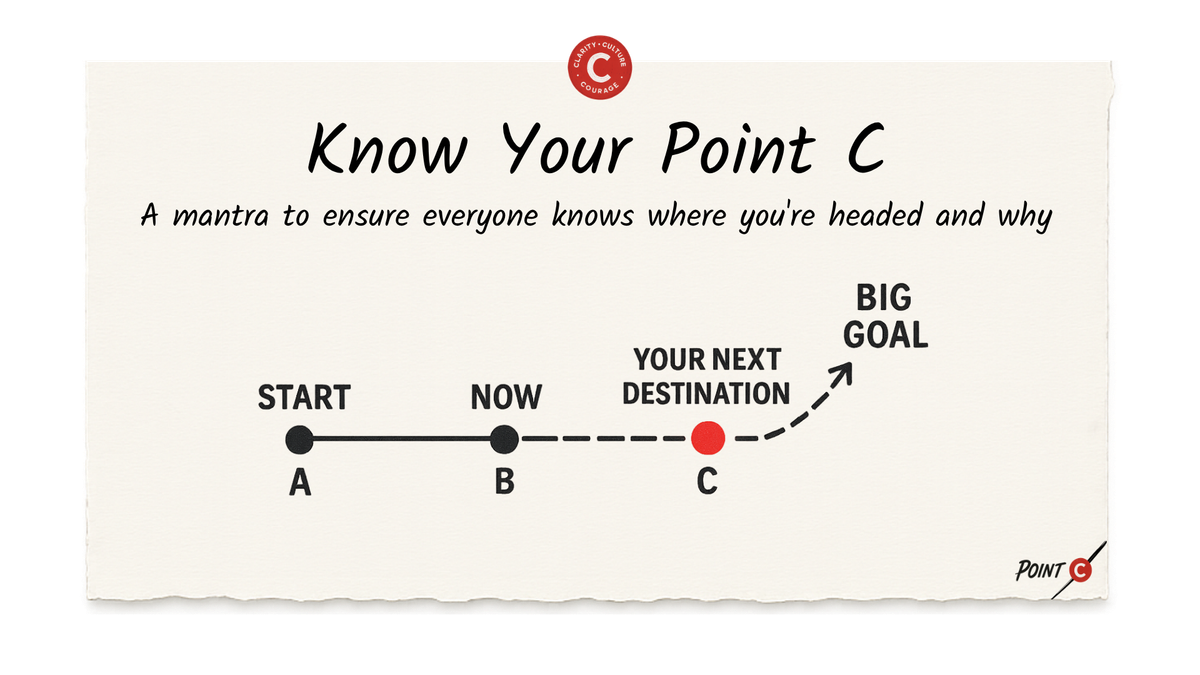
Know Your Point C
A mantra to ensure everyone knows where you're headed and why

Was this forwarded to you? Subscribe here to get one leadership framework per week.
Last week in The Idea Bucket, I shared The Mantra Dashboard: twenty-one mantras across seven categories, the one-page playbook of my go-to leadership mantras. I said that if your team doesn't know where you're headed, none of the other mantras on that dashboard matter.
This week, we go deep on the mantra that sits at the foundation of everything I do. It's the mantra that inspired the name of my company. And it's the first deep dive in a series that will eventually cover every mantra on the dashboard, complete with a full Mantra Ladder for each one.
The mantra is: Know Your Point C
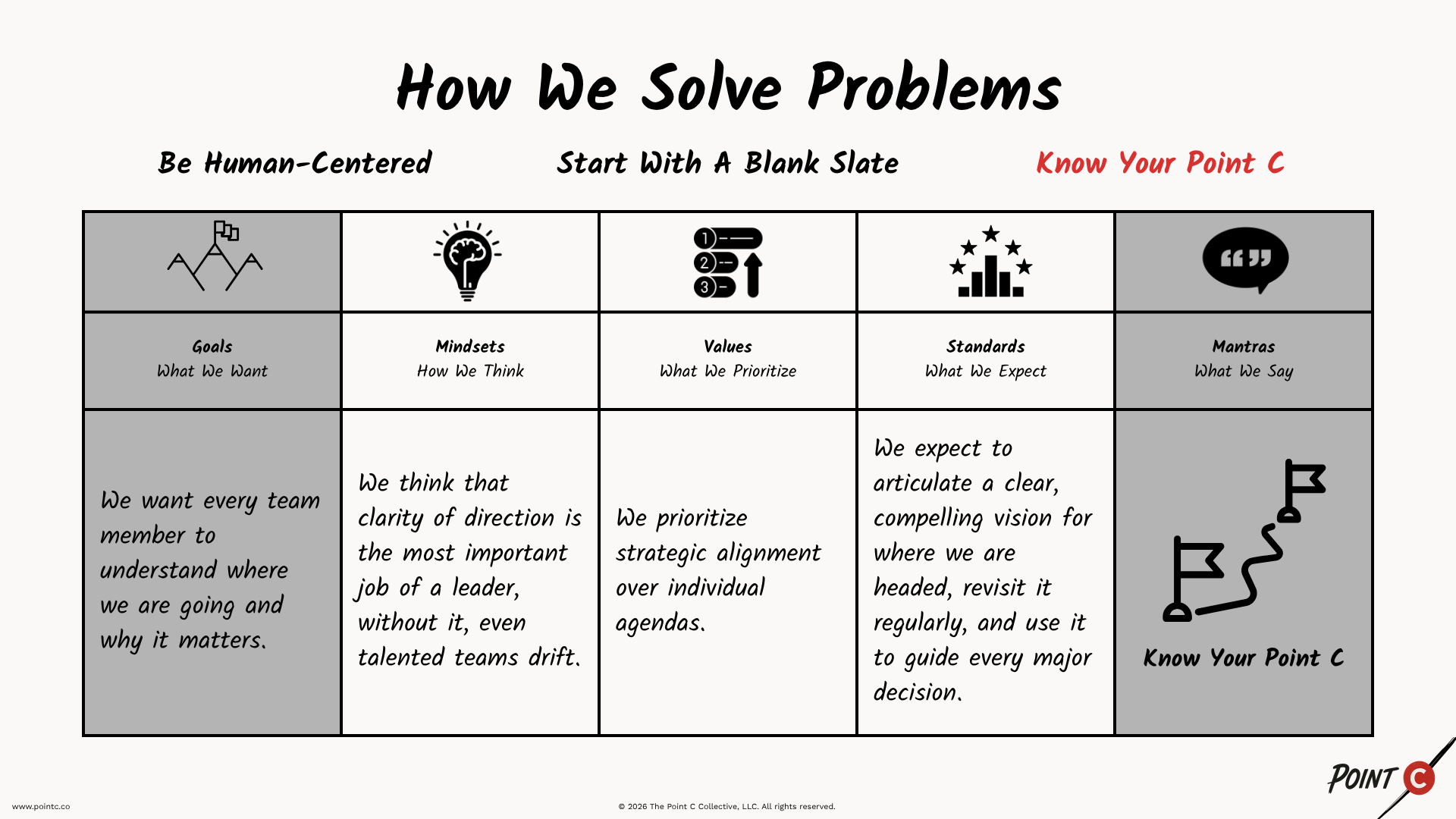
The Mantra Ladder: Know Your Point C
Here's the full Mantra Ladder for Know Your Point C. The rest of this post unpacks it.
Goal (What We Want): We want every team member to understand where we are going and why it matters.
Mindset (How We Think): We think that clarity of direction is the most important job of a leader. Without it, even talented teams drift.
Value (What We Prioritize): We prioritize strategic alignment over individual agendas.
Standard (What We Expect): We expect every leader to articulate a clear, compelling vision for where we are headed, revisit it regularly, and use it to guide every major decision. We expect every initiative to have a Point C. And we expect that if you're on a team and you don't know your Point C, it's your duty to ask.
Mantra (What We Say): Know Your Point C
What Is Point C?
You started at Point A. Now you're at Point B. To reach your big goal, you don't just need to paint a picture of the long-term vision. You need to sell Point C: the concrete, vivid destination you will take yourself, your team, and your company to over the next twelve to twenty-four months.
Not Point Z. Not the big, hairy, audacious, abstract vision of where you'll be in ten years. Point C. The next fundable lily pad.
But Point C is not just a description of where your team will be. It's a vivid picture of what you will have created for your users, how your operations will look, and what it positions you to prove, scale, or expand next. It's user-centered. It's operational. And it's strategic. When someone hears your Point C, they should be able to see the user experience you're building toward, the team and systems that make it work, and the door it opens for whatever comes after.
I've been teaching this concept for years, and I named my company after it because I believe it is one of the most powerful unlocks in leadership. When a leader can articulate a clear, vivid Point C, everything changes. Confidence goes up. Stakeholders align. Resources follow.
When I watch my entrepreneurs pitch investors, the difference between money staying in a pocket and money coming out of a pocket almost always comes down to this: Can you make me see where we'll be eighteen months from now? The ones who sell Point Z without a concrete Point C end up pitching a bridge to nowhere. The vision is inspiring but nobody funds a bridge to nowhere. The ones who nail their Point C make the next destination so vivid that stakeholders want to buy a ticket.
Point C In Practice
Point C is not just for pitching investors. I use it everywhere.
In coaching. When I start working with a new coaching client, one of the first things we do is lay out the concept of Point C. I ask them: What do you envision your Point C to be? Where do you want to be eighteen months from now? What will you have unlocked? That vision anchors all the work we do together. Every coaching conversation points back to it. Every decision, every challenge, every stretch assignment connects to the question: Does this move you closer to your Point C?
Any manager can do this with their direct reports. What are your learning goals? What do you want to have unlocked by this time next year? Let's imagine it together. That's a Point C conversation, and it transforms a one-on-one from a status update into a development conversation.
In budgeting. Think about how most organizations budget. They look at existing budgets and ask managers to adjust by a percentage. Up ten percent, down five percent. It's incremental. It's backward-looking. And it almost never produces strategic clarity.
Now imagine a different approach. Instead of starting from last year's budget, every manager pitches their Point C. Here's where my team will be eighteen months from now. Here's the user journey we're building towards. Here's the plan to get there. Here's the resources we need to unlock that vision. Senior leadership then acts like an investment committee, force-ranking the most important visions for the company and funding them in that order. The most important visions get fully resourced so they can actually come alive. The less critical ones don't get funded. And suddenly, where you'll be twelve to twenty-four months from now is crystal clear for everyone in the organization. That's budgeting as strategy, not budgeting as accounting.
In The Venture Story. If you've been following The Idea Bucket from the beginning, you've already seen Point C in action. Act I is in many ways the vision for your Point C from the bottom up. You start with the user, their pain point, their journey, and what it looks like when your solution becomes essential in their life. And in Act III, Scene 9, everything culminates in Point C. You make your ask, you lay out your next steps and hypotheses, and then you describe your next destination so vividly that your stakeholders can see it. As I wrote in that post: this is the make or break moment in your pitch. Does this feel like the next fundable lily pad, or a bridge to nowhere?
The Selection Stack plays a role here too. Before you can know your Point C, you need to know what matters most. Force-ranked selection criteria help you make the tradeoffs that shape which destination you're aiming for.
It all comes together. Knowing your Point C is not one tool. It's the culmination of a process: understanding your user, defining your strategy, making your tradeoffs, and painting a vivid picture of where you're headed next.
If You Don't Know Your Point C, Prototype It
Here's what I tell leaders who feel stuck: if you don't know your team's Point C, don't wait for it to become clear. Prototype it.
In fact, prototype a few of them. Draft two or three possible Point Cs. Share them with your team. Get feedback. Offer them to your boss. Talk about which one feels right and why. Point Cs are not handed down from on high. They're built together. That's strategy in action.
And this connects back to the standard in the ladder. This mantra doesn't just set expectations for the leader who casts the vision. It sets expectations for everyone on the team. If you don't know where your team is headed, don't sit quietly and hope it becomes clear. Ask. Clarify. Prototype. Because you can't make good decisions about how to get somewhere if you don't know where you're going.
Your Challenge This Week
- Pick one initiative you're leading right now. Can you tell the story of what your user's experience looks like twelve to twenty-four months from now? Not a slide. Not a bullet point. A story. Can you envision it and articulate it? If you can't, that's your most important blind spot.
- Ask someone on your team: Tell me a story of what our user experience looks like a year from now. Listen carefully. The gap between your Point C and their understanding of it is the gap your leadership needs to close.
- If you feel stuck, prototype it. Draft two or three possible Point Cs and share them with someone you trust. Point Cs are built together.
Next Week
Your Point C is only as powerful as the story you tell about it. The best leaders don't just have a vision. They ground it in the real human context of the people they serve, because a user story is more compelling than a feature list every single time.
Next week: Tell User-Centered Stories.
Know someone who would find this useful? Forward this email to them. They can subscribe here to get their own weekly half sheet.
About This Newsletter
The Idea Bucket is a weekly newsletter and archive featuring one visual framework, supporting one act of leadership, that brings you one step closer to building a culture of innovation.
It’s written by Corey Ford — executive coach, strategic advisor, and founder of Point C, where he helps founders, CEOs, and executives clarify their visions, lead cultures of innovation, and navigate their next leadership chapters.
Want 1:1 executive coaching on this framework or others? Book your first coaching session. It's on me.