Close The Loop
A mantra to ensure nothing falls through the cracks

Was this forwarded to you? Subscribe here to get one leadership framework per week.
This is the tenth post in a series where I'm going deep on each mantra in my Mantra Dashboard. Last week, we explored why directness and courage matter more than comfort and avoidance: Talk To People, Not About People.
This week's mantra lives in the How We Value Our Time category of my Subculture Coverage Matrix, alongside Honor The Maker's Schedule and Design The Meeting, which arrives next week to complete this series. Because it doesn't matter how well you protect your team's time in the meeting if the decisions made there never make it back to the people who need to hear them.
The mantra is: Close The Loop.
The Mantra Ladder
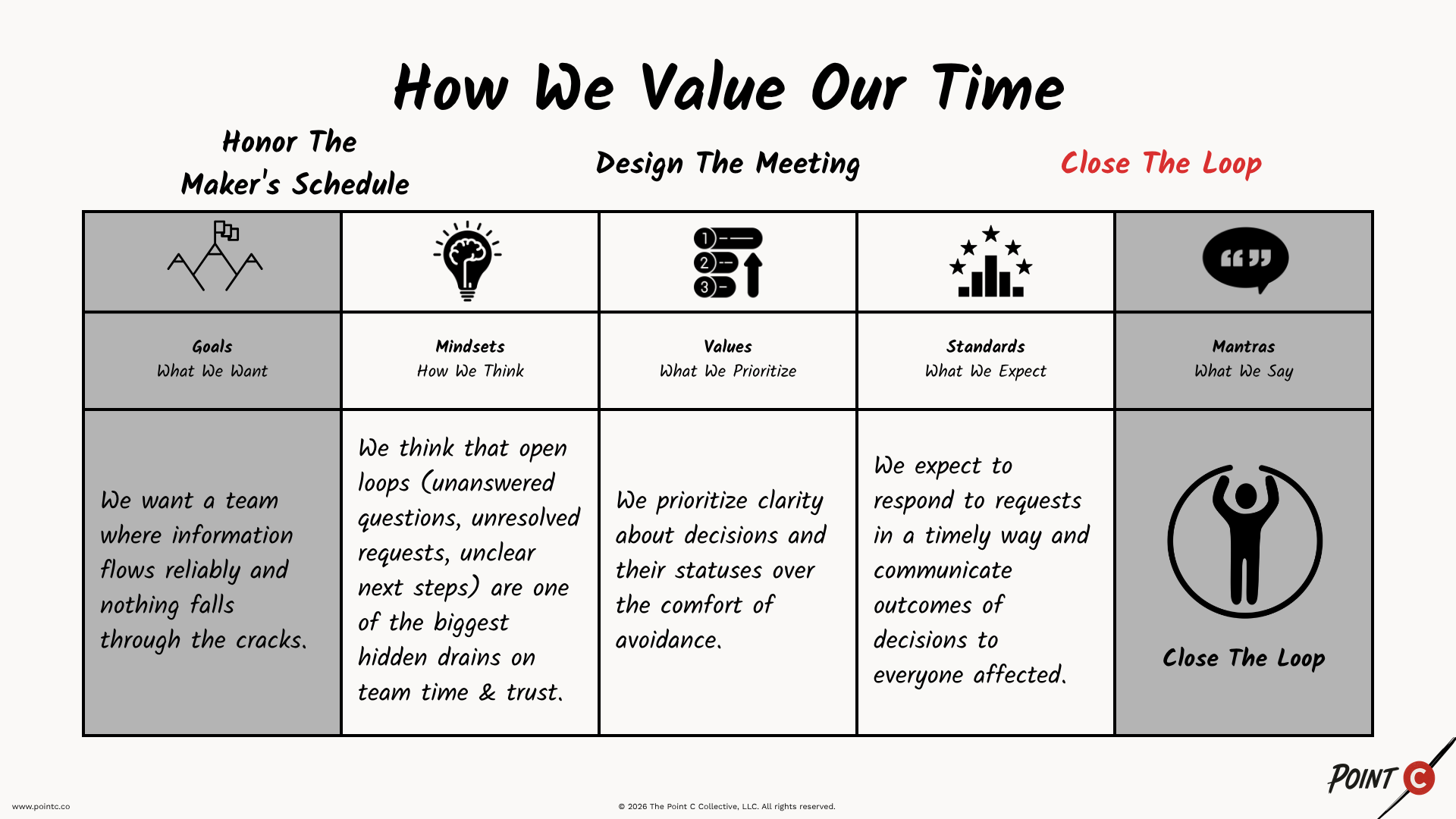
Here's the full Mantra Ladder for Close The Loop. The rest of this post unpacks it.
Goal (What We Want): We want a team where information flows reliably and nothing falls through the cracks.
Mindset (How We Think): We think that open loops (unanswered questions, unresolved requests, unclear next steps) are one of the biggest hidden drains on a team's time and trust.
Value (What We Prioritize): We prioritize clarity about decisions and their statuses over the comfort of avoidance.
Standard (What We Expect): We expect to respond to requests in a timely way, communicate outcomes of decisions to everyone affected, and never leave someone wondering what happened.
Mantra (What We Say): Close The Loop.
The Weight Of An Open Loop
Picture a well-run meeting. A strategic question is on the table. The decision-maker has made space for every voice. The team weighs in with honest, thoughtful feedback. And because this team understands that feedback is a gift, not a demand, nobody expects the decision-maker to commit to anything in the room. Everyone leaves feeling heard. The process worked.
Then the next weekly meeting comes. The topic doesn't come up. Neither does it the week after. No decision is announced. No update is given. The people who invested their thinking in that conversation are left wondering. Did our feedback matter? Was a decision made in some other room? Is this still happening at all?
That is an open loop. And here's what it costs. Every person who contributed is now carrying a small piece of unresolved business in their head. They're wondering whether to bring it up again, and whether bringing it up again makes them annoying. They're operating on old information, or worse, on assumptions about what was probably decided. Multiply that across every discussion, every request, and every proposal on a team, and you begin to see why open loops are one of the biggest hidden drains on a team's time and trust. As we've seen over and over again, in the absence of data, people make stuff up.
The most damaging part isn't the waiting. It's the message the silence sends. When people take a risk, share honest feedback, or bring forward a proposal and hear nothing back, they learn that contributing doesn't lead anywhere. So they stop contributing. The free flow of information you worked so hard to build dries up quietly, one unanswered thread at a time.
A "no" is almost always better than silence. A "no" gives you something to work with. You can ask why, adjust, and move on. Silence leaves you wondering. And left open long enough, it doesn't just leave you wondering about the decision. It leaves you wondering whether you matter at all.
The Human Cost Of An Open Loop
I want to show you what the absence of this mantra does to a talented leader, because I see it often in my coaching.
I've been coaching a leader who is, by every account, excellent at his job. His team gives him glowing feedback. His boss praises him publicly and regularly. In meetings, the boss points to his work as the example. And yet he came to a recent session feeling deeply discouraged. Because behind the public praise, nothing he brings forward actually moves. He has proposed initiatives that stalled without explanation. He has raised his own growth repeatedly, and each time the answer is a version of "this will have to wait," followed by weeks of nothing. As he put it, there's a lot of warm words and very little action.
Here is the part his boss doesn't see. He's now thinking about leaving. Not because the work is bad. Not because the relationship is hostile. Because the loops never close. The praise, without follow-through, has started to feel hollow. Every stalled proposal and every deferred conversation sends the same message: your growth is not a priority here.
The coaching we did together was about naming that directly. Not an ultimatum, but an honest conversation: here are the things that have stalled, the status quo isn't working for me, and I need some of these to start moving. That's his side of the work, and it took real courage. But notice what his boss could have done at any point along the way: give him a real answer. Even a "no, and here's why" would have been more respectful than the silence. An open loop left long enough doesn't just drain time. It drives your best people out the door.
What Closing The Loop Looks Like
When I ran my own venture capital firm, we had a specific expectation for how investment decisions were made. The team would discuss an opportunity. Everyone's perspective was heard. And then the decision-maker was expected to close the loop. As I wrote in Make Space For Every Voice, they would come back and play back what they heard from us, tell us what they ultimately decided, and explain why. Even when the decision went against what you recommended, you understood the reasoning. You felt heard. And you could move on.
This is what I teach leaders about collecting feedback: you don't have to decide anything in the moment. To be clear, deciding in the moment can be a very good thing when you're ready to. But if the pressure of having to decide on the spot gets in the way of hearing everyone or reflecting on what you heard, it's best to have a norm that removes that pressure. Then come back at the next meeting and talk about what you heard, what you decided, and what you decided not to do. Or reflect and close the loop in an email. That's closing the loop. It completes the cycle for every person who contributed, even when the decision doesn't go the way they hoped.
This connects directly to last week's mantra. Talk To People, Not About People is about having the conversation at the source. Close The Loop is its completion. The conversation doesn't end when you have it. It ends when you come back and tell people what happened. Directness without follow-through is incomplete.
Why Closing The Loop Is Hard
If closing the loop matters this much, why do people fail at it so often? In my coaching, I see three patterns come up again and again.
The first is avoidance. I coached a leader who realized she had been putting off a follow-up conversation with a direct report because the direct report was difficult to deal with. Every interaction felt like a negotiation. So she let it slip. Days turned into weeks. The open loop festered. When she finally named what was happening in our coaching session, her response was immediate: "I just need to do it." She did. The conversation took minutes. The anxiety of avoiding it had lasted weeks.
The second is the fear of delivering a "no." Leaders sometimes leave loops open because the answer is one they don't want to give, or because they don't have an answer at all. But clarity is kindness. Leaving someone hoping for an answer you already know is "no" isn't protecting them. It's (falsely) protecting you. This is where Lead With Vulnerability comes in. Closing the loop doesn't require having the answer. It's okay to say "I don't know yet." It's okay to be open about what you're wrestling with: "I haven't decided because I'm torn between the budget implications and what I know this means to the team. Here's when I'll get back to you." That's a closed loop, delivered honestly. It builds far more trust than polished silence ever will.
The third is simply forgetting. You're busy. Someone asks you something, you fully intend to follow up, and it falls off your list. I've been on both sides of this. In a recent coaching session, a client asked me about something I'd promised to look into. "Did you ever close the loop on that?" I hadn't. Even the person who teaches this mantra isn't immune. Which is exactly the point. Closing the loop is not a personality trait. It's a discipline, held up by norms and habits that make follow-through the default rather than something you have to remember.
How To Close The Loop
The practices here are simple. What makes them powerful is doing them consistently.
When someone brings you a request or a decision that needs to be made, acknowledge it and commit to a moment when they'll hear back. Not "I'll get back to you," which is how loops stay open, but "I'll get back to you by our next weekly meeting." If you can't commit to a date, say so and explain what you're waiting on. The commitment to a specific moment is what transforms a vague intention into a loop that will actually close.
One of my favorite versions of this: "Please put it on the agenda for our next meeting so I can honor this request." That one sentence does three things. It acknowledges the ask. It creates a concrete moment where the loop will close. And it shares the ownership of remembering, so the follow-through doesn't depend on one person's memory.
The higher standard, though, is closing the loop before you're asked. If someone has to chase you to find out what happened, the loop technically closed, but the trust didn't build. The goal is for your team to learn that when they bring you something, an answer comes back without them having to hunt for it.
And when a decision affects people beyond the room where it was made, communicate it to everyone affected: what was decided, why, and what happens next. Most organizations skip this step. The decision gets made, the decision-maker moves on, and everyone else finds out through the grapevine or not at all.
When you slip, and you will, the move is simple: name it, own it, close it, and move on. "I owe you an answer on this and I let it sit. Here it is." No elaborate apology needed. The repair itself models the standard.
The Standard This Sets
We expect to respond to requests in a timely way. We expect to communicate outcomes of decisions to everyone affected. And we expect to never leave someone wondering what happened.
We hire people who follow through reliably. We recognize people who close loops before being chased. And we let go of people who consistently leave others hanging or create information black holes.
The feeling on a team that lives this mantra is distinct. You feel informed. You feel like your questions matter. You don't waste energy wondering what happened with that decision or whether your proposal is still alive. Things don't fall through the cracks here. And when something does slip, the norm is to name it, own it, close it, and move on.
This is the discipline that sits underneath everything we've talked about in this series. You can know your Point C. You can align on quality. You can make space for every voice. You can talk to people directly. But if the follow-through isn't there, trust erodes quietly, one unanswered thread at a time.
Your Challenge This Week
Go find three open loops. Three things you owe someone a response on. A decision you haven't communicated. A proposal that's been sitting. A follow-up you said you'd make and didn't.
Close them this week. Even if the answer is "I haven't decided yet, and here's when you'll hear from me." Even if the answer is "no." Especially if you've been avoiding it. Name it, own it, close it, and move on.
Then look forward. The next time someone brings you a request you can't answer on the spot, try the line: "Put it on the agenda for our next meeting so I can honor this request." And notice what it does to the trust between you.
Next Week
This is the twentieth mantra in the dashboard. Next week, we close out the series with the twenty-first and final one. Many of the norms and rituals behind every mantra we've explored live inside one recurring moment: the meeting. And most meetings are badly designed. No clear facilitator. No separation between brainstorming and deciding. No moment where last week's open loops get closed.
Next week, the finale: Design The Meeting.
Know someone who would find this useful? Forward this email to them. They can subscribe here to get their own weekly half sheet.
About This Newsletter
The Idea Bucket is a weekly newsletter and archive featuring one visual framework, supporting one act of leadership, that brings you one step closer to building a culture of innovation.
It’s written by Corey Ford — executive coach, strategic advisor, and founder of Point C, where he helps founders, CEOs, and executives clarify their visions, lead cultures of innovation, and navigate their next leadership chapters.
Want 1:1 executive coaching on this framework or others? Book your first coaching session. It's on me.