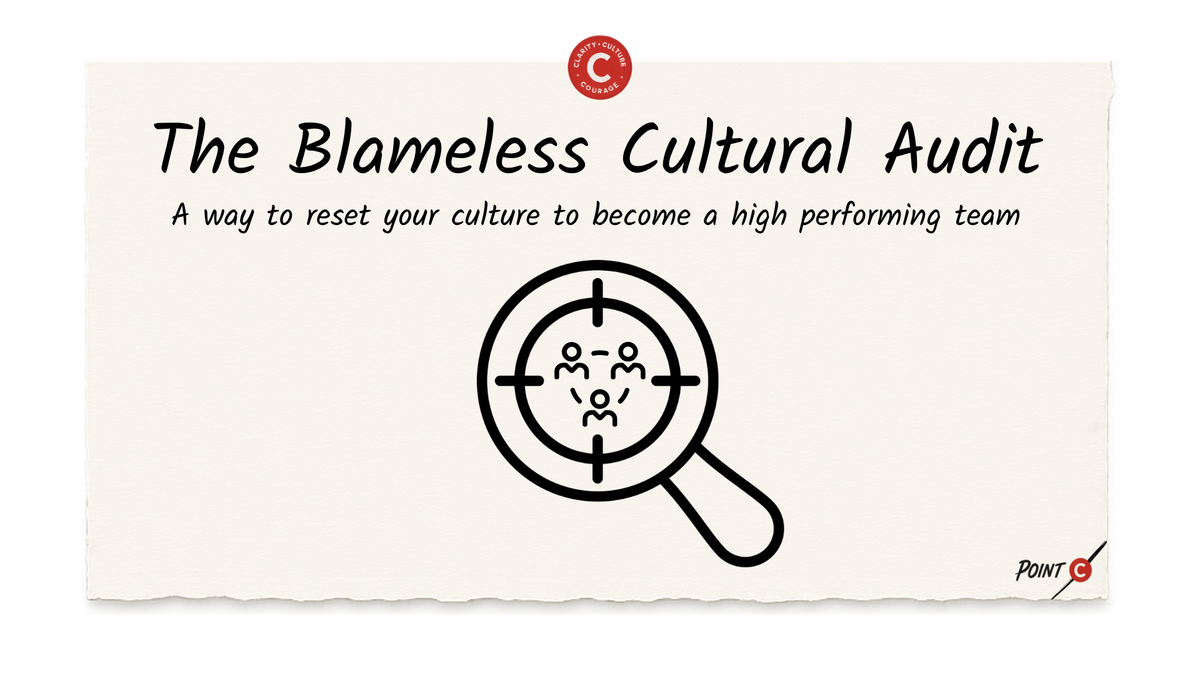
The Blameless Cultural Audit
A way to reset your culture to become a high-performing team

Was this forwarded to you? Subscribe here to get one leadership framework per week.
I believe there are a lot of excellent individuals working in flawed cultures.
I also believe those cultures can change. It's very hard. But with some deep, targeted work and a neutral outside perspective, a flawed culture can become an excellent place to work, one that feels great to be part of and motivates high-quality work.
But that isn’t what usually happens. Bring excellent individuals together, especially Type-A individuals, and while they work to accomplish the mission they can, without knowing it, fall into patterns that make for a terrible place to work and suboptimal outcomes. They make the mistakes that almost all teams make when they don't go slow to go fast: no clear, convergent goals, no clear roles and decision rights, no feedback culture, no explicit norms.
And they can't see it, because each person is trapped in their own point of view. They can't see the forest for the trees, so they miss the fixes that would right the ship.
Then it gets personal. In the absence of clarity, people fill in the gaps with stories about each other, and the problem stops being the missing direction or the unclear roles and becomes them. I call this the identity spiral. A team caught in it decides the fix is replacing the people rather than fixing the alignment of the whole system. The new people arrive, the team is soon in that same place again, and the stigma of that culture solidifies.
Getting out takes something quite nuanced and also quite simple. The first step is deciding that it's time to change and that you cannot do it alone. Two weeks ago, in The Two Rails of Leadership, I promised to show you how I do it with a leadership team, with no one to blame and nothing to hide. I call it The Blameless Cultural Audit.
What A Team Can't Do For Itself
An audit usually means someone coming in to decide who is doing well and who isn't. Let's find out who the asshole really is. This one starts from the opposite premise: the people are excellent, and the pattern is the problem. Working from that premise takes three things.
It takes a neutral third-party outsider whose expertise is building high-performing teams and the cultures that support them. It takes deep empathy skills. And it takes explicit norms, set from the start, that we are not looking for the person to blame. We are helping everyone see the pattern, and then finding the virtuous climb out of the place they've fallen into.
The work itself has three parts: a confidential deep dive with every person on the team, a retreat designed from what I learn, and the follow-through afterward.
I've been refining this work over the last year, and it's work I love. Don't get me wrong, I love one-on-one coaching and I will always do it. But one-on-one coaching can feel limiting when what you're trying to navigate is a complex group dynamic. When I'm able to earn the trust to work with the whole room, treat each individual with the respect and grace they deserve, go deep with each person in confidence, and then start to see the patterns and develop potential solutions, I get extremely excited about the immediate, widespread impact that can have on the trajectory of an organization. I've had the opportunity to do a few of these deep dives this year, and I'm making them a dedicated part of what I offer going forward.
Here's how it works.
Serving The Team, Not The Sponsor
It starts with the sponsor who is bringing me into the organization. After I get a sense of the overall symptoms from them, I establish the norms that give the work a chance to succeed. I am clear that the only thing I'm working for is a high-performing team and culture. I am not serving any one leader or individual, even if they are the one paying me.
This is a crucial first step. To be effective, I always have to put myself in a position to speak truth to power.
Start With Empathy
Once that is established, I do a deep dive with every team member. I don't arrive with a preconceived template for the retreat. I do what any good innovator does: I start with empathy and see where it leads me. I want to be really clear on the actual problems I should be solving for before I design the solution.
I don't rely on surveys or metrics. Those are useful data points, but quantitative data is not where the insights lie. Qualitative data is what fuels creativity, and it's where the real insights and the potential solutions are. You can only uncover those by going deep with each individual, staying curious, and being open to wherever each interview leads you. Where I can, I also sit in quietly on a few of the team's regular meetings, because their rituals show me things an interview can't.
Invite Everyone To The Table
I didn't know it at the time, but I first learned how to do this when I worked for the co-founder of FRONTLINE. For those of you who don't know it, FRONTLINE is one of the last bastions of long-form documentary on American television.
My mentor, Michael Kirk, would say that he approached his films like he was hosting a dinner party. We were making a film about something the public already thought they knew the story of, and we were inviting the people around that story to the table. We weren't aiming for gotcha interviews. We didn't have the story already mapped out with soundbites to fill. We wanted to understand each person's unique perspective, so we spent hours on those interviews, let our curiosity lead the way, and allowed the story to emerge and surprise us. That is how we helped our audience see something they thought they knew from a brand new perspective. We took the time to get to the nuance of things. And a lot of times the story turned out to be about well-meaning people who missed each other along the way, and what fell between them led to tragedy.
I see a direct parallel in this work. Most of the people I meet inside a struggling culture are good and well-meaning, and somewhere in the misunderstandings and misinterpretations between them lies a tragedy of its own: a culture that doesn't enable each individual to live up to their full potential, love the way they work, and feel great being at work.
The Day Zero Retreat
Throughout the interviews, I begin to see patterns and develop hypotheses. I then use them to design an experience to take the group through, which I call a Day Zero retreat: a chance for a culture to reset itself onto the right track. Helping a team do that is an honor and a responsibility I don't take lightly. Each retreat is unique to the organization by design. I run the plan by my sponsors for feedback, do an iteration, and then I run it.
I find that in most cases you can't walk in, hit it on the nose, and go straight to the heart of the matter. First I need to create the container where people have a chance to actually hear each other. So I tend to focus the start of the retreat on experiences where each individual on the team can be more deeply seen, and where we practice empathy on each other. (I throw some principles of innovation in the mix while I do that.) People who have worked together for years consistently realize they never really knew the person sitting across from them.
Once we are in that mode, where we have broken the identity spiral and are seeing people for the humans they really are, I find the right moment to play back the themes I heard, the patterns I see, and the potential pathways out. Importantly, I never attribute the themes or the quotes I use. Confidentiality holds.
From there, the design depends on what I found. Many times the cultural problem is a symptom of a strategy and role-clarity problem. Often I can see which of my frameworks will be most useful to teach. Teaching people how to give each other feedback, at the group level and the individual level, is almost always needed. And once I teach people to say "the story I'm telling myself...", a phrase I learned from Carole Robin, it transforms how they show up in the room. They are interrupting the identity spiral themselves.
Culture Is Born From A Common Experience
There is always work to do after the retreat. The last thing I want is to create a fun experience that people fondly remember but that doesn't put the train on the right tracks. I want lasting impact with real momentum behind it.
By the end, I hope I have opened up an opportunity for people to see the humans they work with in a different way and to avoid the traps they had fallen into. I have also given them a common set of experiences, frameworks, and vocabulary to build their new culture with.
That matters, because a new culture can only be born from a common experience. It's why, when I started my Matter cohorts and my Sulzberger cohorts, and when I onboarded new team members at my own company, we always began with a formational bootcamp. We got explicit about the culture we were building and the mindsets we practice, and we got to know each other deeply as humans.
Yes, this is an investment of time and money, but the returns are enormous and immediate. It's an example of how you need to go slow now to go fast later. The sheer amount of energy wasted in a culture that is misaligned, falling into identity spirals, and lacking explicit norms can derail a company for years. A reset gives that energy back to the work, and to the excellent individuals who were there all along.
Your Challenge This Week
Think of the colleague or the team you are most frustrated with right now. Write down the story you're telling yourself about them. Then ask a different question: if this is a well-meaning person, what would have to be unclear or misaligned around them, in the goals, the roles, or the norms, for their behavior to make sense?
You may not be able to answer it from where you sit. That's what an outside perspective is for. If you read this and recognized your own team, book a first conversation with me and tell me what you're seeing.
Next Week
I’m taking next week off for the Thanksgiving break. When I’m back, we’ll pick up here: A culture that resets has to hold two things at once: high psychological safety and high performance standards. In March I wrote about the ten levers a leader can pull for safety. I recently realized I have never written the companion post for standards. Next post we are fixing that: The Standards Levers.
Know someone who would find this useful? Forward this email to them. They can subscribe here to get their own weekly half sheet.
About This Newsletter
The Idea Bucket is a weekly newsletter and archive featuring one visual framework, supporting one act of leadership, that brings you one step closer to building a culture of innovation.
It’s written by Corey Ford — executive coach, strategic advisor, and founder of Point C, where he helps founders, CEOs, and executives clarify their visions, lead cultures of innovation, and navigate their next leadership chapters.
Want 1:1 executive coaching on this framework or others? Book your first coaching session. It's on me.