Embrace Constraints
A mantra to expand what’s possible by working with what’s not

Was this forwarded to you? Subscribe here to get one leadership framework per week.
This is the eighth post in a series where I'm going deep on each mantra in my Mantra Dashboard. Last week, we explored why shared quality criteria are the foundation of every high-performing team: Align On Quality. That post ended with a question: what happens when the resources aren't there? When the budget gets cut, the timeline shrinks, or the team is half the size you need?
This week's mantra lives in the How We Execute Our Work category of my Subculture Coverage Matrix, alongside Fail Forward and Be Prototype-Driven. Those three mantras work together. You fail forward by running experiments. You run experiments by building prototypes. And the best prototypes are driven by constraints.
The mantra is: Embrace Constraints.
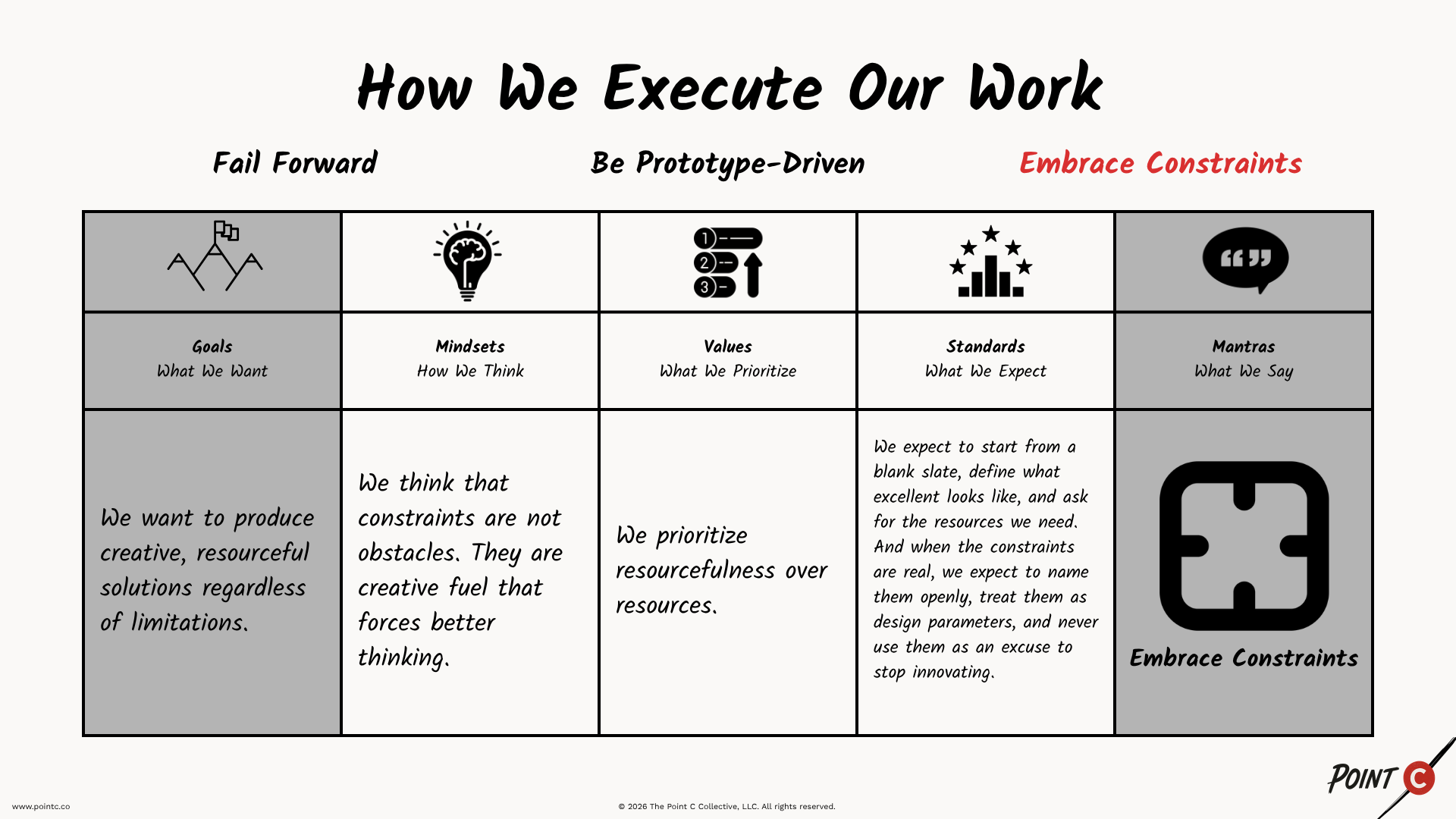
The Mantra Ladder
Here's the full Mantra Ladder for Embrace Constraints. The rest of this post unpacks it.
Goal (What We Want): We want to produce creative, resourceful solutions regardless of limitations.
Mindset (How We Think): We think that constraints are not obstacles. They are creative fuel that forces better thinking.
Value (What We Prioritize): We prioritize resourcefulness over resources.
Standard (What We Expect): We expect to start from a blank slate, define what excellent looks like, and ask for the resources we need. And when the constraints are real, we expect to name them openly, treat them as design parameters, and never use them as an excuse to stop innovating.
Mantra (What We Say): Embrace Constraints.
Start With A Blank Slate
Harvard Business School professor Howard Stevenson defined entrepreneurship as the pursuit of opportunity without regard to the resources currently controlled. I come back to that definition constantly in my teaching and coaching. It is one of the most important ideas I know.
Without regard to the resources currently controlled. That is not a scarcity mindset. It is the opposite. It means you start with a blank slate. You envision where you want to go. You define what excellent looks like. And then you figure out how to get there. If the opportunity is compelling enough, you can attract the resources you need to make it happen, whether that means raising capital, building a team, or making the case for more investment. You don't let what you don't have today stop you from defining what's possible.
This is the first half of embracing constraints: don't start with them. Start with the vision. Start with what's excellent. Pitch for the resources you need. And then, once you understand the reality of what you're working with, design within it.
The Innovator's Job
There's a second definition that pairs with the first and completes the picture.
The job of an innovator is not to execute on a perfect plan. It is to constantly understand their top risks and to spend their limited time and limited resources reducing those risks.
The entrepreneur says: don't be limited by what you have. The innovator says: be intentional about how you spend what you have. One is about defining the opportunity. The other is about executing within it. Embrace Constraints lives at the intersection.
This is where I see people get stuck. They hear "embrace constraints" and think it means accept less. Lower your expectations. Make do. That is not what this mantra means. Embracing constraints means naming your limitations openly and treating them as design parameters. You don't pretend they don't exist. You don't complain about them. And you don't use them as an excuse to stop innovating. You design within them.
I coached a leader recently on exactly this tension. One of her direct reports kept comparing current resources to what she'd had at a previous organization. Every piece of feedback was met with a version of "I can't do that because I don't have enough support." The coaching conversation was about making a shift: from complaining about a lack of resources to embracing constraints. The expectation wasn't "do more with less." The expectation was: these are the constraints, I'm open to any creative solution you bring, but you need to figure out how to deliver within them. That leader later summed it up well: "Working with the constraints we have is part of the job of being a leader here."
The response to limited resources should be "how might we make this work?" not "we can't do this without more."
Constraints As Creative Fuel
I used to be a television producer. And production is a masterclass in embracing constraints. Every shoot is an exercise in working with the weather you get, the light you have, the budget that's left, and the time on the clock.
I was making a film for National Geographic and directing a scene where a helicopter had to land on a dusty trail to rescue a biker who had been attacked by a mountain lion. The dust was blowing everywhere, getting in the way of the shot. And we were racing against the clock because we were losing the magic hour, that narrow window of golden light that is necessary for beautiful cinematography. Once that light is gone, it's gone. There was no budget for a reshoot. There was no option to come back tomorrow. We had to figure it out with what we had, in the time we had. And we did.
That instinct carried into everything I've built since. When I founded Point C, I was living in Oakland with my family. I knew there were probably more opportunities in New York. But I also knew I wasn't going anywhere. My kids were in school. My life was here. And that constraint turned out to be a gift. Instead of chasing what wasn't available to me, I built something within the parameters I had. When you embrace the constraints, more things open up.
My Half Sheet exercise comes from the same instinct. A Sharpie, half a piece of paper, horizontal format. There is no room for hand-waving or abstraction in that format. You have to distill an idea to its essence and make it tangible. The constraints force clarity in a way that a blank PowerPoint deck with unlimited slides never does.
Time-Box It
One of the most practical ways to embrace constraints is to put a timer on it.
In my venture design work, I use a Time Timer, a visual countdown clock that sits in front of the room so everyone can see the constraints they're working against.
When I run the Understand phase of the venture design process, the goal is not to become an expert on the topic. The goal is to figure out what you can in 45 minutes and then share what you learned with the team. We don't know what we'll come up with. But we know we'll have pushed something forward concretely in the next 45 minutes. So let's see what we can do.
That same principle applies to prototyping. As I wrote in Be Prototype-Driven: "We embrace constraints to quickly get the answer to our core question. For example, we could put 45 minutes on a Time Timer and limit ourselves to only using materials we have on hand to build our first prototype. These constraints help prioritize our thinking, and the unfinished nature of the prototype actually invites users to fill in the gaps with us."
Time-boxing works because it removes the option of perfection. You can't overthink when the clock is running. You can't wait for more information. You can't polish endlessly. You have to prioritize. You have to decide what matters most right now. And you have to ship something. We all know deadlines matter. A perfectionist mindset without a deadline never forces the hard choices. Constraints do. They are a forcing function for deeper thought, not shallower thought.
This connects directly to Make Tradeoffs Explicit. When time is limited, you have to force-rank. When budget is limited, you have to force-rank. The constraint is what makes the tradeoff conversation real instead of theoretical.
The Lily Pad
Sometimes your Point C is too big for your current constraints. You've defined excellence. You've pitched for the resources you need. And you still can't get there in one leap. The budget isn't there. The team isn't there. The market isn't ready.
This is where constraints do some of their most important work. Because a smaller, fundable lily pad along the way may be exactly what points you to the real next Point C. You build something within your constraints that proves the concept, generates the signal, and earns you the right to ask for more. That is not lowering the bar. That is being strategic about the path.
Constraints drive a hyper-focus on what matters most. They force you to ask: if I can only do one thing right now, what is the one thing that will teach me the most or move me the furthest? That question, born from constraint, often produces sharper thinking than unlimited resources ever would. Because when everything is available, nothing is urgent. And when nothing is urgent, nothing gets the depth of attention it deserves.
The entrepreneurs I admire most are not the ones who had everything they needed from day one. They are the ones who defined a compelling opportunity, built a lily pad with what they had, proved the signal, and then attracted the resources to take the next leap. That is the cycle. Define, build, prove, attract. And constraints are what keep the cycle moving.
The Standard This Sets
We expect to start from a blank slate and define what excellent looks like. We expect to pitch for the resources we need to get there. And when the constraints are real, we expect to name them openly, treat them as design parameters, and bring creative solutions instead of excuses.
The default on this team when resources are limited is not "we can't." It's "how might we make this work?" We hire resourceful people who have done a lot with a little. And we let go of people who use constraints as reasons to stop delivering.
But this standard goes both ways. We also don't accept "just figure it out" as leadership. If your team needs resources and you have the ability to fight for them, fight for them. Embracing constraints does not mean leadership gets to underfund a team and expect miracles. It means the whole organization, leaders and teams alike, names constraints honestly, makes tradeoffs explicitly, and focuses on what matters most with whatever they have.
Where on your team are constraints being treated as dead ends instead of design parameters? Where are people waiting for resources they may never get instead of building with what they have? And where are leaders failing to fight for resources their teams actually need? That's where this mantra needs to go to work.
Your Challenge This Week
Pick a project that feels stuck. One where the team is waiting for more resources, more clarity, or more time before they can move forward. Put 45 minutes on the clock. Name the constraints out loud: here is what we don't have, here is what we can't change, here is what we're working with. And then ask: given these constraints, what is the smallest lily pad we can build right now that will teach us something or move us forward?
Don't aim for perfect. Aim for concrete. See what happens when you stop waiting for ideal conditions and start building within the ones you have.
Next Week
We've gone deep on eight mantras across my Mantra Dashboard. From knowing your Point C to aligning on quality, from empowering others to embracing the constraints that make your work sharper. But there's a pattern that undermines all of it. It happens when feedback, frustration, or conflict gets routed around the person who needs to hear it instead of to them directly.
Next week: Talk To People, Not About People.
Know someone who would find this useful? Forward this email to them. They can subscribe here to get their own weekly half sheet.
About This Newsletter
The Idea Bucket is a weekly newsletter and archive featuring one visual framework, supporting one act of leadership, that brings you one step closer to building a culture of innovation.
It’s written by Corey Ford — executive coach, strategic advisor, and founder of Point C, where he helps founders, CEOs, and executives clarify their visions, lead cultures of innovation, and navigate their next leadership chapters.
Want 1:1 executive coaching on this framework or others? Book your first coaching session. It's on me.