Design Your All-Hands
A template to turn your company-wide meeting into organizational alignment

Was this forwarded to you? Subscribe here to get one leadership framework per week.
It's the monthly all-hands. You've got ninety minutes, a deck, and the whole company on Zoom. You open with the quarter's numbers. Then each department head takes a turn: here's what we shipped, here's what's next, here's a chart going up and to the right. You're twenty minutes in when you notice that about a third of the cameras are off. The people whose cameras are on have that look, the one where they're reading something else. Over in Slack, a side thread is moving faster than the meeting: a joke about one of the slides, a reaction, a question someone would never ask out loud, boosted by a thumbs up by someone else who's also not listening. By the time you get to "any questions?" there are six minutes left. Two people ask. They're the two people who always ask. Everyone drops, and the company goes back to work exactly as it was before the meeting started.
If you asked anyone afterward, they'd tell you the meeting was fine. That's the tell. An all-hands that nobody designed produces a meeting that nobody minds but nobody needs, and the cost doesn't show up in the room. It shows up in the weeks between. Engineering knows what engineering is doing. Sales knows what sales is doing. Each team settles into its own identity, its own version of the strategy, and its own idea of what matters, and the one meeting that could have pulled them back into a single story spent its ninety minutes reading them a list.
This is the third post in a series about a leader's moments of impact: the few recurring moments where what you do carries much further than anything else in your week, because of who is in the room. I've written about the executive team meeting, where you build the team, and the one-on-one, where you build the person. This is the third, and it's the one with the whole organization in it. It's the only moment on your calendar where every person you lead hears the same thing at the same time, which makes it the only moment built for bridging the islands: making sure everyone knows the vision, knows the strategy, and knows the piece of it they hold. Every other meeting you run can be excellent and still leave the organization in silos.
A Giant Design Review
Every meeting has a default mode: the way people will show up if you don't choose one for them. In Design The Meeting I named some of the choices: to inform, to debate, to listen and iterate, to partner, to negotiate, to advocate, and there are more. The meeting at the top of this post is in inform mode. Nobody picked it. It's what an all-hands turns into when the leader treats it as a broadcast: a round of updates aimed at the room, where each presenter is making the case that their team has been busy. It's job justification with a bigger audience, and the cameras go off because the audience can tell.
You might be thinking that an all-hands is a broadcast by nature. The room is too big for anything else, and a good part of the ninety minutes is going to be one person talking to everyone. That's true, and it's also true of a design review. For the first ten minutes of a design review, someone stands up and presents, and nobody would call its mode "inform," because everyone in the room knows what the presentation is for: it's the setup for the part where the room makes the work better. That's the all-hands I'd design. The leader and a few others present, and then the whole company, in small groups, responds. The presentation is the broadcast. The response is the review. The default mode is listen and iterate, and the whole organization is the reviewer.
That design also solves the cameras. When people know they'll soon be in a room of five, asked what they liked, what they wished, and what they'd do, they show up differently. They pay attention, because they have a role to play that isn't "audience."
One more thing, because leaders worry about it. You're going to say the same things in this meeting that you said last month, and that you say in your team meeting, and in your one-on-ones. Good. Being repetitive is part of leadership, in every room. Leaders are the signal generators of culture, and a signal only becomes a frequency when it's sent again and again. The all-hands is where the whole organization is tuned to it at once.
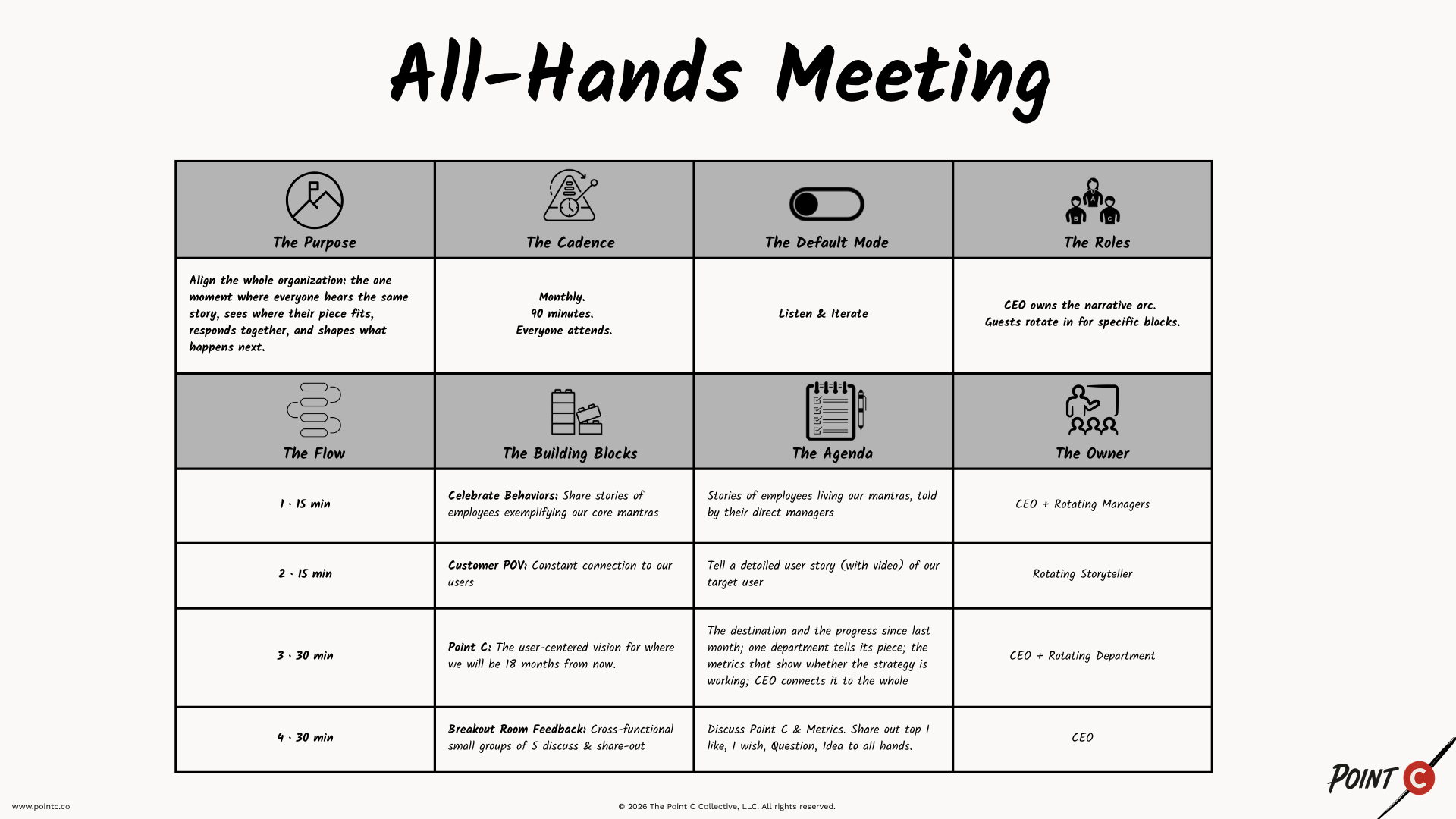
One Way To Design It
Any meeting you design comes down to seven decisions, and I'll walk through how I'd answer them for an all-hands. There's no right way to do this; there are many excellent all-hands that look nothing like mine. The wrong way is not to design it. What follows is one version, so you can see the shape and build your own.
1. Purpose: What are we here to do that we can't do anywhere else?
Align the whole organization: the one moment where everyone hears the same story, sees where their piece fits, responds together, and shapes what happens next.
Most of what tends to fill an all-hands belongs somewhere else. Status updates belong wherever your teams already share them. Decisions belong in the executive team meeting. Development belongs in the one-on-one. What's left is the thing only this room can do: put the whole picture in front of the whole company, let each person see their place in it and connect the dots, and let them improve upon it.
2. Default Mode: How do I want us to show up?
Listen and iterate, built on a broadcast. Parts of the meeting exist to inform, and that's fine. In an inform all-hands, the slides are the meeting. In a listen and iterate all-hands, the slides are the setup, and the meeting is what the organization says back.
3. Building Blocks: What happens inside the meeting?
A meeting is a bunch of mini meetings, and each one has a job. In my version there are four, and together they tell one story: who we are, who we serve, where we're going and how we'll know we're getting there, and how you'd improve it.
The "Celebrate Behaviors" block
The Job: Show what gets celebrated here, in front of everyone.
My Answer: Imagine one of your mantras is Fail Forward. Somewhere in the company this month, a team lived it. They ran a two-week test on a feature they'd been excited about, the test came back flat, and instead of quietly shipping it anyway, they killed it and wrote up what they'd learned for everyone. Their manager saw it happen. So in the first block of the all-hands, that manager gets up and tells it: here's what they did, here's the mantra it reflects, and here's why it mattered. The leader celebrates too, and should. But the manager who was there tells the story, and a different manager tells one each month, so over a year every team has been seen.
That's Celebrate Behaviors, Not Just Outcomes at the scale of the company. A mantra on the wall is a claim about who we are. A story told in front of everyone is the evidence.
The "Customer POV" block
The Job: Keep the whole organization connected to the people it serves.
My Answer: One detailed story of one real user, with video wherever you can get it. A person, a situation, what they were trying to do, and what happened. Not a dashboard of customer metrics. Rotate who tells it on purpose, because nothing changes how someone does their job like having to tell a user's story to the whole company.
The "Point C" block
The Job: Say where we're going, show every team the part of it they're building, and show whether we're getting there.
My Answer: The leader opens by restating the Point C, the user-centered picture of where we'll be eighteen months from now, and the progress since last month. Most months the destination is the same and the story is further along. Some months what you've learned moves the destination, and when it does, say so and say why. Either way, everyone leaves knowing what we're tacking toward.
Then one team tells its part of the story. This isn't the department update from the meeting at the top of this post, a look back at what they shipped. It's a look forward: here's the piece of Point C we're building, here's where it stands, here's what's hard about it. This month it's product, next month sales, then operations. The leader closes by connecting that piece back to the whole, so the company sees not just the destination but the map, and who's building which road. Over a year, everyone has seen every part and knows how the parts fit.
The numbers live here too. Whoever owns the metrics takes a few minutes to share the ones that tell you whether the strategy is working, or not working, and why. End on the two lines that make it theirs: this is where we're going, and this is how you can contribute.
The "Breakout Room Feedback" block
The Job: Turn the whole organization into the reviewer.
My Answer: Everything before this was the presentation, and people should know that from the first minute: tell them at the top that in an hour they'll be asked what they think. Now break the company into cross-functional groups of five, mixed on purpose so no group is one team talking to itself, and give each group the same four prompts on what they just heard: I like, I wish, a question, an idea. Then a share-out. Small groups are how you make space for every voice when there are too many for one room. The person who would never unmute in front of the company will say exactly what they think to four colleagues.
Your job in this block is to listen, not to respond to each point, defend the plan, or fix anything in the room. Then, at the next all-hands, close the loop on what you heard and what you did with it, because that's how the organization learns you were listening.
4. Flow: What order does it go in?
Celebration first, because opening with people doing the right thing says what this organization values before anyone says a word about strategy. Then the customer, then Point C, and the breakouts last, so the organization reviews the whole story rather than a piece of it.
5. Cadence: How often, and for how long?
Monthly, for ninety minutes, and everyone attends. Monthly keeps the stories current and still makes each one an event. Ninety minutes is what the four blocks add up to: fifteen for celebration, fifteen for the customer, thirty for Point C, and thirty for the breakouts. If you need to make it shorter, shorten the presentation. Don't shorten the breakouts, because they're the block that makes it a review at all.
6. Roles: Who owns what?
The leader owns the narrative arc. The four blocks have to add up to one story, and making sure they do, from the first behavior celebrated to the loop closed on last month's feedback, is the leader's job. Guests rotate in for specific blocks: managers tell the behavior stories, someone different tells the customer's story each month, a different department tells its piece of Point C, and whoever owns the metrics brings them. One owner for the meeting, one for each block, and the leader designs the room without running every minute of it.
7. Agenda: What are we talking about today?
This one is last, and it's shaped by what you most want to push the organization on this month: which behaviors get celebrated and who tells each story, which customer, which department tells its piece of Point C and which metrics moved, and what you heard in last month's breakouts that you're closing the loop on today.
Your Challenge This Week
Before you build a single slide for your next all-hands, run it through the seven questions:
1. Purpose. Write it in one sentence. If it reads like a list of departments, try again.
2. Default Mode. Name the mode you want. Then think back to your last all-hands and count the minutes when anyone other than a presenter was talking.
3. Building Blocks. What are the jobs this meeting has to do for the whole organization? Give each one a block. Borrow mine or write your own.
4. Flow. Put the block that shows what you value first, and the block where the organization talks back last.
5. Cadence. Let the blocks set the length, not the calendar.
6. Roles. Name the owner of the arc and the owner of every block. If you own all of them, you've designed a speech.
7. Agenda. Fill it in last.
Then run it.
Next Week
All three moments of impact now have a design. Underneath each of them sit the two ladders this series started with: the Mantra Ladder, which takes a goal to the words your team says, and the Ritual Ladder, which takes those words to the practices your team repeats. The two share a rung, and that shared rung is the reason to put them together. A mantra with no ritual behind it is a slogan. A ritual with no mantra inside it is a habit nobody can explain. Put them end to end and you get one system, nine rungs from a goal to a meeting on your calendar, and every time the ritual runs, the mantra gets more real and the goal gets closer. Next week I draw the whole thing in one picture: The Subculture Flywheel.
Know someone who would find this useful? Forward this email to them. They can subscribe here to get their own weekly half sheet.
About This Newsletter
The Idea Bucket is a weekly newsletter and archive featuring one visual framework, supporting one act of leadership, that brings you one step closer to building a culture of innovation.
It’s written by Corey Ford — executive coach, strategic advisor, and founder of Point C, where he helps founders, CEOs, and executives clarify their visions, lead cultures of innovation, and navigate their next leadership chapters.
Want 1:1 executive coaching on this framework or others? Book your first coaching session. It's on me.