The Design Review
A ritual to ensure teams fail fast to get feedback and succeed sooner

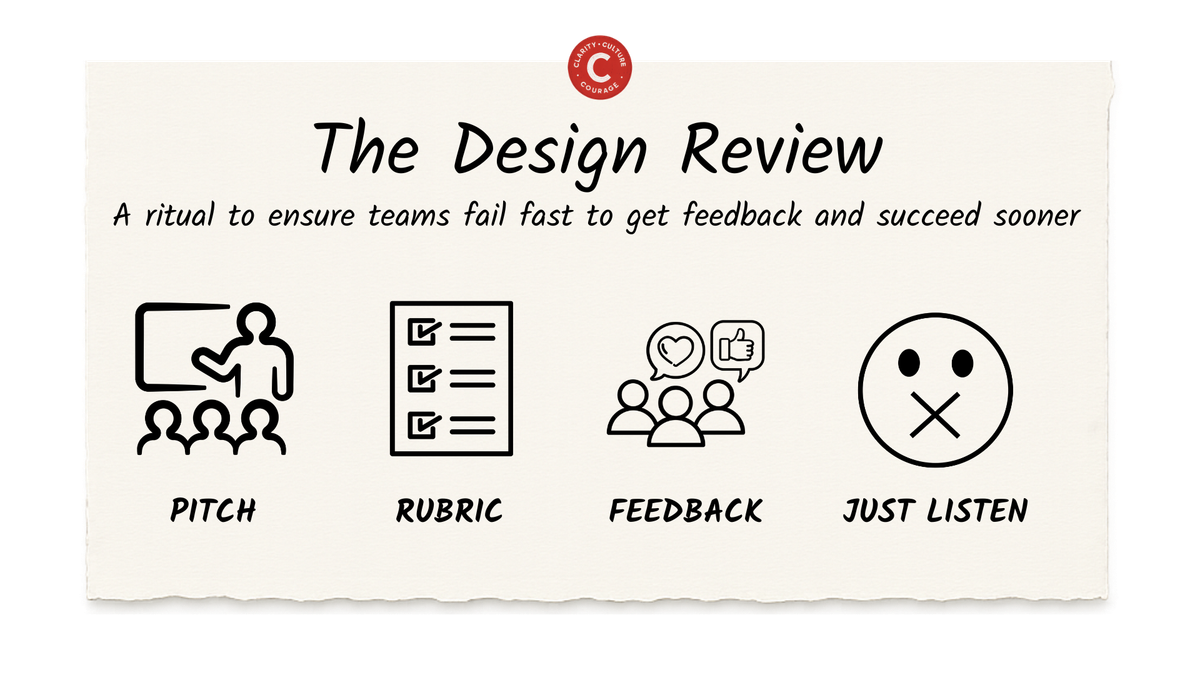
Welcome back to The Idea Bucket.
This week’s post is about one of the most powerful tools a leader can embed in their culture.
Because your job isn’t just to review decisions — it’s to build rhythms that hold high standards and high psychological safety at the same time.
Rhythms where your team sharpens its own thinking long before you need to step in.
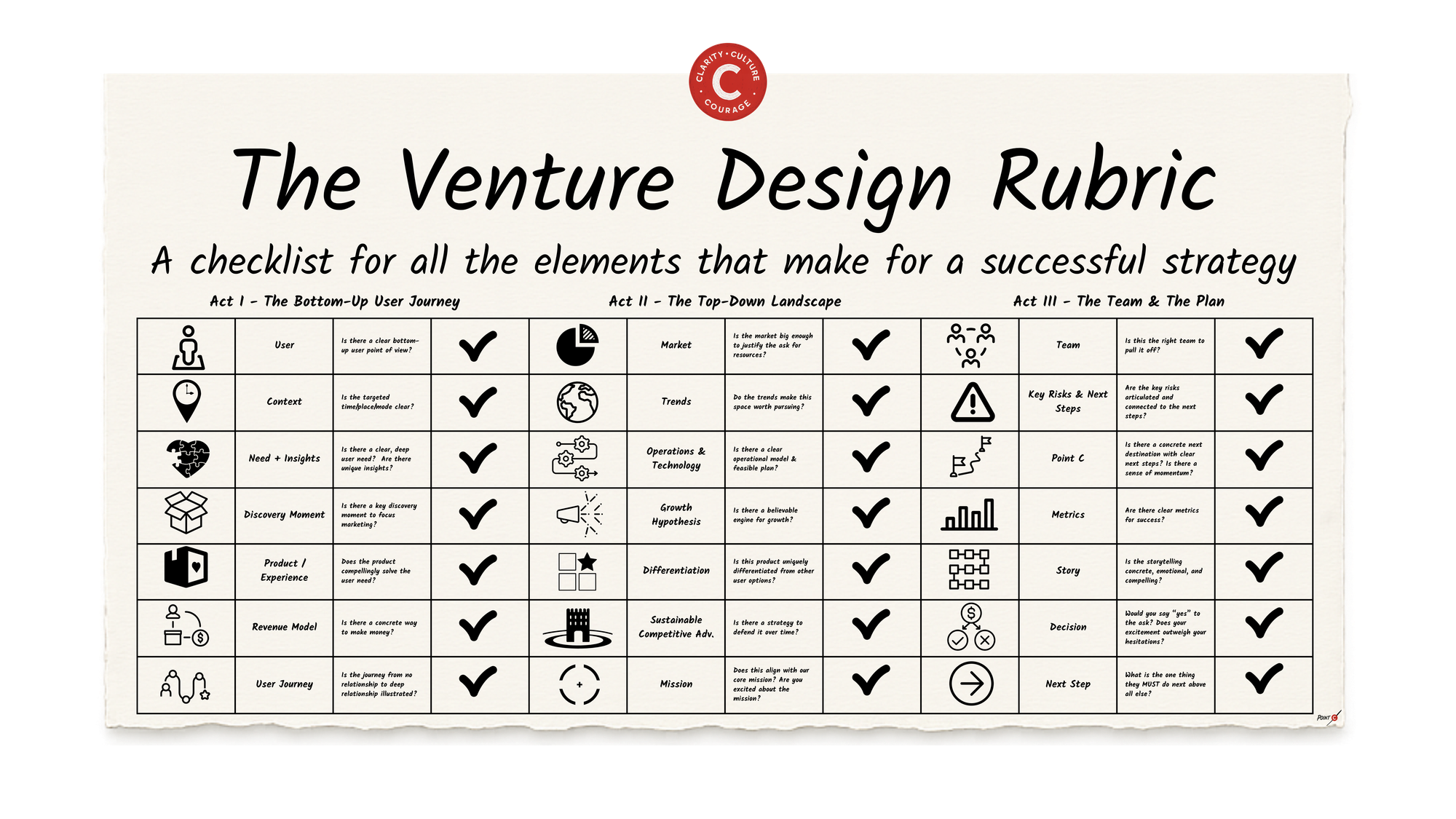
In last week’s post, we built The Rubric — your team’s shared definition of “great.” But writing it down isn’t enough.
The hardest part of leadership isn’t setting standards. It’s creating the rhythms that reinforce them in a way that creates a psychologically safe space that gets the best out of each member of your team — so your team gets sharper, faster, and more self-correcting with every iteration.
Without a ritual, your rubric is just a poster on the wall.
The real question is:
How do you create a ritual to ensure teams can experiment, fail fast, and get feedback based on high standards so they can succeed sooner?
That’s where this week’s framework comes in.
Introducing: The Design Review
When I was building the Runway program at Innovation Endeavors, and later the accelerator at Matter, I found myself a stop on a kind of whistle-stop tour of innovation that leaders from around the world embarked on. Everyone was asking the same question:
"What’s the secret behind how innovation works in Silicon Valley?"
I gave the same answer every time:
If you want to innovate, you need to ask yourself one question:
What does failure look like in my organization?
In most companies, failure is something to be avoided at all costs — career-ending, reputation-threatening, politically dangerous. But in the best innovation cultures, failure isn’t avoided. It’s built into the operating system. It’s how teams learn.
Because real innovation doesn’t follow a perfect plan. It follows the drunken walk of the innovator — focusing and flaring your way toward something that’s desirable, feasible, and viable. That path only works if your teams have permission — and pressure — to experiment, learn, and adjust.
Which means: you don’t just need high standards. You need rituals that turn failing forward into muscle memory.
That’s the job of The Design Review.
What Is The Design Review?
The Design Review is a recurring ritual where teams present their current strategy in-progress, receive structured, non-defensive feedback, and surface key risks, gaps, and tradeoffs while it's still early enough to adjust.
It’s not pitch practice. It’s not final presentation day. It’s a safe learning loop built into the rhythm of real work.
Done well, it teaches teams to fail fast, absorb feedback, and improve their strategy while momentum is still on their side.
The Purpose of The Design Review
The Design Review exists to create safe failure loops inside the team.
It pushes teams to bring their work forward before they’re ready. It shortens the distance between action and learning. It surfaces the hard questions while there’s still time to adjust — before people get too attached to any one solution.
You are not optimizing for perfection. You’re optimizing for learning clarity — revealing what’s working, what’s unclear, and what’s missing.
The Design Review Is Leadership Leverage In Action
As a leader, your job isn’t to review every decision yourself. It’s to build the operating system where teams sharpen their own thinking.
The Design Review gives you a way to build this directly into your culture — without having to personally catch every gap. Over time, your team develops its own strategic lens, sees risks sooner, and learns to course-correct faster — without waiting for you to step in.
That’s why, as you’ll see below, the leader should always give feedback last. Your job is to build a team that surfaces the right risks before you ever need to name them. That's a learning culture that builds future leaders one design review at a time.
The Cadence
The Design Review works best when teams are doing real work with real stakes.
At Sulzberger, these are high-priority strategic projects for their companies. At Matter, they were new ventures that founders were preparing for funding.
The cadence matters.
I like 20-week programs, with Design Reviews roughly every four to six weeks. That gives teams enough time to make meaningful progress, but not enough time to get too attached.
For executive teams, you can turn your weekly executive team meeting — your most high-leverage ritual — into a regular, mini-Design Review. As part of the standard agenda, one leader presents the latest prototype of their current strategy and thinking, while the others provide structured feedback. Not as blockers — we trust that executive to listen and make the hard decisions — but as a way to ensure the free flow of information, surface unknown unknowns, uncover coordination points, and get unstuck. (We did this inside my own executive team every week.)
The key is constant forward pressure. Teams know when the next Design Review is coming — and that pushes them to take risks, not hide behind polish.
Three Ways to Set It Up
There isn’t one perfect format. You have options depending on your context:
1. The "Fresh Eyes" External Panel (The Matter Model)
Bring in a rotating group of external advisors to serve as the main feedback panel. They see the strategy with fresh eyes for the first time. The other participants (the cohort) sit in the audience and provide non-verbal feedback, but aren’t the main voices.
This keeps the stakes high and brings fresh eyes to each pitch.
2. The "We're In This Together" Peer Feedback Model (The Sulzberger Model)
Everyone is both presenter and reviewer. You give feedback because you’re in the arena yourself.
This builds empathy. It also creates a shared accountability — you know you’ll be on the hot seat too.
3. The "C-Suite" Hybrid Panel (The Corporate Model)
For companies, I often mix both. You have the full cohort of teams presenting and giving each other feedback — but you also include a dedicated panel of key stakeholders (often the C-suite) who give primary feedback.
This creates a learning moment for everyone: the teams get direct exposure to how senior leadership thinks, and the leadership gets to align in real time. Often, you surface misalignments between senior leaders that weren’t obvious before — which becomes its own powerful learning loop for the org.
The Facilitator’s Real Job
The facilitator matters more than people realize.
Yes, you keep the train moving.
Yes, you enforce the time.
Yes, you hold the norms.
But your real job is to be the signal generator of culture.
Your job is to make sure the room hears, over and over again, what this ritual is for:
“Our goal is failure.”
We are here to fail fast, so we can learn fast, so we can succeed sooner.
You need to say it so many times that people start making fun of how often you say it. That’s when you know it’s sinking in.
(I’ll have more to say on being a signal generator — and how leadership mantras reinforce culture — in future posts.)
How A Design Review Actually Works
1. The Setup
Each team gets 30 minutes. The setup is simple: a facilitator, a Time Timer, The Rubric written on a big whiteboard, rubric worksheets handed out for written scoring, a space to present with a projection of the slides, an audience and/or feedback panel.
3. The Setting of Norms
The facilitator always has to set the norms:
"Our purpose is to fail fast. You’re about to see pitches that aren’t fully ready. But these teams know that success involves getting feedback early on half-baked strategies. So we should expect rough, unfinished presentations and we should reward risk-taking. I'd rather see someone spectacularly fall on their face testing something new than hide behind a polished yet safe deck they've pitched before. This takes courage and we are going to honor that courage by listening intently and giving our full unvarnished feedback so they can succeed."
3. The Presentation
The team presents their strategy for 10-15 minutes. No interruptions. Everyone listens. The team knows ahead of time they’ll be evaluated using The Rubric — it’s fully visible the entire time.
4. The Instant Feedback Loop
After the pitch, the facilitator reads each rubric question one by one. For each question, the audience responds in real-time:
Two hands up: Strong Yes
One hand up: Lean Yes
No hands: Lean No
Arms crossed: Strong No
In under 90 seconds, you get an immediate visual map of where the strategy feels strong — and where the holes are. The presenter often takes a video on their phone so they can be fully present in their listening and review it afterward.
5. The Feedback Session
Now the audience (or panel) provides verbal feedback. A gigantic Time Timer lets everyone know how much time is left so they can self-regulate how much they talk.
Here’s the critical rule:
The presenter can only listen.
They take notes or record on their phone.
They don’t answer questions.
They don’t defend.
They don’t explain.
They are only allowed to say two words: “Thank you.”
6. The Leader Goes Last
This is a leadership diagnostic as much as a feedback session. Your job is to listen for whether your team is already seeing — and naming — the right risks before you speak. If you consistently hear your team raising the right issues before you do, that’s not redundancy. That’s leadership leverage. That’s how you build future leaders.
Why The "Thank You" Norm Matters
This isn’t pitch practice. This is the testing of strategy prototypes. The pitch is simply the fastest way to expose the current state of the strategy.
The goal is to expose how the audience is processing the story — what’s clear, what’s confusing, and what questions they’d still leave the room with. If an audience member had to run straight to their next meeting the moment the pitch ended, I want to give the presenter access to what is going on in their mind. Are they more excited or hesitant? What's the key unanswered question? What left them confused?
They won’t implement all the feedback. They’ll hear conflicting views. That’s expected. The discipline is to listen fully, take it all in, and then make the next hard call.
This norm only works if you hold one cultural truth above all:
Feedback is a gift. It is not a demand.
You’re creating a system where information flows freely, and trust the team to sort it. (More on this mantra in a future post.)
Between Design Reviews
Between design reviews, teams work on their strategies. They’re not re-polishing the same safe story. They’re pushing forward.
The question after every Design Review is simple:
What did you learn?
Did you test something?
Did you discover a new risk?
Did you reveal an unknown unknown?
In deciding what to pitch at a design review, think about the choices you need to make. Are you debating between Path A and Path B? Great! Pick one. Pitch it hard.
You’ll get sharper feedback — and move faster — if you stay concrete. You can always change your mind the next day. It's just a prototype!
The Design Review is the Manifestation of High Standards + Psychological Safety
It’s one of the purest expressions of innovation culture I know:
High standards.
Safe failure.
Clear norms.
Tight cadences.
Cultural reinforcement.
You don’t build high-performing innovation teams by hoping they’ll learn to do this on their own. You build it by giving them the ritual that trains this muscle.
Your Challenge This Week
Run a mini-Design Review.
Turn your next weekly team meeting into a place where your team members can share their imperfect strategy prototypes, get feedback, and fail fast.
Carve out at least 30 minutes in the agenda for one team member this week. (Include more team members if you have the time, otherwise, have them present the following week.). Have them prepare a pitch. Share The Rubric with your team ahead of time.
Run the full ritual:
- 10-15 minute pitch
- Written scoring using the rubric
- Instant feedback loop through hand raising
- Verbal feedback while the presenter listens and takes notes
- The presenter only says “Thank you”
- Reinforce that feedback is a gift and not a demand. We trust the presenter to listen to all feedback and to decide what to implement and what to ignore for now.
Check in with everyone about how that felt.
And once you’ve tried it, I’d love to hear what surfaced. Reply to this email, comment below, or reach out at theideabucket@pointc.co to share what surfaced for your team — I read every one.
Next Week
Now that you know how the ritual works, the next question is:
How do you best prepare your story for a Design Review?
Next week, I’ll share The Venture Story — a pitch template to help your team structure their strategy in a way that answers the hard questions and delivers it through a clear, narrative lens your audience can absorb.
About This Newsletter
The Idea Bucket is a weekly newsletter and archive featuring one visual framework, supporting one act of leadership, that brings you one step closer to building a culture of innovation.
It’s written by Corey Ford — executive coach, strategic advisor, and founder of Point C, where he helps founders, CEOs, and executives clarify their visions, lead cultures of innovation, and navigate their next leadership chapters.
Want to give your teams an immersive learning experience on these concepts? Bring me in to run The Point C Training Camp at our company. Want 1:1 executive coaching on this framework or others? Book your first coaching session. It's on me.