The VAK Checklist
A way to engage different learning styles for maximum impact


Was this forwarded to you? Subscribe here to get one leadership framework per week.
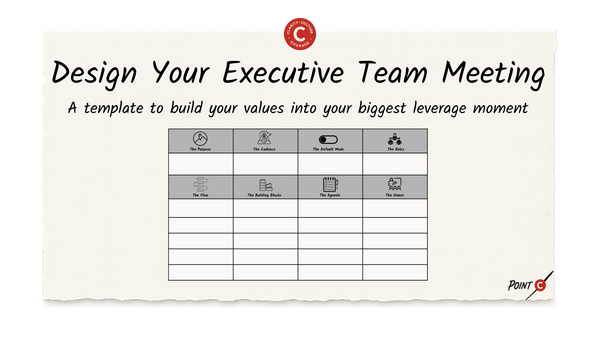
Every meeting, class, and presentation you run has design choices, whether you know it or not. Over the past few weeks I've been writing about those choices: how to design your executive team meeting, the gut check I run on every meeting before I walk in, and why fast-moving teams have to slow down on the foundation if they want the speed to last.
This week is a second gut check, and it comes from the teaching side of me. The first one asks whether the room is set up to balance the relationships and the process to achieve the task. This one asks whether what happens in the room actually lands for everyone in it.
Years ago I spent a brief stint at Jump Associates, a strategy and innovation firm the Wall Street Journal had named one of the best small workplaces in the country. They went slow to go fast on new hires. Onboarding ran two full weeks, with personality tests, norms, and process before anyone touched client work. It was designed by the late Sarah Singer-Nourie, and it showed a company that took its own culture seriously.
One of those two weeks included a short test called VAK, which scored how much you lean on each of three ways of taking in information. Visual: you need to see it, on a slide, a wall, or a page. Auditory: you need to hear it, in a story, a conversation, or an explanation. Kinesthetic: you need to move, do, build, or feel the energy in the room.
I learned later that the research behind sorting people into learning types is contested, and I'm not going to pretend otherwise. But the idea stuck with me, and I still use it in the classes I teach and the retreats I design. Not to label anyone. Every room has people who lean each way, and most rooms are designed for only one of them, usually whichever one the person running the room leans on. The work lands hardest when you bring all three together, because each one reinforces the other two.
The checklist is: Visual, Auditory, Kinesthetic.
Auditory Is The Default
Most meetings are purely auditory. Someone talks, everyone else listens, and the only record is whatever each person retained. That works for some people. For a lot of others it doesn't, and you'll never know, because they'll nod along and leave with a different version of the meeting than you had.
The fix isn't less talking. It's talking that gives people something to picture, then a visual to anchor it and a reason to move.
The way you give people something to picture is a character-driven narrative: the story of one specific person. This is the principle underneath The Venture Story. You don't explain a complex topic. You tell the story of one person and let the topic reveal itself. You take your audience into a concrete moment in that person's life, the time of day, the place they're standing, the frustration in front of them, and only then do you zoom out. You have to earn the right to go abstract.
The pitch I show in class to teach this opens with one woman in rural India, a mother of four with no electricity. Only after you know her does it mention the 1.6 billion people living the same way. By the time the number arrives, it has a face. A number is information. A person in her kitchen is something the room can picture, and the slide behind you only has to show her.
Visual Is The Reference Point
When I teach people to present, the rules are simple. One idea per slide. As little text as possible, because if people are reading they aren't listening to you. And build a presentable deck, not a sendable one. Those are two different jobs, and one deck can't do both.
Most meetings do have a deck. The trouble is that it's usually a sendable deck being presented: dense slides, read aloud, that nobody can take in while they're also listening. The visual a meeting actually needs is simpler. In almost every room I facilitate, I write the agenda on a 3M pad and stick it to the wall, with the goal for the day next to it, and a Time Timer on the table so everyone can see how much of the block is left. It's a map and a clock. At any moment, people can look up and know where we are, what's left, and what we're trying to walk out with. When the conversation drifts, I don't have to argue it back. I point.
The same idea works one-on-one. A leader I coach has a boss who runs almost entirely by ear. He thinks out loud, goes with his gut, and decides. A week later the decision is gone and the priorities have been rearranged again, not because he intentionally changed his mind but because nothing was ever stored anywhere. Taking the world in by ear had served him well. It had also let him live in the abstract and the ethereal, in conversations that could go anywhere and didn't have to land. He didn't need a better conversation. He needed to be grounded in the concrete, visual world.
So I told my coachee: bring a visual, consistent dashboard of the goals, the current experiment, and what we're trying to learn, to every single interaction. The same page, every time. When the boss jumps to the next thing, turn back to the page and ask: if we do that, what does it shift? It's okay to change it. We're just not going to change it in a vacuum. The page became the thing they consistently returned to, which a conversation could never be for him.
Kinesthetic Starts With The Room
Movement is the third mode, and it's the one that gets designed for least. People have bodies in the room. Their energy rises and falls, and you can feel it drop after lunch or an hour into a dense session. The usual response is to push through. Don't. Notice the energy and design for it, starting with the room itself.
At a two-day retreat I ran this summer for a large company, day one was in a windowless room with the tables spread far apart, some people sitting behind other people. By the end of the day the energy was off. Day two was in a new room with great windows, but the tables were laid out exactly the same way. I wanted a semicircle, so that nobody was behind anyone else and everyone was in the front row, turned toward each other.
So I started moving tables. The facilities team ran over to tell me they could call for help, and that they weren't sure why I'd want the tables anywhere other than where they always go. I said I just needed to play around with it. No job above you, no job below you is a personal mantra of mine. I rolled up my sleeves and found the semicircle.
The day went great. There was far more engagement, because nobody could hide. At the end, the facilities manager told me it was the most energetic meeting she had seen in that room, and that they were going to name the configuration and set it up that way by default. None of that would have happened if I didn't give myself permission to push some furniture around.
The room is the setup. What you do with bodies during the day is the rest of it. I design almost every exercise so that people have to move at some point. Write on stickies alone, then everyone up to put them on the wall and cluster them. Break into groups and send each group to a different corner. Walk the wall together to read what the other groups made.
The kinesthetic move that unlocks the most is building something. Prototyping is thinking with your hands. An idea in your head, or in the air of a conversation, feels complete. The moment you have to make it real and concrete, with whatever is lying around the room, you find the gaps you'd been talking past, and filling them in is where the new thinking happens.
That's why I'm so insistent on being prototype-driven, and why a design challenge sits at the center of my classes. I give people twelve minutes to build something their partner can interact with. Most don't believe they can do it at first, but everybody has something built when the Time Timer goes off. It works in a meeting too. Hand people the markers, the stickies, and the foam core, and ask them to build the thing instead of describing it.
And when the room needs a boost, I get everyone on their feet and we shake it out. Everyone stands. Count down five, four, three, two, one while shaking your right arm. Then the left arm, the left leg, the right leg, the whole body. Then run it again from four, then three, then two, then one. It takes about a minute, it's impossible to do without laughing, and it resets the mood completely. I like to do it before the final presenters on a long design review day, so the people who go last don't get the short end of the energy stick.
Your Challenge This Week
Take the next thing you're about to run, a meeting or a presentation, and check it against all three.
Visual. Is there something on the wall or the screen that the room can come back to? One idea per slide. The agenda, the goal, and the clock where everyone can see them.
Auditory. Is there a story, or only information? Does the room meet a specific person before it hears a number?
Kinesthetic. Does the room setup match what you're asking people to do? Can everyone see everyone? Is there any movement at all, or is it ninety minutes of sitting? Is there anything to build, or only things to discuss?
Then look for the mode you skipped. It's natural to design for the one you lean on yourself, and the room is full of people who lean the other way. Pick one thing from the missing mode and build it in before you walk in.
And if you're curious which way you lean, take a few minutes with a VAK self-test. When I took the one at Jump, I came out visual first, then kinesthetic, then auditory, and like any good personality test it made some things click. I started noticing when I was tuned in and when I'd tuned out, and I now knew why.
If that was true for me, it's true for the people in your meetings. You can tell who in the room is strongly auditory, and you can see just as easily who isn't. Look for it at your next meeting.
Next Week
Everything in this run of posts has been about meetings with your whole team in them: how to design the executive team meeting, how to check whether it's built for the task, the process, and the relationships, how to slow a fast team down long enough to lay the foundation, and now how to make sure what happens there lands for everyone. Next week we go to the smallest meeting on your calendar. It's the meeting where you develop the leaders around you, where relationship carries more weight than in any other, and where most leaders show up to get a status update. Next week: Design Your One-on-Ones.
Know someone who would find this useful? Forward this email to them. They can subscribe here to get their own weekly half sheet.
About This Newsletter
The Idea Bucket is a weekly newsletter and archive featuring one visual framework, supporting one act of leadership, that brings you one step closer to building a culture of innovation.
It’s written by Corey Ford — executive coach, strategic advisor, and founder of Point C, where he helps founders, CEOs, and executives clarify their visions, lead cultures of innovation, and navigate their next leadership chapters.
Want 1:1 executive coaching on this framework or others? Book your first coaching session. It's on me.