Design Your One-on-Ones
A template to turn your one-on-ones from status updates into leadership development

Was this forwarded to you? Subscribe here to get one leadership framework per week.
This run of posts started with The Ritual Ladder, the rung where a mantra becomes a practice your team repeats, and most of those practices live inside meetings. So we went there: how to design the executive team meeting, how to check it for task, process, and relationship, and last week, how to make sure what happens there lands for everyone in the room.
This week we go to the smallest meeting on your calendar. It's the meeting where you develop the leaders around you. It's the meeting where relationship carries more weight than in any other, because there are only two of you in it. And it's the meeting where most leaders get handed a status update that could have been a Slack message.
In Design The Meeting I described a leader's moments of impact, the handful of recurring moments that carry many times the leverage of the rest of the week, and named the executive team meeting as the first of them. The one-on-one is the second. The executive team meeting is where you build the team. The one-on-one is where you build the person. Leaders are leverage, and this is the hour where you decide whether the leaders around you get built on purpose or by default.
The Status Update That Isn't
Picture the one-on-one most leaders are actually having. The direct report arrives with a list. Here's what I did this week, here's what's on track, here's what's next. The leader asks a few questions, makes a few calls, and both of them leave feeling like the meeting did its job.
Listen to what the list is really saying. It's backward-looking, and it's aimed at the one person who decides whether this person keeps their job. Underneath the update is a case: I've been busy, I've been productive, you can see that, right? It's the one-on-one version of job justification. It isn't the report's fault. If you've never told them what this meeting is for, they'll assume they're being managed, and they'll show up to be managed.
What you want is the opposite direction: here's how I'm thinking about this, and I'd like your help. You only get that if you've chosen a different way to show up and said so out loud.
For a one-on-one there are really three ways a leader can show up. You can show up to manage: track the tasks, check the status, hold people accountable. You can show up to direct: here's what I need you to do and how. Or you can show up to coach: ask questions, develop their thinking, share how you would think about it, and then let them make the call and fail forward. None of the three is wrong, and there are weeks that call for each. But one of them is a default and the other two are tools, and the leaders I work with who get the most out of this hour chose coach as the default, because every bit of judgment you build in a person gets applied to every decision you're not in the room for.
The Template
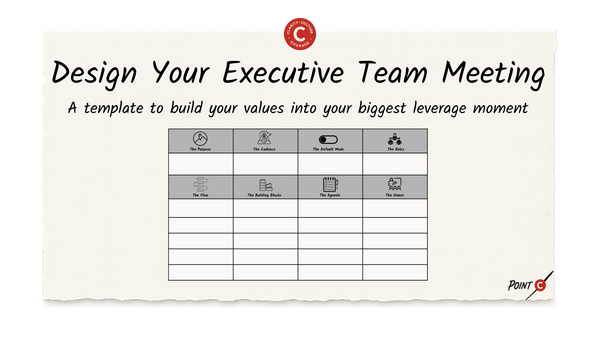
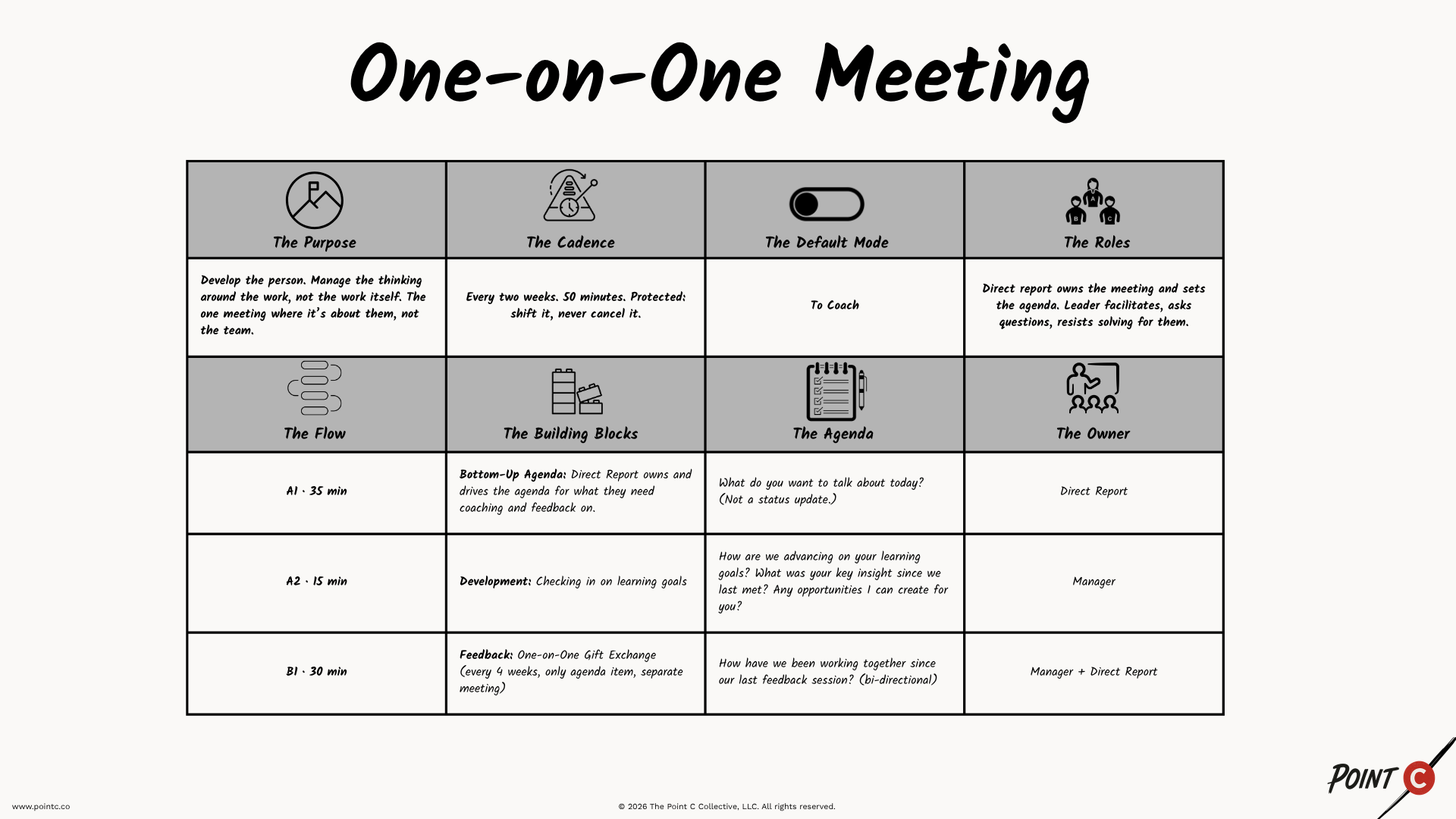
Any meeting you design comes down to seven decisions: what it's for, how people show up, what happens inside it, in what order, how often, who owns what, and what's on the agenda. In a one-on-one the answers look different from any other meeting on your calendar, because the meeting is about one person. Here's how I fill them in.
1. Purpose: What are we here to do that we can't do anywhere else?
Develop the person. Manage the thinking around the work, not the work itself. This is the one meeting where it's about them and not the team.
That line does real work, because a lot of what usually fills a one-on-one belongs somewhere else. The status update belongs in writing. The decision that touches three other lanes belongs in the team meeting, where everyone hears it once.
A leader I coached a few years ago was drowning in one-on-ones that had become a grab bag of salary questions, logistics, and the work, all at once. We split them: one meeting every two weeks for everything administrative, batched, and every other meeting about the work and the person. He told me it changed his relationship with his team. Once you've said what the meeting is for, it's clear what it isn't for.
2. Default Mode: How do I want us to show up?
To coach. You'll still talk about the work. What changes is your job in the conversation: not to check the work, but to ask how they're thinking about it and help them think better.
There's a rule that comes with this choice, and it's the hardest part for most of the leaders I work with: you can't be directive for forty minutes and then switch into coaching for the last ten. The mode is set by how the meeting opens. If the first thing out of your mouth is a question about where things stand, you've chosen manage, whatever you intended.
3. Building Blocks: What happens inside the meeting?
A meeting is a bunch of mini meetings, and each one has a job. If the purpose is to develop the person, there are three jobs to do: give them room to think out loud with you, keep their growth on the table, and keep the two of you honest with each other about how it's going. Each gets a block.
The "Bottom-Up Agenda" block
The Job: Give the direct report the room to bring what they're working through, and keep it from turning into a status update.
My Answer: They own this block, and it gets most of the meeting. It opens with one question: "What do you want to talk about today?" The answer comes from them. You ask questions, you unpack their thinking, you offer how you'd think about it. You coach, they decide. That's one consultative decision-maker per lane applied to the smallest possible room. It takes discipline not to solve it for them. Solving it may be faster this week, and it's slower every week after.
Owning the agenda comes with a standard, and it’s a high one. This is the most expensive hour on their calendar, and the question underneath every agenda they bring is whether they’re taking advantage of it: digging into the strategic and leadership questions only you can help them think through, not handing you a list, not catching up, and not using the time to stay on your good side. Tell them that’s the bar. Then tell them, as part of the feedback you trade, how well they’re using you. Most people have never been told that getting the most out of their boss is a skill, and that you’ll be watching for it.
The "Development" block
The Job: Make sure their growth is a standing item, not something that comes up at review time.
My Answer: Every direct report has a learning goal, written down, that you both know. Not a deliverable. The one or two things they're trying to get better at this year as a leader. If you don't have one for each person, that's the first conversation the redesigned meeting has. After that, fifteen minutes at every one-on-one keeps it alive. How are we advancing on it? Is there an opportunity I can create for you? And one question I'd ask every time, and expect an answer to: what was your key insight since we last met? People who know the question is coming start noticing their own learning. A learning goal nobody asks about for three months stops being a goal.
The "Feedback" block
The Job: Talk about how the two of you are working together, in both directions.
My Answer: The One-on-One Gift Exchange, every four weeks. You go first, because you're the one with more power in the room and it's on you to set the tone of vulnerability. You reflect on yourself out loud, what you like and what you wish about how you've worked with them since last time, and then they tell you what they like and wish about you, including the things that are hard to hear about how you lead. Then it flips: they reflect on themselves, and you share your feedback on them. Feedback that only flows down is a performance review. Feedback that flows both ways is a relationship. Give it its own thirty-minute meeting every four weeks rather than a slot at the end of a one-on-one, because feedback that sits last on an agenda gets pushed, every time. There are co-founders I introduced this ritual to over a decade ago who still practice it weekly.
4. Flow: What order does it go in?
Their agenda first, because it's the block that says, out loud, this hour is yours. Development second, so growth gets talked about while there's still energy in the room rather than in the last two minutes. And feedback gets its own meeting, so it never competes with either of the other two.
5. Cadence: How often, and for how long?
There's no right answer here, only a chosen one. Weekly works, and plenty of leaders I respect run it that way. My preference is every two weeks for fifty minutes, because coordination already has a home in the weekly team meeting, where everyone hears the same thing once. If that meeting is doing its job, the one-on-one doesn't have to carry it, and two weeks gives a direct report enough time to make real progress on what the two of you talked about. It's the rhythm I use with my own coaching clients, for the same reason.
Whichever you choose, protect it, and protect the feedback meeting the same way. Drag the calendar invite somewhere else in the week, but don't delete it. Time can be shifted but not cancelled, because cancelling a one-on-one is a signal, and your direct report reads it exactly the way you'd expect.
6. Roles: Who owns what?
The direct report owns the meeting and sets the agenda. You facilitate, ask questions, and resist solving for them. Those roles are the opposite of what most people expect from a meeting with their boss, so they have to be said out loud, up front, before the first redesigned one-on-one happens.
At the start of every coaching engagement I run, we don't jump into the coaching. The first conversation is about the norms of the relationship: what I do, what I don't do, and what I expect of them. Then those norms sit at the bottom of every calendar invite I send, so they're in front of both of us every time. Do the same. Something like: This meeting is yours: bring what you’re working through and want help thinking about. I’ll ask questions and tell you how I’d think about it; the decision stays with you. I expect you to bring the hardest strategic and leadership questions you have, and I’ll tell you how well you’re using this time. Every four weeks we’ll trade feedback on how we’re working together.
There's one more role to be clear about, and it's the one you don't want. A lot of leaders tell me the same thing: more and more, their direct reports arrive at the one-on-one expecting a therapist's couch. A frustration with a colleague, a conflict on the team, something that upset them this week, brought to you to be absorbed and handled.
It feels right in the moment. You're being there for them. But play it forward. You end up carrying everyone's emotional burdens. The people being talked about never hear any of it. And the team learns that the way to deal with a problem is to bring it to you instead of to each other. That's conflict avoidance with a sympathetic face, and it's the confession booth I wrote about this summer.
The question that closes it is the same one: have you talked to them about this? Coach them on how to have that conversation. Don't have it for them.
7. Agenda: What are we talking about today?
The agenda is the question that opens the meeting: what do you want to talk about today? They answer, and the meeting follows. Tell them ahead of time that you'll be asking, so they arrive with an answer. If a direct report can't think of anything they want your help with, that's worth a conversation on its own.
Your Challenge This Week
Pick one direct report and redesign their one-on-one before you next meet:
1. Purpose. Write it in one sentence. If it contains the word "update," start over.
2. Default Mode. Name the mode you want. Then look at how your last three one-on-ones opened. Whoever asked the first question set the mode.
3. Building Blocks. What are the jobs this meeting has to do for this person? Give each one a block. Steal mine or write your own.
4. Flow. Sequence them so the opening says whose meeting this is.
5. Cadence. Decide how often and how long, and then protect it.
6. Roles. Write down the norms you'll say out loud, and where they'll live afterward.
7. Agenda. Don't write one. Tell them you'll be asking for it.
Then don't throw them into it. Spend one meeting on how the two of you meet: what you're changing, why, and what you'll be asking of them. (Feel free to forward this post to them to set the context.) Then run the first redesigned one-on-one and let them feel the difference.
Next Week
Two of the three moments of impact are now designed. The third is the one where the whole organization is in the room at once, where most leaders show up to inform and few show up to listen, and where the mantras you've been building either get celebrated in front of everyone or stay on the wall. Next week: Design Your All-Hands.
Know someone who would find this useful? Forward this email to them. They can subscribe here to get their own weekly half sheet.
About This Newsletter
The Idea Bucket is a weekly newsletter and archive featuring one visual framework, supporting one act of leadership, that brings you one step closer to building a culture of innovation.
It’s written by Corey Ford — executive coach, strategic advisor, and founder of Point C, where he helps founders, CEOs, and executives clarify their visions, lead cultures of innovation, and navigate their next leadership chapters.
Want 1:1 executive coaching on this framework or others? Book your first coaching session. It's on me.