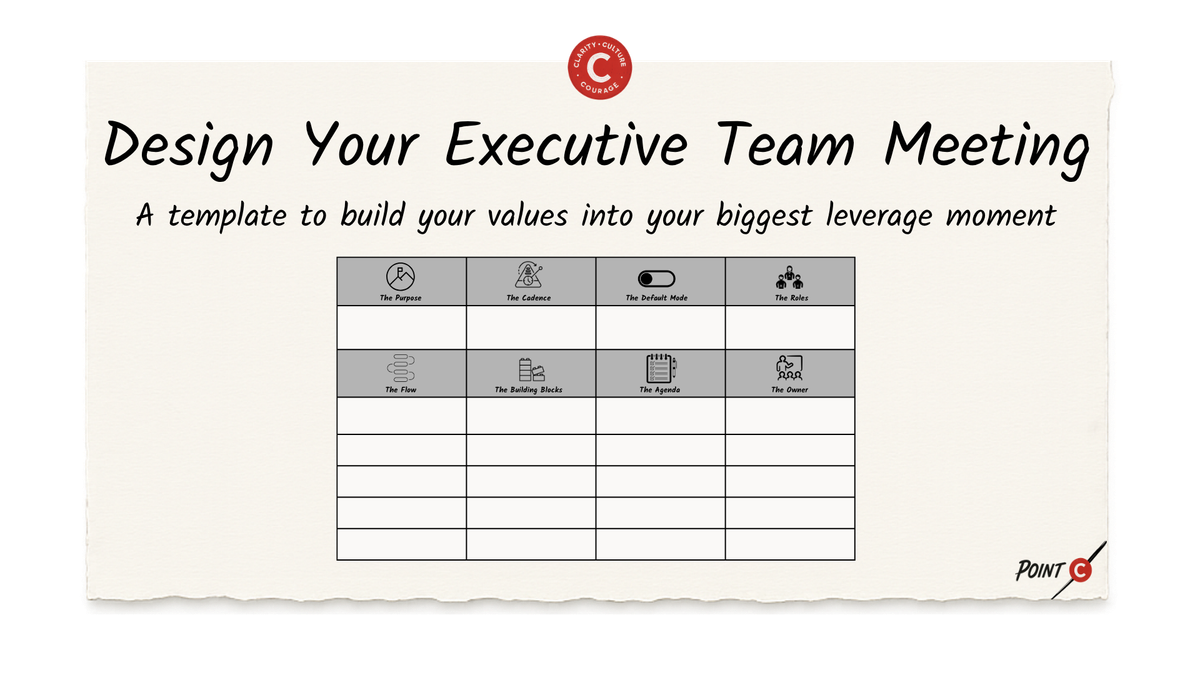
Design Your Executive Team Meeting
A template to build your values into your biggest leverage moment

Was this forwarded to you? Subscribe here to get one leadership framework per week.
Last week's Ritual Ladder ended on the rung where a mantra becomes a practice you repeat, and this is the room where most of those practices have to live. In Design The Meeting I made the case that the executive team meeting is your biggest leverage moment, and laid out the seven elements of any meeting design: the purpose, the default mode, the building blocks, the flow, the cadence, the roles, and the agenda.
You have an executive team meeting. Almost every leader I work with does. And most are dissatisfied with it. They inherited it but they haven't yet owned that they need to change it.
This week I want to show you what happens when a leader actually fills those in, starting with what it feels like from the inside.
Your First Month
Imagine you've just been hired onto an executive team. Wednesday at 1pm is the team meeting. Here's your first month.
Instead of the status updates you sat through at your last job, the meeting opens with a customer story. Not a composite, not a persona, not the customer as a category: one person, with a name, and clips of her talking in her own words about what she was trying to do and where the product let her down. Fifteen minutes on one human being you're now in the business of serving. Nobody frames it as an icebreaker. It's simply how the meeting starts, and by the third week you notice that when the group is weighing a decision, you hear that customer's voice in your head.
Then the CEO spends ten minutes closing the loop on the decisions that were outstanding from last week. What got decided, what didn't, why, and what's still open. You raised something in week one that you assumed had disappeared into the ether, the way things did at your last job. In week two it comes back with an answer you didn't love but a reason you understood. You stop wondering, and you're freed up to move forward.
Next, your new boss takes fifteen minutes on a disagreement between two of your peers whose work overlaps. Most decisions never reach her at all; they get made by whoever owns that lane, without a meeting and without her. This one sits across two lanes, so she clarifies which piece belongs to which person, and where it genuinely falls between them she makes the call herself, quickly, and says why. Two weeks later it's your work tangled up with someone else's, and it's untangled before the block is over. At your old company this kind of thing dragged on for months. The relief isn't that you won. It's that you know whose call it is, and the work can move again.
Then comes the half hour that surprises you most. One executive presents work that is obviously unfinished. Not a polished readout. A strategy in progress, with holes in it they name out loud, and a few more they hadn't seen until the room pointed them out. The room gives feedback for twenty minutes, and the presenter doesn't defend any of it. They take notes. At the end they say thank you, and the meeting moves on. In week three you offer a few ideas on something well outside your lane, braced for the territorial defensiveness you'd have gotten at your old job, and instead people take them seriously and the plan comes out better. Nobody treats it as trespassing. You start out dreading your own turn, and by the time it arrives you're looking forward to it, because thirty minutes of the sharpest people in the company working on your problem is not something you get anywhere else.
And once a month, the last twenty minutes have nothing to do with the work. They're about the team. Everybody writes down what's working and what they wish were different about how this group operates, and then they read them out loud, to each other, in the room. You watch the team adjust how it works in real time. Nothing gets filed away for a performance review six months later. It slowly dawns on you that the standards here are this high because there's a safe way to say the hard thing.
Four months in, you're running your own team's meeting on Thursdays, and you've started stealing pieces. You open with a customer now. You built a slot for closing loops. You didn't set out to spread anyone's culture. You just liked how it felt to work in that room.
Rewind: The Seven Questions
None of that was luck, and none of it was personality. It was just intentionality.
Eighteen months earlier, your new boss decided that designing this meeting was her job, not something to delegate to whoever books the room, and she sat down with a blank template to do it. One question was in front of her when she started: if this meeting is my biggest leverage point as a leader, how do I want to use that time intentionally?
Everything you experienced came out of the seven questions she worked through that afternoon, in this order.
What are we here to do that we can't do anywhere else?
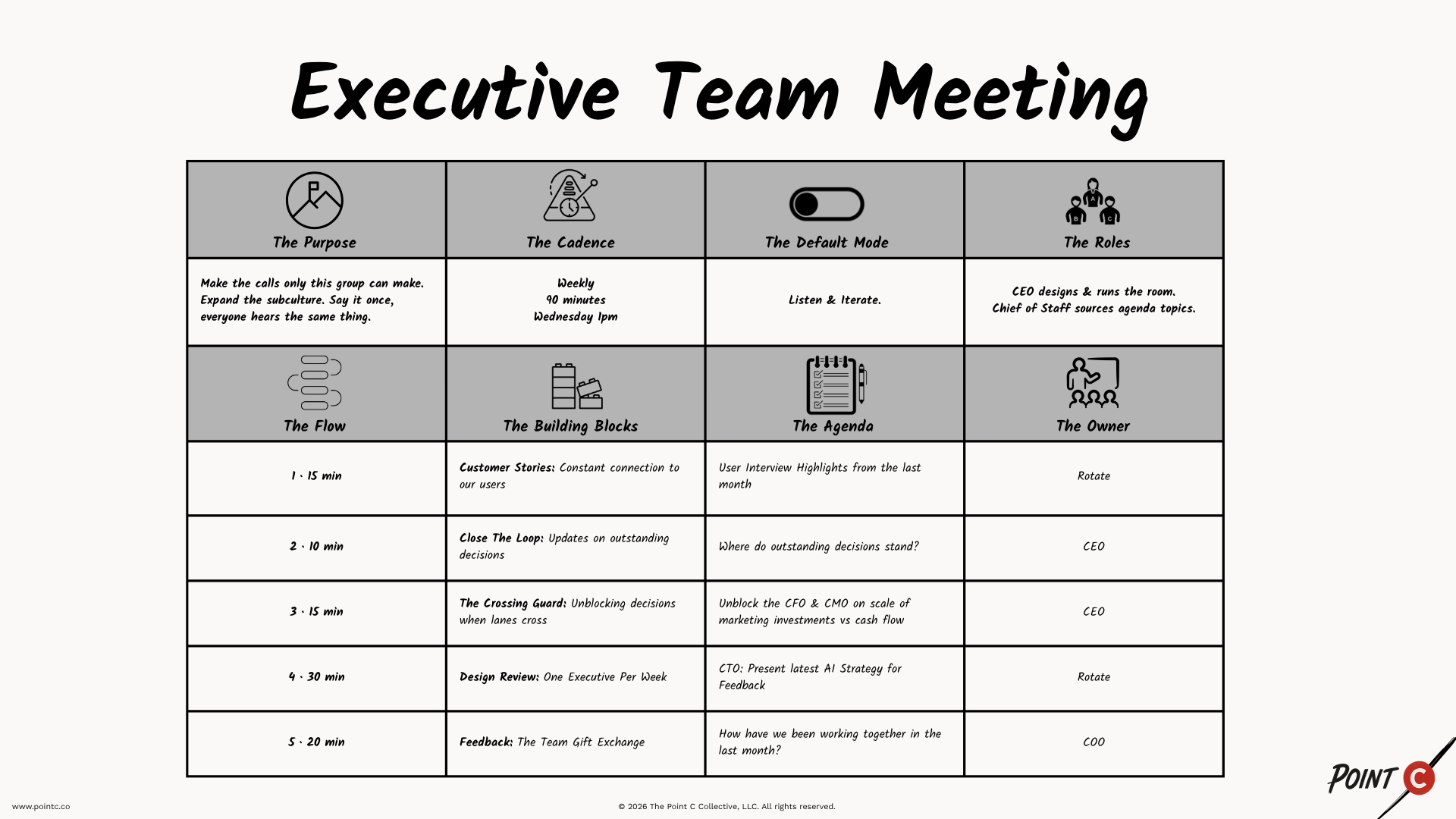
That's the purpose, and it's the question most executive teams have never asked. Hers had three parts. One, make the calls that only this group can make. Two, expand the subculture through the people who run every other team. Three, say it once, so everyone hears the same thing instead of hearing versions of it in silos.
How do I want people to show up?
That's the default mode, and it's the element most leaders never name. A group can show up to inform, to debate, to advocate, to negotiate, to partner, to listen and iterate, and for plenty of other purposes. There's no one right choice, but there has to be a choice. Otherwise people show up at cross purposes, creating a conflict nobody can quite put their finger on, but whose cause is obvious the moment you take a step back.
Her choice was listen and iterate. She'd sat in too many rooms where the default was job justification: everyone reporting from their own lane, demonstrating how busy they'd been, nobody saying much about what they were hearing because it wasn't their lane. She didn't want a recap of last week. She wanted forward-looking strategy, brought in while it was still being figured out.
That choice carries a principle with it. When a room is listening and iterating, everyone's feedback is valuable, because feedback is a gift and not a demand. The owner still owns the call. But everyone gets to play in each other's sandbox to get to better results, and that's the difference between an executive team and a group of executives: you own your role, we own the outcome.
What do I want this team to value, and what do we do each week that reinforces it?
That's the building blocks, and she refused to start them with a list of topics. She started with what she wanted to be true about this team.
She wanted a group that never talked about customers in the abstract. She wanted decisions to come back to the people waiting on them. She wanted stuck calls between two lanes unstuck in days rather than quarters. She wanted strategy examined while it was still soft enough to change. And she wanted a team honest enough to tell each other how it was going.
Then she gave each of those a block. A meeting is a bunch of mini meetings, and each block is one of them, with its own job to be done. A mantra on the wall is a claim. A block on the agenda is the proof. Your team learns what you value from what you protect time for, week after week, which means the things you left out are saying something too.
The "Customer Stories" block (15 minutes)
The Job: Keep a direct connection to the people you serve, so no decision this group makes gets made in the abstract.
Her Answer: Every week a different leader brings in a conversation they actually had with a customer, with clips of that person speaking in her own words. Not a composite, not a segment, not a summary of what customers think. A person. Rotating is the whole point: it means everyone on this team has to stay in direct contact with customers, because everyone knows their week is coming. Be human-centered stops being a slogan the moment somebody's voice is in the room.
The "Close The Loop" block (10 minutes)
The Job: Make sure no decision this group touched last week is quietly sitting open.
Her Answer: Every outstanding decision gets a status. What was decided, why, who else needs to know, and what's still open. That's Close The Loop as a standing block instead of a good intention. In the absence of data, people make stuff up, and this is where the data shows up on a cadence.
The "Crossing Guard" block (15 minutes)
The Job: Get people unstuck fast when their lanes cross.
Her Answer: She's the crossing guard. Say the CFO and the CMO are stuck on the scale of a marketing investment. The CMO owns marketing, the CFO owns available cash flow, and the decision sits across both lanes, which means neither can settle it alone and both are burning weeks waiting. Her job isn't to referee a fight. It's to clarify the lanes, name whose call it is, and get traffic moving again, and to make the call herself when it genuinely falls between them. Most stalled decisions aren't stalled because nobody has an opinion. They're stalled because nobody has said whose decision it is, which is why one consultative decision-maker per lane is the mantra underneath this block. She also treats every trip through it as information: if the same two lanes keep crossing, the lanes themselves need clarifying, and the block should get quieter over time.
The "Design Review" block (30 minutes)
The Job: Get strategy in front of the room while it's still early enough to change, and give the team a standing place to practice showing up by listening and iterating.
Her Answer: One executive per week, rotating, so everyone knows their slot is coming. Ten minutes to pitch the imperfect strategy as it stands today, a quick gut check against the rubric, then feedback from the room. One rule makes the whole thing work, and it's the one most teams skip: while the feedback is happening, the presenter can only listen and take notes. No defending, no debating. At the end they say two words, thank you, and the meeting moves on. That's what shifts a room out of defend and debate and into a free flow of information, and it trusts the owner to decide what to do with what they heard. It's the design review scaled to one presenter and one room. Thirty minutes is a third of the meeting, on purpose. If you take one block from this template, take this one.
The "Feedback" block (20 minutes, monthly)
The Job: Make time to talk about how we're working together, not just what we're working on.
Her Answer: Once a month, The Team Gift Exchange. Everyone writes their I likes and I wishes on how the group has worked together since the last time they asked, they read them out, they listen, and they're done. Note who this block is about. The other four are about the work. This one is about the team, and it's the one most executive teams never make time for, which is usually why the same friction keeps showing up in all the others.
With five blocks drafted, she had three questions left:
What order should it all go in?
That's the flow, and it matters more than people expect, because the same five blocks in a different sequence make a different meeting.
The customer went first, so everything decided afterward had a face attached to it. Closing the loop landed right after, so last week was properly finished before anyone opened this week. The design review got the middle and the most time, because that was the block she most wanted the team to protect. And feedback went last, because a team is more honest about how it's working together after ninety minutes of actually working together than it is cold at one o'clock.
How often do we need each other, and for how long?
That's the cadence, and she saved it until she knew what was going inside, because the length of a meeting should follow from the work it has to do rather than from whatever the calendar defaults to.
Ninety minutes, because that's what these five blocks need, and an hour would have meant cutting the design review. Weekly, because the decisions this group owns can't sit for two weeks with the rest of the company waiting on them. And Wednesday at 1pm, because she wanted her team to have two heads-down days on their own strategic work first, on Monday and Tuesday rather than over the weekend, so they'd walk in prepared and rested instead of scrambling.
Who owns what?
Only now, with a designed meeting in front of her, could she answer this one. She owns the room and the design, which she'd settled before she sat down. What she needed to assign was the inside.
Every block gets an owner, because a block that belongs to everybody belongs to nobody. Customer stories rotate, so the owner changes weekly and nobody gets to outsource staying close to customers. The design review rotates the same way, one executive at a time. Close the loop is hers, deliberately, because the person who has to say out loud what she decided and why, or admit she hasn't yet, should be the one who made the call. Crossing guard is hers for the same reason. Feedback belongs to her COO, not to her, because a block about how this team is working shouldn't be facilitated by the person everyone reports to.
What's on deck for the next meeting?
That's the agenda, and it comes last for a reason. Agendas are important, but an agenda isn't a meeting. It's this week's version of one, and it's the only part she doesn't do herself. Her chief of staff spends the week sourcing what the team needs in front of the group and brings her a draft each Tuesday. She decides what makes the ninety minutes because she ultimately is responsible for prioritization at this company.
Expanding The Subculture
Which brings us back to you, four months into the job, sitting down to design your own team's meeting.
You already know what it feels like when it's done well, because you've been in it every Wednesday. What you have now is the rest of it: the seven questions she asked, in the order she asked them, and the understanding that the blocks are where what you value actually lives.
You didn't set out to spread anyone's culture. You just liked how it felt to work in that room. That's how a subculture expands, and it's why she designed one meeting and ended up shaping meetings she will never attend.
Your Challenge This Week
Take your executive team meeting through the same seven questions, in the same order.
First, do what she did before she answered any of them, and own the design. This meeting is yours. Not your chief of staff's, and not whoever set it up before you.
Then work the questions via this workbook:
1. What are we here to do that we can't do anywhere else? Write the purpose in three parts or fewer. If your answer describes something that could just as easily happen over email, you've found your first problem.
2. How do I want people to show up? Name the mode you want. Then name the mode your team actually walks in with today. The gap between those two is your redesign brief.
3. What do I want this team to value, and what do we do each week that reinforces it? Write down three things you want to be true about how your team operates. Give each one a block with a job to be done, and a name you'd say out loud.
4. What order should it all go in? Sequence the blocks. Notice what your first block says about what matters here, and what your last one says about what you had time for.
5. How often do we need each other, and for how long? Now, and only now, decide the length and the frequency, and let the blocks tell you the answer rather than the calendar.
6. Who owns what? Give every block an owner. If a block's owner is you by default rather than by design, ask who else it should develop.
7. What's on deck for the next meeting? Write the agenda last, and notice how little time it takes once everything above it is decided.
Then run it. Don't workshop it for a month first. Put the new design in front of your team next week, tell them what you were trying to do and why, and let them feel it. Then fix what didn't work and run it again.
Next Week
You now have a template for your executive team meeting. But before you run it, you'll want to audit it, because there's a gut check I use on every meeting I design and most of us Type-A personalities fail it the first time, myself included. We fill the room with tasks and skip the process and the relationships, and then wonder why the task suffers. Next week: The TPR Checklist.
Know someone who would find this useful? Forward this email to them. They can subscribe here to get their own weekly half sheet.
About This Newsletter
The Idea Bucket is a weekly newsletter and archive featuring one visual framework, supporting one act of leadership, that brings you one step closer to building a culture of innovation.
It’s written by Corey Ford — executive coach, strategic advisor, and founder of Point C, where he helps founders, CEOs, and executives clarify their visions, lead cultures of innovation, and navigate their next leadership chapters.
Want 1:1 executive coaching on this framework or others? Book your first coaching session. It's on me.