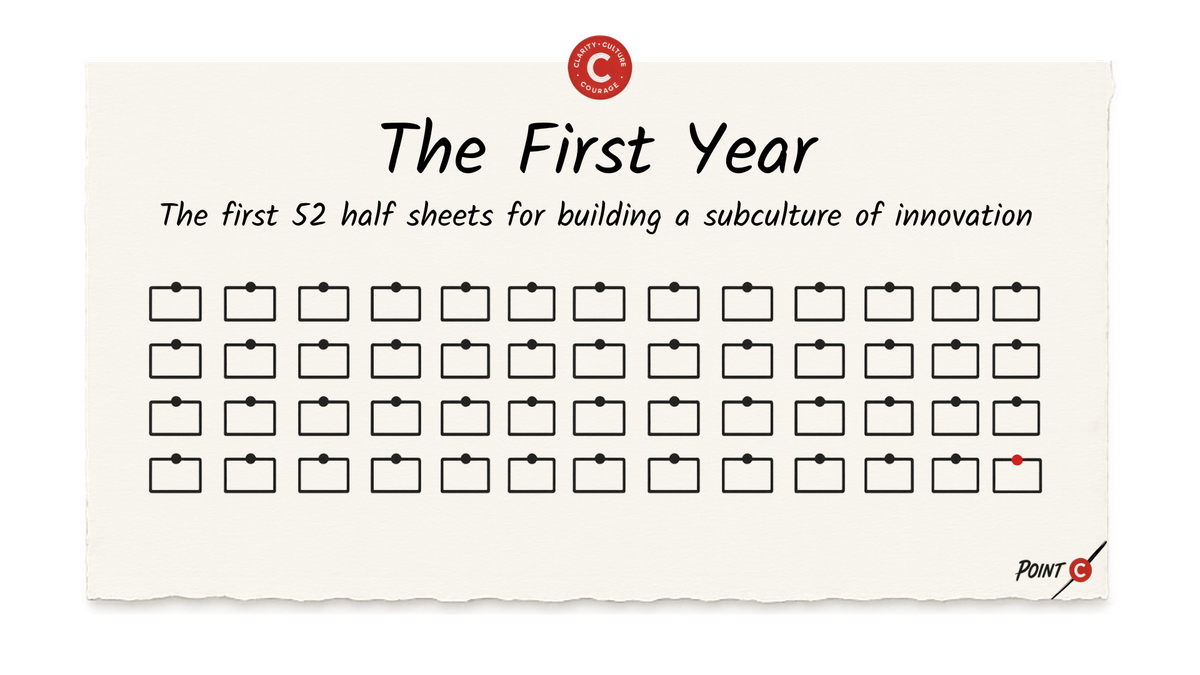
The First Year
The first 52 half sheets for building a subculture of innovation

Was this forwarded to you? Subscribe here to get one leadership framework per week.
A year ago this week, I published the very first post of this newsletter. It wasn't a framework. It was an announcement. I was launching Point C, a new coaching practice, and I made a promise: every week, I would share one visual framework supporting one act of leadership, built from the tools I use with my coaching clients, and I would build it all in public.
I didn't have a content calendar. I didn't have a book outline. I had years of frameworks I'd been teaching and coaching with but had never written about, a blank half sheet of paper, and a question I couldn't stop thinking about: What if I just started sharing these tools, one at a time, and see what happens?
A week later, The Half Sheet became the first framework in what would become The Idea Bucket.
And now, fifty-two posts later, I want to step back and take stock of what I've built in constant partnership with you, my coaching clients and students.
An Emerging Leadership Playbook
In the second issue of this newsletter, I introduced The Idea Bucket as a concept: a shared, persistent, frequently glanced at space where your team stores and sees its ideas together, in one place. The purpose isn't to decide. It's to capture, hold, and revisit ideas without rushing to pick a winner too early.
I described it as "a growing, glanceable wall of frameworks" that you can draw from when you're stuck, leading, or building.
That's exactly what this newsletter has become. I designed for this scenario. I didn't know what would fill the Idea Bucket when I started, but I knew that if I kept showing up every week, intentional serendipity would take over. So I just started. Fifty-two posts later, some of them are tools you can use in a meeting tomorrow. Some of them are mantras you can repeat until your team starts lovingly mocking you for it. Some of them are deep dives into a single idea that took ten weeks to fully unpack. But taken together, they form something I didn't fully appreciate until I stepped back and looked at the whole collection.
They form a leadership playbook. Built in public, one half sheet at a time. All contained in a glanceable wall of frameworks that you can view here.
The 5 Arcs That Grew On The Wall
Here's what's on it. Fifty-two posts, organized into five arcs that trace the journey from the first sketch to where we are today.
Arc 1: Innovation Tools (May - June 2025)
It started with Point C, the post that launched the company and the newsletter in the same breath. From there came five foundational frameworks for turning abstract ideas into concrete prototypes, evaluating them, and building a culture of innovation.
The Half Sheet taught you to get ideas out of your head and onto paper. The Idea Bucket gave those ideas a shared home. The Selection Stack showed you how to surface the criteria that matter before you start evaluating ideas. The Rubric made those criteria explicit and tangible. And The Design Review gave your team a ritual for presenting and pressure-testing ideas together.
If you are building a team that innovates, start here.
Arc 2: The Venture Story (June - September 2025)
This arc is a complete storytelling framework for anyone who needs to articulate a compelling vision, whether you're pitching investors, rallying a team, or aligning stakeholders on where you're headed.
It starts with The Venture Story overview, then walks through nine scenes across three acts. Act One covers The Pain Point, The User Journey, and Becoming Essential. Act Two covers The Opportunity, The Venture, and The Competitive Landscape. Act Three covers Who We Are, Where We've Been, and Where We're Going. It culminates in The Venture Story Workbook, a guidebook for premium members and coaching clients to build your own story from scratch, later updated and expanded as The Venture Story Guidebook. (I'm always iterating on my own prototypes, as I hope you would expect I would.)
If you need to tell the story of what you're building and why it matters, this arc will take you there.
Arc 3: Culture and Leadership Mantras (September- December 2025)
This is the heart of the playbook. It begins with The Learning Zone, the model that sets the target for every innovation leader: the intersection of high psychological safety and high standards. From there, The Subculture Expansion Zone showed you how to grow your subculture outwards, one context at a time.
Then came the mantras. Feedback Is A Gift, Not A Demand and its companion rituals, The One-on-One Gift Exchange and The Team Gift Exchange. One Consultative Decision-Maker Per Lane brought clarity to how decisions get made. Always Separate Flaring and Focusing made you aware of how to manage the two critical innovation modes. The Subculture Coverage Matrix gave you a way to audit the gaps in your cultural leadership. And I gave you a series of operational mantras:Fail Forward, Honor The Maker's Schedule, Text If Urgent, Be Human-Centered, Be Prototype-Driven, and Start With A Blank Slate.
If you are ready to intentionally define and build your own subculture, spend time here.
Arc 4: Career Frameworks (December 2025 - February 2026)
My one-on-one coaching then inspired me to write eight posts for the individual leader navigating their own career with the same intentionality they bring to their teams. It started with The Go/No-Go Date, a framework for managing risk and runway during a bold career move. From there, The Personal Selection Stack helped you define what you're optimizing for in your career. Create Intentional Serendipity showed you how to design your own luck. The Curiosity Tour and The Forwardable Email gave you tools for building relationships with intention. Know Your Number forced the financial clarity most people avoid. Avoid The Pretzel Trap named the pattern of contorting yourself to please everyone. And Use The Language of Interests taught you how to steer a negotiation into the most productive zone by focusing on shared interests rather than power or rights.
If you are navigating a career transition or wondering what comes next, start here.
Arc 5: The Psychological Safety Deep Dive (February - May 2026)
This is the most recent arc. It began with I Can't See Inside Their Head, a mantra to stick to what you know is true in hard conversations by resisting the urge to assume you know what's going on inside another person's head. Psychological Safety Is A Leadership Choice made the case that safety isn't something that happens to a team. It's something a leader builds on purpose.
Then came The Safety Levers, an overview of the ten levers you can pull to increase psychological safety in your subculture on your quest to move it into The Learning Zone. Some of these levers had already appeared earlier in the newsletter, like Fail Forward, Feedback Is A Gift, Not A Demand, and Flare Before You Focus. But this arc brought them together as a complete system alongside the new ones: Cultivate A Growth Mindset, Lead With Vulnerability, Make Space For Every Voice, Design For The Roller Coaster, Celebrate Behaviors, Not Just Outcomes, You Own Your Role, We Own The Outcome, and Make Expectations Explicit.
If you want to understand how to create a team where people feel safe enough to take risks, challenge each other, and do their best work, this is the arc.
What's Next: The Mantra Playbook
Most recently, The Mantra Ladder introduced the framework for building leadership mantras from the ground up. That's the foundation for what's coming next: the true heart of the leadership playbook, where I'll share my full Mantra Dashboard, the corresponding mantra ladders beneath it, and how to operationalize all of it through repeated, intentional rituals like your executive team meeting, your one-on-ones, and your all-hands meeting.
What I've Learned From Building In Public
When I launched this newsletter, I promised to build in public. I didn't know what that would feel like over fifty-two weeks. Now I do, and building week in and week out has left me with some hard-earned insights.
The first insight is that building is knowing. I've always taught that you don't really know something until you have to teach it. This year reinforced that viscerally, and extended it: you don't really know something until you have to write about it either. It's thinking with your hands. I knew a lot of these frameworks when I started, but not all of them. As I built, I saw new tools I could build. I made connections I would not have made otherwise. I filled gaps and refined my tools and the purpose behind them. Each half sheet sharpened the next one. Ideas that sit side-by-side start to connect. When you keep ideas visible and persistent, serendipity happens. That's not just a theory of mine anymore. It's a year of evidence. It reinforces everything I teach about having a bias toward action and being prototype-driven. The frameworks got better because I wrote about them. I got better because I wrote about them.
The second insight is that consistency compounds. I embraced constraints and forced myself to ship every week, without a long-term plan. Half sheet by half sheet. The first few posts felt like shouting into the void. (And if I'm being honest, I sometimes still wonder whether anyone has time to read these long posts at all.) But then I would run into someone in person at a conference. Or I would catch up with an old student on Zoom. And I would hear the same thing, over and over: Thank you for sharing these frameworks. I just sent our latest one to my team. A few people have told me they've created a special folder in their email called "Corey Ford" and have been saving every post for reference. Fellows are forwarding specific half sheets to their teams as a way to introduce new practices.
Part of why consistency compounds is that I'm also actively deploying these frameworks with clients and in classes, and those experiences create a virtuous feedback loop where I am constantly learning about the needs of my users and designing for them. The writing feeds the teaching, the teaching feeds the coaching, and the coaching feeds the writing.
It's not the inbox metrics that keep me going. It's those moments of qualitative feedback, the ones that remind me the wall is being used, not just read. So if these posts have moved you and I haven't heard from you yet, just reply to this email with a short story of how you've used these tools. Each reply will put another gallon in my fuel tank for the year to come.
The third insight is that each half sheet is a pebble thrown into a pond. One of the biggest realizations I've had this year is that each half sheet doesn't just help the leader who reads it. It lowers the activation energy for them to spread an innovation subculture to their team. I might teach a client a technique in a coaching session, and now they don't just have the learning for themselves. They have a post they can forward to their team and say, Let's try this. It takes the burden off them from having to introduce something new from scratch.
I've seen this work for many of the frameworks, but especially for The One-on-One Gift Exchange and The Team Gift Exchange. That ripple effect is deeply motivating for me. I believe that leaders are leverage, and that there is no bigger leverage point for creating the change you want to see in the world than investing in the people who lead others. I want to build leaders who build great places to work that are innovative, empowering, and impactful.
Each half sheet is one more pebble. And the ripples keep spreading outward.
One Year of Point C
This anniversary is also a milestone for Point C. A year ago, I launched this practice with a clear vision: to help founders, CEOs, and executives clarify their visions, lead cultures of innovation, and navigate their next leadership chapters. The newsletter has been the public face of that work. But behind it, the coaching practice has grown in ways I'm deeply grateful for.
One of the biggest learnings this year is that what I teach applies far beyond media, entrepreneurship, and technology. Those are the industries where I built my career and have the deepest networks, and they're where I started. But my clients know other leaders in other industries and once they trust me, they introduce me, and my teachings get to spread. Over the past year, I've gone deep with Fortune 500 C-suites in industries I had never touched before, and the impact has been similar if not greater. The fundamentals of building a subculture of innovation, of creating psychological safety, of making expectations explicit, those are universal. They work everywhere leaders lead.
I'm also realizing that I can impact not just individual leaders, but entire teams of leaders through what I'm starting to call a blameless cultural audit. The process is simple: I deeply interview multiple people in a group, surface the gaps in what's keeping them from being a high-performing team, help them see those insights together in a retreat, and guide them toward closing the gaps. I can see what they cannot because I am a neutral outsider who can speak truth to power, with one interest in mind: helping this team become a high-performing team.
I'll be writing more about this soon, but if you've been thinking about how to transform your team's culture, that's going to be an increased focus of mine in year two. If you've been reading along and wondering what it would be like to work together, I'd love to have that conversation.
Book your first coaching session. It's on me.
Your Challenge This Week
This week, throw a pebble and extend the ripple.
Think of one person in your life who is navigating a leadership challenge right now. Then pick the half sheet that fits their moment and forward it to them.
Not sure which one to send? Here are a few starting points:
For someone navigating a career move: The Personal Selection Stack or The Go/No-Go Date
For someone who needs to tell a better story: The Venture Story or The Pain Point
For someone building a team culture: The Learning Zone or The One-on-One Gift Exchange
Or just forward this post and let them browse the full archive themselves.
That's how a subculture of innovation spreads. One pebble at a time.
Next Week
Next week, we revisit The Subculture Coverage Matrix, the audit tool I use to make sure your mantras cover the seven categories that every team needs to be high-performing.
And this time, I'll share my full, updated playbook: The Mantra Dashboard.
Know someone who would find this useful? Forward this email to them. They can subscribe here to get their own weekly half sheet.
About This Newsletter
The Idea Bucket is a weekly newsletter and archive featuring one visual framework, supporting one act of leadership, that brings you one step closer to building a culture of innovation.
It’s written by Corey Ford — executive coach, strategic advisor, and founder of Point C, where he helps founders, CEOs, and executives clarify their visions, lead cultures of innovation, and navigate their next leadership chapters.
Want 1:1 executive coaching on this framework or others? Book your first coaching session. It's on me.