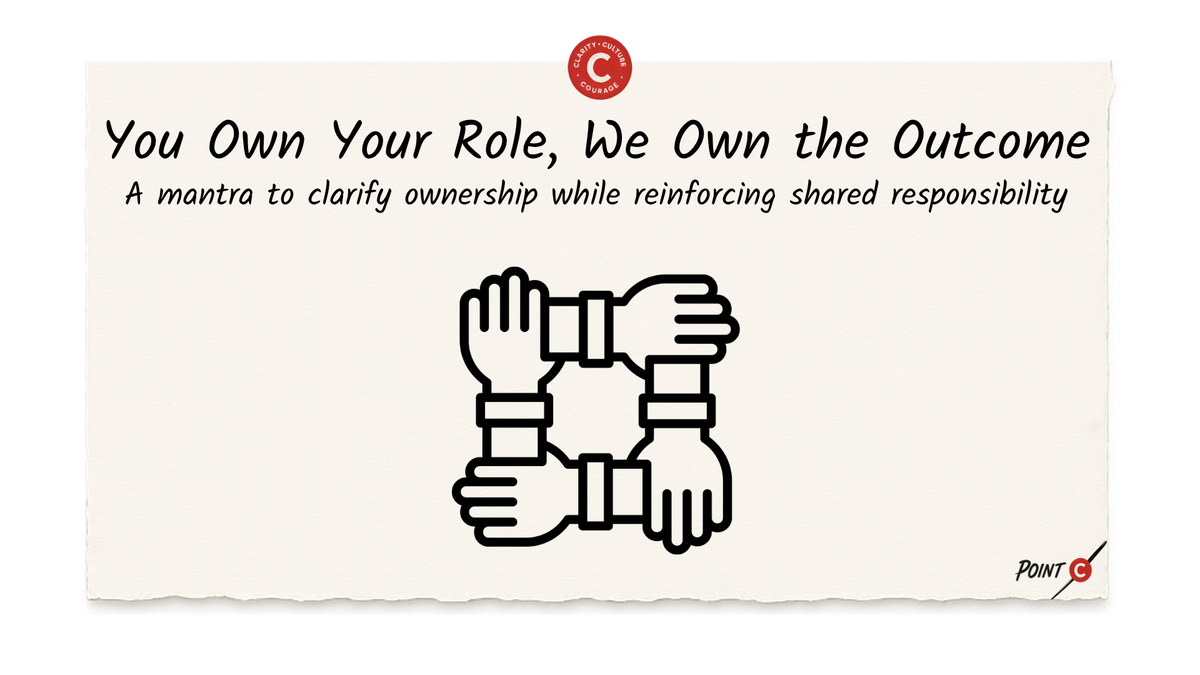
You Own Your Role, We Own The Outcome
A mantra to clarify ownership while reinforcing shared responsibility

This week in The Idea Bucket we continue unpacking the ten levers that you can pull to increase psychological safety in your subculture. So far we've explored the following mantras:
- Cultivate A Growth Mindset
- Fail Forward
- Feedback Is A Gift — Not A Demand
- Lead With Vulnerability
- Make Space For Every Voice
- Design For The Roller Coaster
- Celebrate Behaviors, Not Just Outcomes
Today we pull the lever of creating shared accountability.
As you may recall from my previous post, One Consultative Decision Maker Per Lane, I am a huge believer in having clarity on roles and decision rights. You should empower individuals on your team to make decisions in their lanes. But alongside individual empowerment, it is also important to make sure you operate as a team rather than as a collection of individuals. Great leaders do both. They make roles clear while fostering a collective sense of ownership for the outcome.
They embrace the mantra: You Own Your Role, We Own The Outcome.
Create Shared Accountability
As a reminder, one of the ten levers you can pull to increase psychological safety in your subculture is to create shared accountability.
Ownership is individual. Responsibility is collective.
When failure feels personal, people protect themselves. When responsibility is shared, people surface risks earlier.
In the Anxiety Zone, you hear: “That wasn’t my role.”
When you create shared accountability:
- You speak in “we” language
- You focus reviews on systems, not blame
- You reinforce that noticing problems is part of the job
This is not about fuzzy ownership. It’s about fewer surprises and better outcomes.
Make it clear: you own your role, but we own the outcome.
How Things Fall Through the Cracks
One of the most frustrating dynamics on a team is when something clearly goes wrong, and yet when you unpack it, no single person actually did anything wrong. You’ve likely been in this meeting before. A deadline slips, a deliverable misses the mark, or a client is frustrated, and the team comes together to understand what happened. As you go around the room, each person can explain their piece of the work. Marketing was waiting on input. Product was working off the information they had. Everyone operated within their role, and everyone can justify their actions.
And yet, it still failed.
What becomes clear in those moments is that the issue is not individual performance, but the space between roles. When teams operate purely as a collection of individuals owning their lanes, the work gets done, but the handoffs don’t. The gaps between those lanes become the source of risk, and without a shared sense of ownership, those gaps go unaddressed until it is too late.
No one dropped the ball. But the ball fell between them.
Bringing It All Together
This is where many of the ideas we’ve already discussed in this series start to come together.
If feedback is treated as a gift, not a demand, people feel permission to share what they are seeing without worrying about whether it's “their place.” If you have made space for every voice, more perspectives are actually heard before decisions are locked in. If you lead with vulnerability, it becomes easier for someone to say, “I might be wrong, but I think we’re missing something.” And if you have framed the work as a learning problem, not an execution problem, then raising a risk is seen as contributing to the work, not disrupting it.
Shared accountability is what ties all of those behaviors together.
It is what turns a group of well-intentioned individuals into a team that is actually working toward a common outcome. Because once the mindset shifts from “my role” to “our outcome,” people begin to pay attention not just to what sits inside their lane, but to what is happening around it. They start to notice when something feels off. They connect dots across functions. They surface risks earlier, not because they were told to, but because they understand that the outcome belongs to all of them.
The Signals You Send
In practice, this shows up in small but important moments in how a team operates.
Someone flags a risk that technically sits outside their role, and instead of being told to stay in their lane, they are met with appreciation. A teammate hears, "this might not be my area, but I think this could impact us,” and responds with curiosity rather than correction. Over time, those moments signal that paying attention to the whole system is doing your job.
It also shows up in how teams respond when things go wrong. In low-safety environments, the instinct is to quickly identify who owns the mistake. In high-performing teams, the conversation moves in a different direction. The question becomes how the team allowed the issue to go unnoticed, what signals were missed, and how the system can be strengthened so that it is caught earlier next time. The goal is not to diffuse responsibility, but to expand it.
Importantly, none of this replaces clear ownership. Roles and decision rights still matter. In fact, they matter even more. But they exist alongside a shared understanding that while individuals own their pieces of the work, the team owns the result.
And in innovation work, where each individual needs to take smart risks, the safety net of the team is even more important.
Your Challenge This Week
This week, pay attention to the moments that sit just outside your role.
Notice when you see something that could impact the outcome, but hesitate because it doesn’t technically fall within your responsibility. In those moments, practice raising it anyway. You don’t need to be certain, and you don’t need to have the answer. A simple observation is enough to make a difference.
If you lead a team, pay even closer attention to how you respond when someone does this. Those responses are what shape the culture. When you acknowledge and reinforce those moments, you signal that shared accountability is expected. When you dismiss them, even unintentionally, you signal that people should stay in their lanes.
Over time, it's those small interactions that determine whether problems are surfaced early or allowed to grow.
Next Week
As a reminder, here are the ten corresponding mantras to increase psychological safety in your organization:
- Cultivate A Growth Mindset
- Fail Forward
- Feedback Is A Gift — Not A Demand
- Lead With Vulnerability
- Make Space For Every Voice
- Design For The Roller Coaster
- Celebrate Behaviors, Not Just Outcomes
- You Own Your Role, We Own The Outcome
- Flare Before You Focus
- Make Expectations Explicit
Next week, we dive into the mantra that pulls the lever of modeling curiosity and asking questions: Flare Before You Focus.
About This Newsletter
The Idea Bucket is a weekly newsletter and archive featuring one visual framework, supporting one act of leadership, that brings you one step closer to building a culture of innovation.
It’s written by Corey Ford — executive coach, strategic advisor, and founder of Point C, where he helps founders, CEOs, and executives clarify their visions, lead cultures of innovation, and navigate their next leadership chapters.
Want 1:1 executive coaching on this framework or others? Book your first coaching session. It's on me.