Make Expectations Explicit
A mantra to turn implicit norms into shared standards

This week in The Idea Bucket we arrive at the tenth and final lever in our series on the ten levers you can pull to increase psychological safety in your subculture. We've explored the following mantras:
- Cultivate A Growth Mindset
- Fail Forward
- Feedback Is A Gift — Not A Demand
- Lead With Vulnerability
- Make Space For Every Voice
- Design For The Roller Coaster
- Celebrate Behaviors, Not Just Outcomes
- You Own Your Role, We Own The Outcome
- Flare Before You Focus
Today we pull the final lever: establishing clear team norms.
Here's a pattern I see over and over again in my coaching practice. A leader steps into a new role and immediately wants to prove themselves. They are smart, they are ambitious, and they want to show results. So they dive into the work. They focus on the task. They skip the process. They skip the relationships. And they definitely skip the step where they pause to establish how the team is going to operate together.
We're all adults in the room. We don't need that.
And it works. For a while. Until the first real disagreement. Until the first missed handoff. Until the first time someone gets blindsided by feedback they didn't see coming or a decision they weren't consulted on. And then the leader looks around and wonders why the team isn't functioning the way they expected.
The answer is almost always the same: the expectations were never made explicit.
The leaders who get this right are the ones who are willing to go slow to go fast. They resist the urge to sprint into execution and instead take the time to name the norms, to align on how the team will work together before the pressure arrives. It feels slow in the moment. But it is the single most leveraged investment a leader can make.
That's why this final lever is, in many ways, the one that activates all the others: Make Expectations Explicit.
Establish Clear Team Norms
As a reminder, the tenth lever you can pull to increase psychological safety in your subculture is to establish clear team norms.
Unspoken expectations create hidden landmines. When norms are implicit, people have to guess what's valued, and when they guess wrong, they feel unsafe.
In the Anxiety Zone, people learn the rules by breaking them.
When you make expectations explicit:
- You reduce the cost of entry for new team members
- You make it safe to hold each other accountable
- You give people permission to name what's not working
This is not about bureaucracy or creating a rulebook. It's about removing ambiguity so that people can focus their energy on the work instead of trying to decode the culture.
Make expectations explicit.
Intentionality Makes A Leader
Every team has norms. There are always rules, spoken or not, about how decisions get made, how people communicate, how conflict gets handled, and how time gets spent. The question is whether those norms were chosen intentionally or whether they just showed up.
I believe this is one of the most important distinctions in leadership. There are many people who occupy positions of power. But the ones who are truly leaders are separated by intentionality. They don't just react to the culture that forms around them. They shape it. On purpose.
When norms are left implicit, they will always diverge over time. Think about something as fundamental as feedback. Without explicit norms, one person on your team might operate as though feedback is a gift, not a demand. They share their work early, invite input while their thinking is still forming, and treat the feedback they receive as information to weigh, not instructions to follow. Another person hears the word "feedback" and feels obligated to incorporate every opinion, gradually giving away their autonomy in an effort to please everyone. Over time, that person stops sharing their work early altogether, because every time they ask for feedback, it feels like they're handing over control. One person is leading. The other is pretzeling. Same team, same "feedback" word, completely different assumptions about what it means.
New people have no way in. They have to learn the culture by trial and error, which means they learn the norms by violating them. That's an expensive and demoralizing onboarding experience.
And when norms are implicit, they can't be improved. You can't examine what you haven't named. You can't iterate on a standard you've never articulated. The team gets stuck with whatever norms happened to form, whether those norms serve them or not.
Intentional leaders don't accept this. They take ownership of their subculture the same way they take ownership of their strategy. They recognize that culture is their lane, and they lead it accordingly. That doesn't mean handing the team a list of commandments. But it also doesn't mean sitting back and hoping the right norms emerge on their own.
The leader's job is to go first. Propose the norms. Name what you believe matters most. And then listen. Adjust if you get feedback that truly improves your norms. Treat your norms the same way you'd treat any other important work: as a prototype, not a finished product. But someone has to put the first draft on the table, and that someone is you. You are the consultative decision-maker in the lane of your team's culture. You own that lane. You seek input. You welcome feedback on it. But the feedback is a gift, not a demand. The culture is yours to shape.
Because whether you realize it or not, your team is watching everything you do. The meetings you show up to. The questions you ask. The behavior you praise. The behavior you tolerate. Every action generates signal about what matters in your subculture. The question is whether you are generating those signals intentionally or accidentally.
From Norms to Mantras
So how do you take your intentions and make them stick?
You can document your norms in a shared doc. You can discuss them in an offsite. And you should do both of those things. But norms written in a Google doc will only get you so far. The real test is what happens when the pressure arrives. When the deadline is looming. When the team is at the bottom of the roller coaster. When emotions are running high and no one has the bandwidth to pull up a document.
That's where mantras come in. Short, sticky phrases that encode your most important expectations into language that people can remember, repeat, and reinforce, even under stress.
Think about what we've done in this series. Each lever came with a mantra. And each mantra carries a specific expectation about how you want your team to operate:
When you want your team to frame work as a learning problem, you say: Cultivate a growth mindset.
When you want your team to treat experiments as learning, not failure, you say: Fail forward.
When you want your team to share their work early and invite input instead of waiting until it's perfect, you say: Feedback is a gift, not a demand.
When you want your team to show that it's OK to not have all the answers, you say: Lead with vulnerability.
When you want your team to ensure every perspective is heard, you say: Make space for every voice.
When you want your team to prepare for hard moments before they arrive, you say: Design for the roller coaster.
When you want your team to reinforce the daily behaviors that produce excellence, you say: Celebrate behaviors, not just outcomes.
When you want your team to take ownership of the whole, not just their piece, you say: You own your role, we own the outcome.
When you want your team to generate ideas before evaluating them, you say: Flare before you focus.
These aren't slogans. They are compressed expectations. And because they are short and memorable, they travel. They show up in the moments that matter. They move with your team into every meeting, every decision, every hard moment, even when you aren't in the room.
That's the power of a mantra. It makes your expectations portable.
And yes, you need to repeat them so often that your team starts to lovingly mock you for it. That's actually how you know they're landing.
The Meta-Mantra
Now take a step back and consider what we've done over this series.
Each mantra we've explored is, in essence, an explicit expectation. Cultivate a growth mindset is an expectation about learning. Fail forward is an expectation about experimentation. Feedback is a gift is an expectation about sharing early and inviting input. You own your role, we own the outcome is an expectation about accountability.
Every single mantra in this series has been an act of making expectations explicit.
That's why this is the capstone. It's not just another mantra alongside the other nine. It's the mantra that makes all the other mantras work. Because a mantra only works if people know it exists. A norm only shapes behavior if people can name it. And a culture only holds together under pressure if its expectations have been made visible, shared, and reinforced.
Make expectations explicit is not just a mantra. It's the practice of intentional leadership itself.
Your Challenge This Week
This week, I want you to be intentional about your norms.
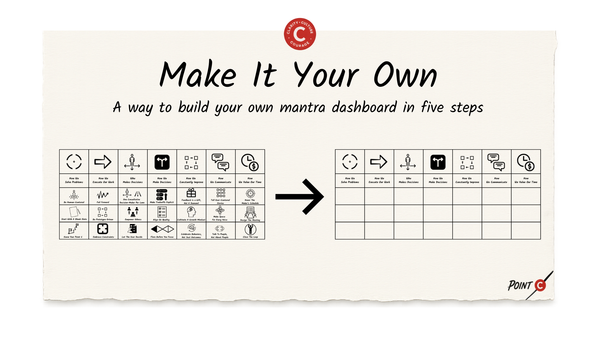
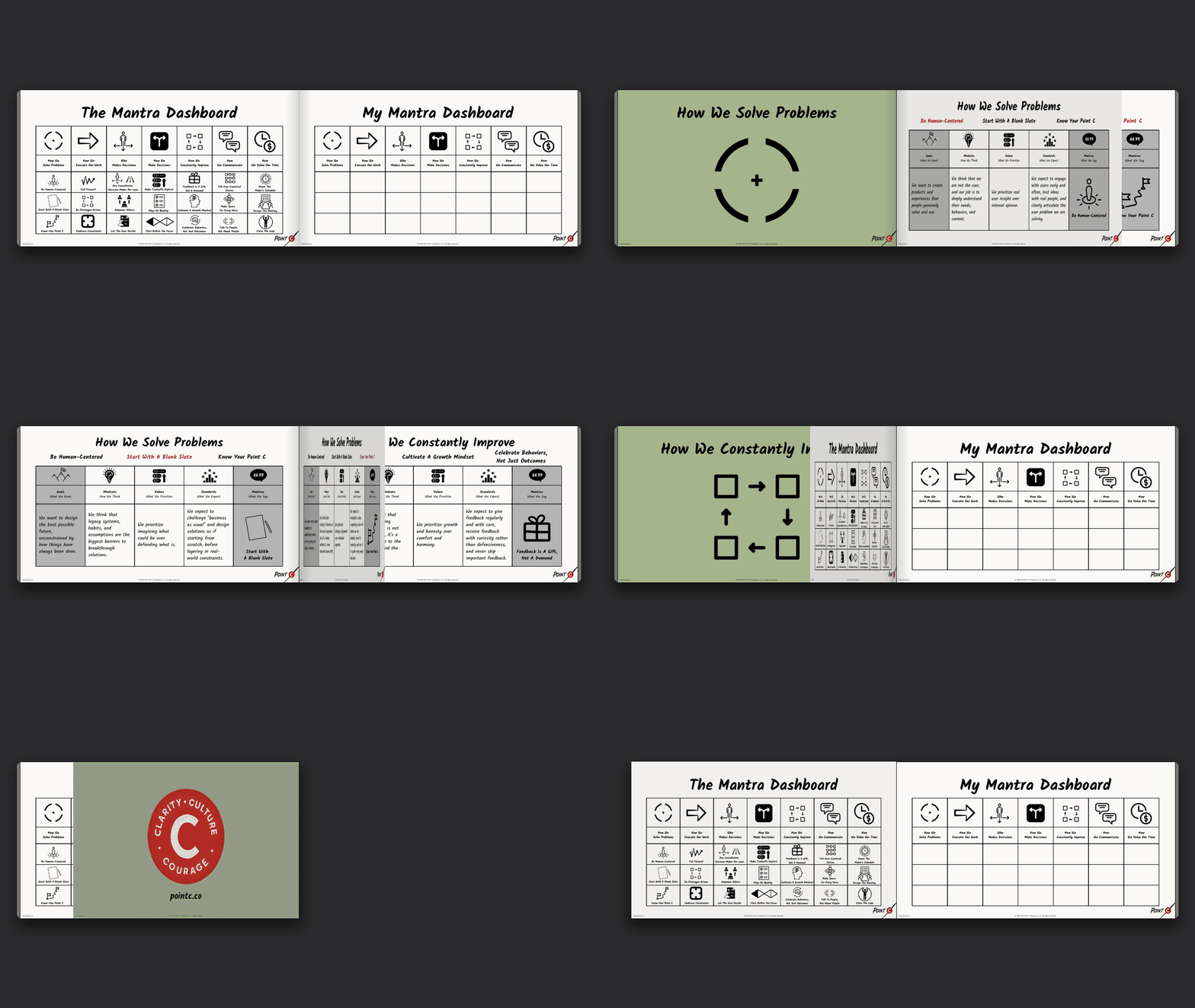
- Think about the seven essential categories that your team's norms need to cover: How We Solve Problems, How We Execute Our Work, Who Makes Decisions, How We Make Decisions, How We Constantly Improve, How We Communicate, and How We Value Our Time. (If you haven't already, take a look at The Subculture Coverage Matrix for a deeper explanation of each category.)
- For each category, ask yourself: Do I have an explicit expectation here? Have I actually said it out loud?
- Identify one category where your norms are unclear or unspoken. Just one.
- This week, make that expectation explicit. Say it in a meeting. Name it in a one-on-one. Write it down and share it. It doesn't have to be perfect. It just has to be visible.
- Then watch what happens. Notice whether your team responds with relief, with surprise, or with questions. All three are signals that the norm was needed.
Because making it visible is where intentional leadership begins.
The Series In Full
Over the past ten weeks, we've unpacked the ten levers you can pull to increase psychological safety in your subculture:
- Cultivate A Growth Mindset: Frame work as a learning problem
- Lead With Vulnerability: Model fallibility
- Flare Before You Focus: Model curiosity and ask questions
- Feedback Is A Gift, Not A Demand: Share early and invite input
- Fail Forward: Embrace experimentation and learning
- Make Space For Every Voice: Practice inclusive participation
- You Own Your Role, We Own The Outcome: Create shared accountability
- Celebrate Behaviors, Not Just Outcomes: Celebrate effort and progress
- Design For The Roller Coaster: Anticipate and prepare for hard moments
- Make Expectations Explicit: Establish clear team norms
Each lever is an act of leadership. And like all acts of leadership, they compound. Pull one and you'll see a difference. Pull all ten and you'll transform your subculture.
If you are new to this series, start with The Learning Zone Matrix to understand the foundation, then explore The Safety Levers for the overview, and dive into any of the ten levers above. Each post stands on its own, but together they form a complete toolkit for building psychological safety in your subculture.
Next Week
We've completed the ten levers of psychological safety. But naming the levers is only the beginning. The real work is building your own mantras that stick.
How do you actually construct a mantra? Not borrow one from a list on the internet, but build one from the ground up, rooted in your goals, your values, and the standards you actually hold your team to?
Next week, I'll introduce The Mantra Ladder, the framework I use to build every mantra from its foundation to its final form.
About This Newsletter
The Idea Bucket is a weekly newsletter and archive featuring one visual framework, supporting one act of leadership, that brings you one step closer to building a culture of innovation.
It’s written by Corey Ford — executive coach, strategic advisor, and founder of Point C, where he helps founders, CEOs, and executives clarify their visions, lead cultures of innovation, and navigate their next leadership chapters.
Want 1:1 executive coaching on this framework or others? Book your first coaching session. It's on me.