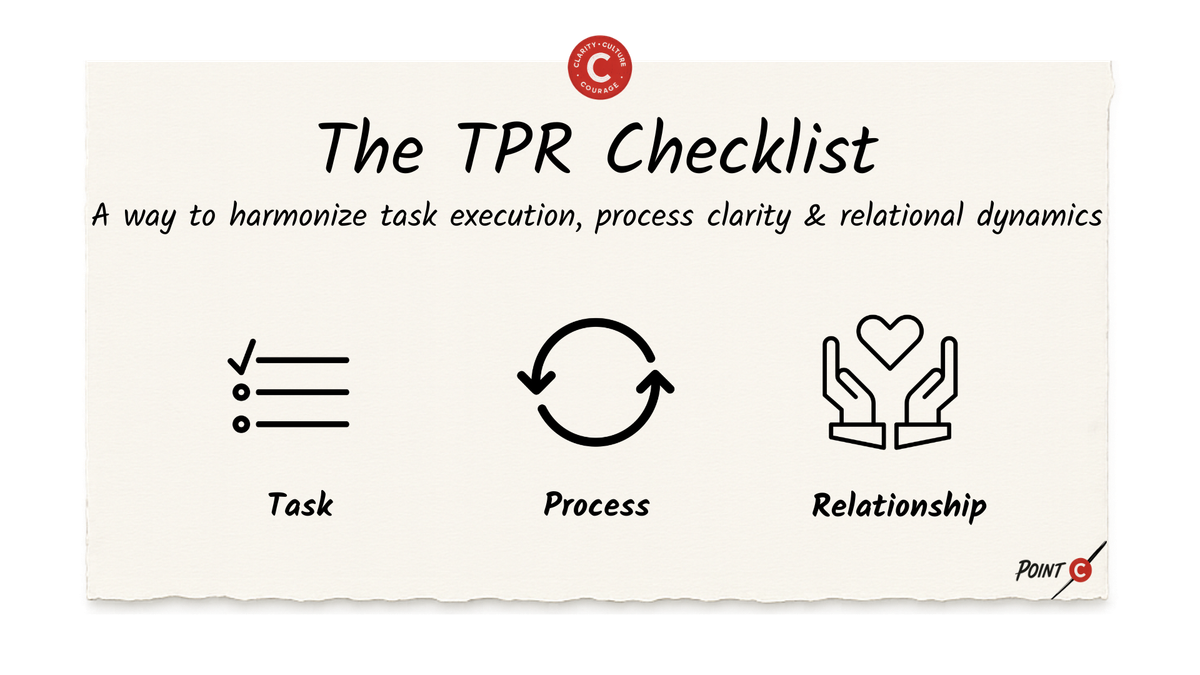
The TPR Checklist
A way to harmonize task execution, process clarity & relational dynamics

Was this forwarded to you? Subscribe here to get one leadership framework per week.
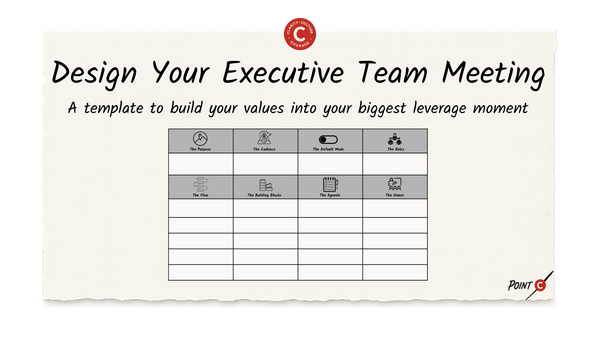
Last week I gave you a template to design your executive team meeting. Before you run it, I want you to put it through a gut check I use on every meeting I design, every retreat I plan, and in a lot of my coaching conversations.
It's three words: task, process, relationship. You can break almost any meeting down into those three things. And if you're a Type-A personality like me, there's a good chance your design fails the gut check the first time.
The Fully Baked Plan
A leader I coach was preparing for his first working meeting with a new boss. He really wanted to prove himself in the role, so he planned to walk in and present a fully baked plan he'd built on his own.
That might have made him look competent and driven. But think about how his new boss would see it. Would she be put off by a finished plan that never started with a conversation about what she actually wanted to accomplish? Would she look at something that fully baked and conclude there was no room for her feedback, and no room to iterate?
When we role-played the meeting, we built it back up in layers. The task was already done. He had his version of the plan. So I asked what process would let her shape it. He would say up front that this was early thinking he expected to change, and he'd keep the document in reserve. Then I asked what the relationship needed first. He would open with questions that helped her talk through what she really wanted, so he could build empathy with his new boss before he pitched anything. Coming out of the gate with the plan would have set all of that back, and she might have lost trust in him from the very beginning.
So that's how he ran it. The plan could wait. Her trust couldn't.
He almost failed the gut check, without even realizing he was running one.
Every Meeting Has Three Layers
I first learned to break a meeting down into task, process, and relationship at Stanford's Graduate School of Business, where the Leadership Labs had us give each other feedback on all three, and where I spent my second year as a Leadership Fellow coaching first-year students through those labs. I thought it was a pretty basic framework at the time. I still do. What surprises me is how often I see it overlooked.
Every meeting has a task. It's what you're there to get done: the decision, the plan, the strategy, the problem. It's the part that shows up on the agenda, and it's the part everyone remembers to prepare for.
Every meeting also has a process, whether or not anyone designed it. It's how the group gets the task done. Who speaks first. Whether you're generating ideas or judging them. Who owns the call. What happens to feedback once it's given. When nobody designs the process, the room runs on defaults, and the default is usually the loudest or most senior voice steering in real time.
And every meeting has relationships, because every meeting is a group of human beings. The question is whether they walk out trusting each other a little more or a little less. Have you set the meeting up so they can actually hear each other, or will they talk past each other? Do they know what the person across the table is great at, what that person is trying to learn, and how to tell them something hard? That gets built or worn down every time the team is together, whether or not you're paying attention to it.
The three aren't separate boxes. They interact. You don't get a task done without a process for doing it and relationships strong enough to carry it, and when you design how each one affects the other two, the likelihood that the task actually gets done goes way up.
The trouble is that the task usually wins. It's the part you can check off, and for Type-A leaders like me, that's the whole appeal. We fill the room with tasks, skip the process and the relationships, and then wonder why the task suffers. You have to check your Type-A self and realize that sometimes you need to go slow to go fast. If you hit the task on the nose right away, you won't get much done that's durable.
The TPR Checklist is a way to harmonize the three. It isn't a formula, and nothing says each one gets a third of the clock. It's a gut check you run on the design of any meeting: do I have the right balance of task, process, and relationship, and how do I design the flow so they interact to reinforce each other?
Build It In Layers
That role-play was a preview of the easiest way to see how the three work together: build one meeting in layers, the way a cook layers flavors into a sauce. You know what you want to make. Each layer changes how the others come through.
Here's the same meeting three times: kicking off a new project with a team that hasn't worked together before.
Task only. You open with the goal, the deliverables, and the deadline. You walk through the plan, assign each piece to a name, and ask if there are any questions. There aren't. Thirty minutes later, everyone is back at their desks, and it feels efficient. A few weeks in, two people have built the same thing, a decision has stalled because nobody knew it was theirs to make, and the first real disagreement is happening in side conversations instead of in the room.
Task and process. Same goal, same deadline, same plan. But this time you don't open by presenting. You open by facilitating. You put the major pieces of the work on the wall, ask the team which lanes make sense and who should own what, and then confirm which calls stay with you. You tell the room when you'll flare and when you'll focus. You ask everyone to write down their concerns on their own before anyone discusses them, so the loudest voice doesn't set the direction. You agree together on how you'll give each other feedback and when you'll check in on how it's going.
It's a better meeting. But watch the room. People go along with the lanes because nobody feels comfortable enough yet to push back. The engineer who spotted a problem with the timeline writes it down, then softens it when it's her turn to share, because she doesn't know anyone well enough to be the one who slows things down. The process is sound. The people using it are still strangers.
Task, process, and relationship. Same goal, same deadline, same plan. This time you open with the people. You ask each person to take a couple of minutes on their why, their superpower, and one thing they want to learn on this project. Then you facilitate the lanes, the flaring and focusing, and the feedback norms, just as before. Only then do you get to the plan. When you ask everyone to write down what's missing, the engineer names the timeline problem plainly, because ten minutes earlier she told the room that spotting risks early is her superpower, and now everyone expects it of her. The meeting ran longer. The project won't.
Notice what changed across the three versions. The task never did. What changed is how likely it is to actually get done. Notice who's talking. In the first version, you did almost all of it. By the third, you were facilitating far more than you were presenting. Notice the order. You added the layers task first, but the version that works runs the other way: people, then process, then plan. That's the flow question from last week, and it's where the three start reinforcing each other. The relationships make people willing to use the process, and the process gives them a safe way to say the hard thing about the task.
At one retreat that was about repairing important relationships I went further, pairing people up and having each person design a meaningful experience for their partner before we rolled up our sleeves on the hard stuff. That's a bigger investment than most meetings need. But the principle is the same: people who know each other as human beings do better work on hard problems together.
Your Challenge This Week
Pick one meeting you're about to run. Start with the executive team meeting you designed last week, or the meeting on your calendar this week that matters most. It works on any meeting that matters: the board prep, the offsite, the first conversation with a new boss. Then gut check the whole thing.
Task. Does everyone know what we're here to get done, and does it need this group in the same room?
Process. Have I designed how we'll do it, or left it to the defaults? Does the room know who owns the call, when we're flaring and when we're focusing, and how every voice gets in?
Relationship. Have I set it up so people can actually hear each other, or will they talk past each other?
Then ask the question that ties them together: do I have the right balance, and how do I design the flow so the three reinforce each other? If one of the three comes up empty, change one thing before you run the meeting.
Next Week
Go back to the three versions of that kickoff. The task-only meeting was the fastest meeting and the slowest project. The one that worked took longer up front, because it spent time on the people and the process before it ever touched the plan. That's the trade at the heart of the TPR Checklist, and it has a name I use in almost every retreat I design: go slow to go fast. It's also a hard sell, because the teams that need it most are usually the ones proudest of moving fast. Next week, we'll dig into why that resistance makes sense, when slowing down pays off, and how to make the case to a room that just wants to get to work: Go Slow To Go Fast.
Know someone who would find this useful? Forward this email to them. They can subscribe here to get their own weekly half sheet.
About This Newsletter
The Idea Bucket is a weekly newsletter and archive featuring one visual framework, supporting one act of leadership, that brings you one step closer to building a culture of innovation.
It’s written by Corey Ford — executive coach, strategic advisor, and founder of Point C, where he helps founders, CEOs, and executives clarify their visions, lead cultures of innovation, and navigate their next leadership chapters.
Want 1:1 executive coaching on this framework or others? Book your first coaching session. It's on me.