Go Slow To Go Fast
A mantra to invest in the team foundation before chasing the quick win

Was this forwarded to you? Subscribe here to get one leadership framework per week.
Every meeting has three layers: the task you're there to get done, the process you'll use to get it done, and the relationships between the people in the room. That's The TPR Checklist, which I wrote about last week, and it ends on a trade. A meeting that goes straight at the task is the fastest meeting you'll have and the slowest project you'll run. The version that works takes longer up front, because it spends time on the people and the process before it ever touches the plan.
Much of my work is designing retreats and team offsites, and this trade is the conversation I have with almost every client before we get in the room. The client wants to get to a deliverable, fast. I help them get there by pausing on the relationships and the process first. I have a mantra for it. It isn't on my Mantra Dashboard yet. It probably should be.
The mantra is: Go Slow To Go Fast.
The GSD Team
On the first afternoon of a retreat I ran this summer, I asked each member of a leadership team to write down the purpose of their group: why it exists, and what it can do that no other group can. The answers went in every direction. These people had been working alongside each other for years, and they did not agree on what they were there to do.
Purpose wasn't what they had come to work on. They had come to build a strategy. But you don't build a solid strategy on top of a purpose nobody agrees on, and we would never have found that out if we'd started where they wanted to start.
Here's how we got there, and what happened the next morning.
When someone asks me to design a retreat, the request is almost always framed in terms of a task deliverable: a 30/60/90 plan with owners and dates.
Coming up with a plan is the easy part. Any group of focused people can leave a room with one. The hard part is laying the foundation that produces the right plan: the conversations that surface what people actually think, and the agreements about who decides what. Skip that and you'll still walk out with a plan. It just won't be the right one, and it won't hold.
This team was heading into a transition, with new members joining and longtime members stepping back. On our first call, the leaders were clear about what they wanted: two days on strategy and nothing else. They talked, loudly and proudly, about how GSD they were. Get Shit Done. Get in, get out, and leave with a plan that was finished and checked off the list.
Then I did deep interviews with everyone on the team, and I found some gaps. Roles weren't clear. It wasn't clear who in particular they were serving, or which of the people they served mattered most right now. There was a lot of checking tasks off a list, but no real forward-looking strategy and not a lot of direction for where they were going. And a lot of people were burned out.
The GSD mentality had gotten this team a long way, and it was about to undercut the very task they'd hired me for. So I designed the retreat differently. We weren't going to dive into the strategy work they wanted right away. First we were going to get clear on who was on this team, what the roles and norms were, and what the group's purpose was. Only then would we build the strategy.
When I presented the plan, they pushed back. They didn't want to spend too much time on touchy-feely stuff, and they were worried about losing the room. This is where I earn my pay, because I pushed back too.
So we spent that first afternoon focused on the team, the process, and the relationships. Everyone shared their why, their superpower, and one thing they wanted to learn. We named what we expected of ourselves and of each other. We took that first pass at the purpose question, the one that went everywhere. We designed each seat on the team before talking about the person in it, including which decisions that seat could make without asking. And we closed the day with The Team Gift Exchange.
The next morning, I put the purpose question back in front of them. This time it took about four minutes for the team to align. The work we'd done the day before made room for an agreement that, when we probed it, hadn't quite been there under the surface.
Why The Resistance Makes Sense
I don't blame that team for pushing back. I'd have pushed back too. I'm as Type-A as anyone I coach.
The resistance makes sense because the two sides of the trade don't look alike. The task is visible. You can put it on an agenda, check it off, and show it to your boss. The foundation is invisible. Its payoff is a conflict that never happens, a decision that doesn't stall, and a hard piece of feedback that gets said in the room instead of in the hallway. Nobody celebrates the fire that didn't start.
And the cost of skipping it shows up late. The quick win comes first, and it feels like proof that you were right to move fast. Then the first real disagreement arrives, or the first missed handoff, or the first decision nobody knew was theirs, and it rarely gets traced back to the afternoon you didn't spend. I wrote about that pattern in Design For The Roller Coaster: teams that skip the foundation get a quick win or two, and then friction turns into dysfunction.
So the pull toward the task isn't a character flaw. It's a strength being overused. Which is why the answer isn't to stop moving fast. It's to know when to pause so you can actually move faster.
When Slowing Down Pays Off
You don't need to slow down every meeting. There are specific moments when the pull toward the task is strongest and skipping the foundation costs the most.
When someone joins or leaves. Every time the people in the room change, you have a new team, even if most of the faces are familiar, and the process and relationship work starts over.
When the team hasn't settled why it exists, or how it works together. You need both, and neither settles itself. A shared purpose gives people something to aim at. How you work together is where the friction lives.
When the same two people keep colliding. The instinct is to schedule another meeting about the task. The meeting they need first is about their roles, who decides what, and what feedback means between them.
When new work begins. A kickoff is the cheapest moment you'll ever have to agree on lanes, decision rights, and norms. Every week you wait, they get more expensive to set.
When the temperature rises. That's when the urge to skip the touchy-feely stuff and just drive it through is strongest, and it's when skipping it most often produces something worse that takes longer.
Making The Case
Knowing when to slow down is the easy part. Getting a room full of fast movers to agree to it is harder. Here's what I've learned from having that conversation more times than I can count.
Start with the strength. Don't tell a GSD team they move too fast. Tell them the truth: moving fast is a superpower, and every weakness is an overused strength. My job, as I put it to that team's leaders before the retreat, is to take all of that GSD energy and make sure they don't skip the things that will help them GSD a lot more efficiently later.
Put it in their language. Nobody on a fast team wants to hear about relationships for their own sake. They want to hear about speed. So say it in their terms: we're going to GSD our process and our relationships first, so we can GSD the task later.
Show them their own gaps. The most persuasive thing I brought to that team wasn't a framework. It was what their own people had told me in interviews: the unclear roles, the missing direction, the burnout. When the data comes from the room, the room listens.
Slowing down doesn't mean slowing down your decisions. A team that has spent months circling a task without deciding anything isn't going slow to go fast. It's just going slow. The slowing down happens on the foundation: how you'll decide, how you'll disagree, and how much you trust each other. That foundation is what lets the decisions move.
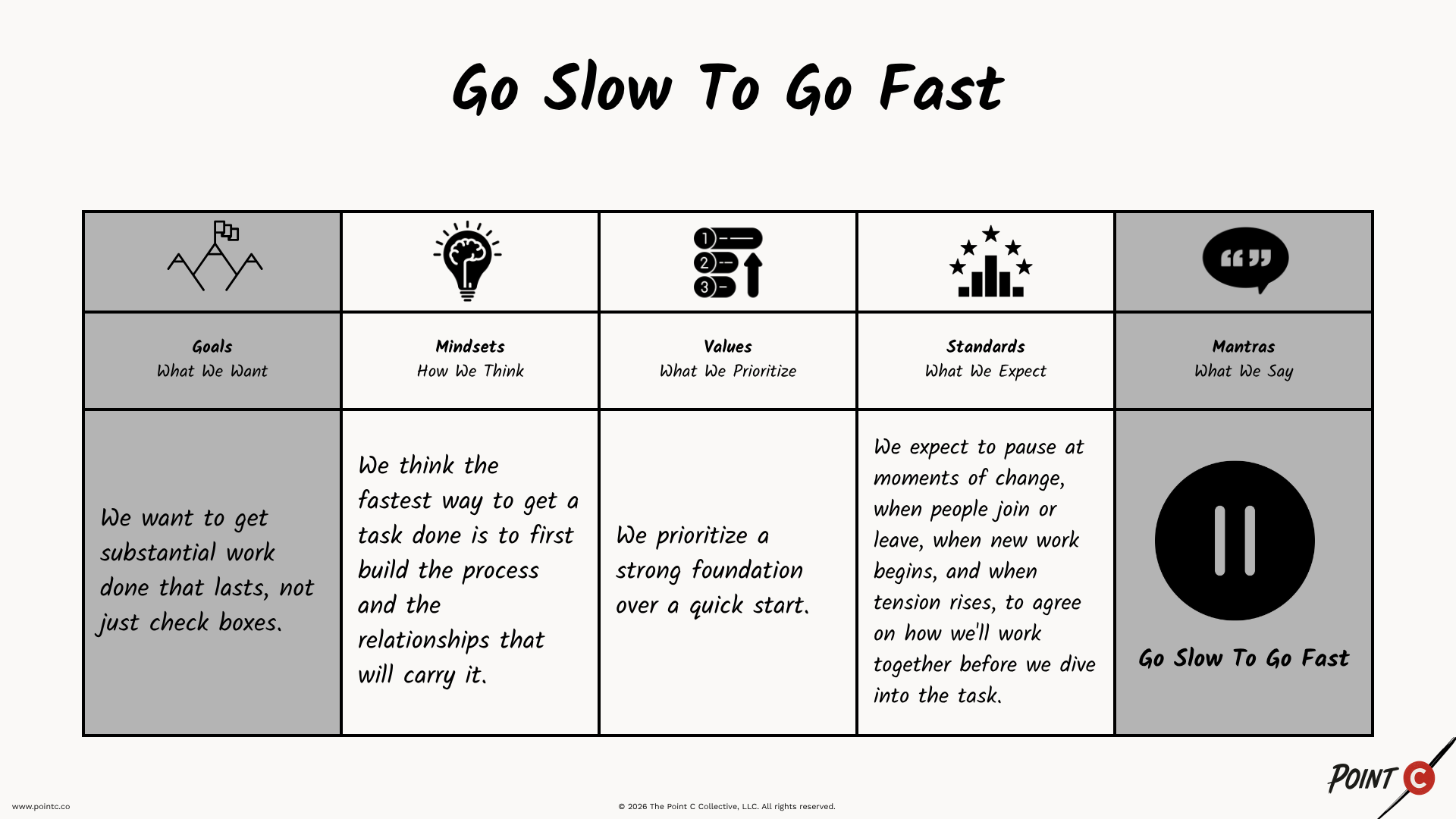
The Mantra Ladder
Here's the Mantra Ladder for Go Slow To Go Fast.
Goal (What We Want): We want to get substantial work done that lasts, not just check boxes.
Mindset (How We Think): We think the fastest way to get a task done is to first build the process and the relationships that will carry it.
Value (What We Prioritize): We prioritize a strong foundation over a quick start.
Standard (What We Expect): We expect to pause at moments of change, when people join or leave, when new work begins, and when tension rises, to agree on how we'll work together before we dive into the task.
Mantra (What We Say): Go Slow To Go Fast.
The Standard This Sets
We hire people who can hold urgency and patience at the same time. We recognize leaders who slow the team down at the right moment, especially when it's unpopular. And we let go of people who repeatedly run over process and relationships to get a quick win for themselves.
On a team that lives this mantra, the first meeting feels slower than you expected, and every meeting after it feels faster. Disagreements happen in the room. Nobody wonders whose call it is. And when the pressure rises, the team doesn't fall back on instinct, because it already agreed on what to do.
Your Challenge This Week
Look at your calendar for the next moment of change: a new hire starting, a project kicking off, a team being reorganized, a partnership that's been running hot.
Before you dive into the task, carve out time for the two things that will carry it. First, who you're working with: ask everyone to share their why, their superpower, and one thing they want to learn. Second, how you'll work: who owns what, how decisions get made, and how you'll give each other feedback.
Then run the TPR gut check on the meeting you've designed. If the first thing on the agenda is the task, try moving it last.
Next Week
Going slow gets the people in the room ready to hear each other. But there's a second gut check I run on every meeting, and it comes more from the teaching side of me: whether what happens in the room actually lands for everyone in it. People take in information differently. Some need to see it, some need to hear it, and some need to move. Next week: The VKA Checklist.
Know someone who would find this useful? Forward this email to them. They can subscribe here to get their own weekly half sheet.
About This Newsletter
The Idea Bucket is a weekly newsletter and archive featuring one visual framework, supporting one act of leadership, that brings you one step closer to building a culture of innovation.
It’s written by Corey Ford — executive coach, strategic advisor, and founder of Point C, where he helps founders, CEOs, and executives clarify their visions, lead cultures of innovation, and navigate their next leadership chapters.
Want 1:1 executive coaching on this framework or others? Book your first coaching session. It's on me.