Lead With Vulnerability
A mantra to model uncertainty, learning, and humility

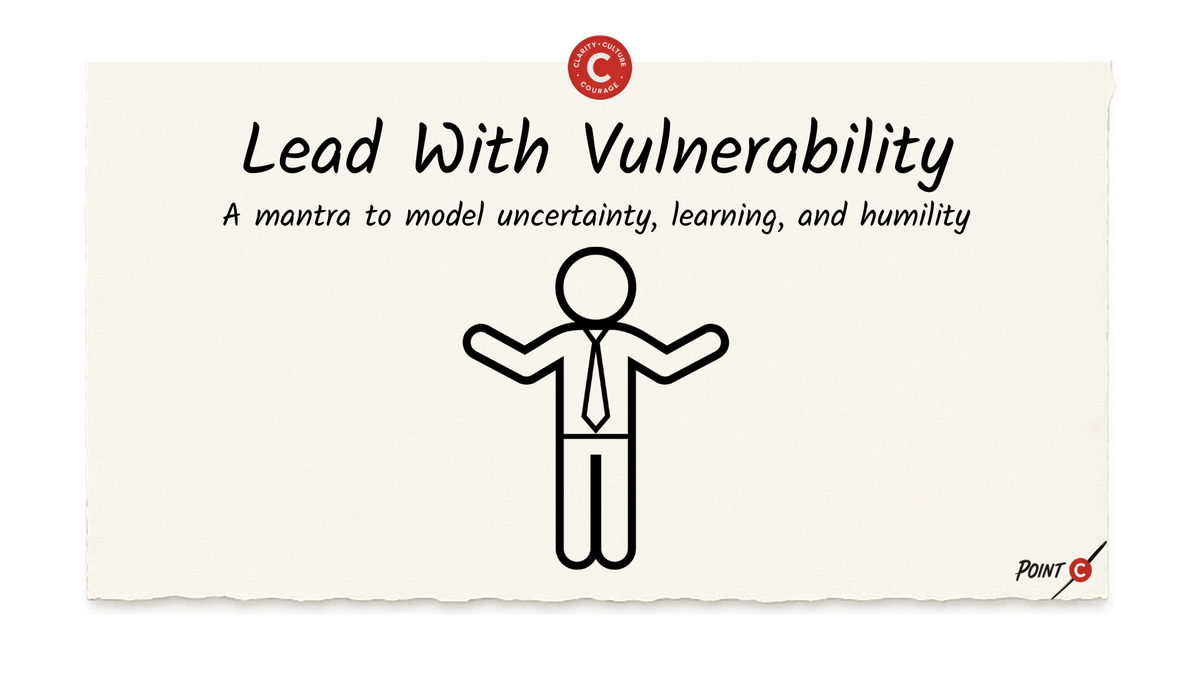
This week in The Idea Bucket we continue our dive into the mantras behind the ten levers that you can pull to increase psychological safety in your subculture. Last week we embraced the mantra Cultivate A Growth Mindset to frame work as a learning problem rather than an execution problem.
Today we turn the mirror on ourselves as leaders and pull the lever of acknowledging our own fallibility. This requires abandoning traditional leadership tropes of the strong and infallible leader and embracing the mantra: Lead With Vulnerability.
Acknowledge Your Own Fallibility
As a reminder, the second lever you can pull to increase psychological safety in your subculture is to acknowledge your own fallibility.
When leaders project certainty, dissent feels risky. When leaders acknowledge fallibility, speaking up becomes contribution, not challenge.
In the Anxiety Zone, authority amplifies silence. Naming your own assumptions lowers the interpersonal risk of disagreement.
When you acknowledge fallibility:
- You say “I might be wrong” before debates
- You name assumptions instead of conclusions
- You invite others to challenge your thinking
This is not about self-doubt. It’s about confidence without defensiveness.
If you want better thinking in the room, lead with vulnerability and model uncertainty, learning, and humility.
In order to do this, we need to abandon the myth of the strong, infallible leader.
The Myth of the Infallible Leader
I grew up competing in very masculine sports - football, wrestling, and rugby (with baseball and track thrown in there for good measure.) My job was to physically beat my opponent. I mostly did that with my feet, outmaneuvering the defenders with my speed and agility. But because I wasn't the largest person, I especially prided myself in my ability to deliver a crushing hit against the biggest guys on the field. I liked the surprise on their face when they got taught that energy really does equal mass times velocity squared.
Wrestling was the hardest sport. I'm convinced that nobody actually enjoys being a wrestler. Instead, they pride themselves on the challenge of being able to survive a wrestling season - waking up at 5am for a morning practice, cutting weight (an awful practice), and beating the crap out of each other as your muscles quickly fatigue and it becomes harder and harder to breathe. Nothing in my life before or after has made me tougher and shown me that I can overcome any adversity. (At least it's not wrestling!)
As the captain of both my football and wrestling teams, I learned to lead by example. The harder I worked, the tougher I became, the tougher my team would be.
When I entered the workforce, the mentality of the tough leader continued to be reinforced. The journalism industry has notoriously little training, especially around leadership and strategy (hence why the Sulzberger Program exists). In absence of best practices, people who rise through the ranks from journalist to manager have to make things up about what it means to be a leader. They look to other managers for examples and, unfortunately, what they mostly see are people who act tough, use the techniques of command and control, and would never admit that they are wrong or that they don't know the answer to a question. They also see people with big egos, huge egos in fact.
So it wouldn’t be a surprise that this is what I thought a leader was supposed to be: tough, infallible, and larger than life.
It wasn't until I left journalism to go to Stanford Business School where that myth started to crack. I remember picking up the book Good to Great by Stanford Business School professor Jim Collins when I was trying to soothe my imposter's syndrome of a documentary filmmaker going to business school and being floored by his conclusions on what makes someone the highest level of leader, what he calls Level 5:
Level 5 leaders display a powerful mixture of personal humility and indomitable will. They're incredibly ambitious, but their ambition is first and foremost for the cause, for the organization and its purpose, not themselves. While Level 5 leaders can come in many personality packages, they are often self-effacing, quiet, reserved, and even shy. Every good-to-great transition in our research began with a Level 5 leader who motivated the enterprise more with inspired standards than inspiring personality.
A mix of ambition and humility. I had certainly seen the ambition part in leaders before but not the humility. That really began to crack open my preconceived notion of what a leader actually looked like and I was curious to learn more. I took every class on leadership that I could while at business school.
And on that journey I came to a very different conclusion: Vulnerability is leadership.
Vulnerability is Leadership
Leadership is not a position. It is an act.
Leadership is recognizing an opportunity or a problem and taking action to pursue it or solve it. There are many people who occupy roles and carry titles that would imply that they are leaders, but their actions don't earn them the right to be called that.
The opportunity within innovation is to create a space where your team can effectively work together to build a venture that is both desirable, feasible, and viable — not just now, but into the future as trends change the field of play. In order to do that effectively, these teams need to be able to learn quickly by failing forward. That only happens when people have permission to be vulnerable. And that permission only comes from the leader having the courage to be vulnerable first.
So what does it mean to be vulnerable as a leader? Vulnerability is not oversharing or emotional dumping. It’s not about lowering standards or creating an environment where anything goes. Instead, vulnerability is the willingness to let yourself be seen in moments of uncertainty. It’s the discipline of saying, “I don’t know,” “I might be wrong,” or “I need your input,” especially when the pressure to appear certain is highest.
Let's take a brainstorm for example. The best brainstorms always separate flaring and focusing, they go for a volume of ideas, and they encourage wild and crazy ideas - not because that wild and crazy idea is the one you'll end up doing, but because it's the one that could spark that truly breakthrough idea that you will pursue. The leader needs to make the space for this type of activity to happen. So how they show up to one of these sessions determines everything. Does the most powerful person in the room throw out wild and crazy ideas or do they remain reserved? How the leader shows up sets the ceiling for everyone else. That's why if you find me in a brainstorm you might hear me talking about pandas flying airplanes throwing out lollipops. Not because I think that's a great idea. But because I know that if I float something crazy like that, someone else might feel comfortable sharing a really great idea that they have stuck in their head that they might not have felt comfortable sharing.
At its core, leadership comes down to a simple question:
Why would someone follow me?
Not because they have to, but because they choose to. People don’t follow leaders who pretend to have all the answers. They follow leaders who create the conditions where they can contribute to finding them.
This is what leadership research often refers to as resonant leadership. Leaders who create resonance don’t rely on authority alone; they create connection. And that connection doesn’t come from projecting perfection. It comes from authenticity, humility, and emotional awareness—in other words, from vulnerability.
In moments of uncertainty, leaders have a choice in how they show up. If they show up with their shield up, everyone else will put their shield up, kicking off what may become a spiral of distrust. If they show up vulnerable, they invite others to be a bit more vulnerable as well, kicking off what could be a climb towards trust and psychological safety. It's like a classic Prisoners Dilemma, except in this case, the leader has the opportunity to signal which direction the partnership can go in. Since leaders often have more structural power than others in the room, they are the ones who dictate how the dynamic will play out.
This applies to negotiations as well. As I discussed in my previous post Use The Language of Interests, the choice of language that leaders use determines whether they will start a chain reaction that leads to conflict or leads to alignment. Strong leaders who have the ability to wield power choose vulnerability in these moments instead. They could threaten to use their power and invite counter-threats but they know that strong leaders don't have to make threats. Instead, they lead with the language of interests and become genuinely curious about how to uncover the needs of the other side, even when they don’t technically have to in order to achieve their goals.
Threats are a sign of weakness. Vulnerability is a signal of strength.
If you want a team that speaks up, challenges assumptions, and contributes ideas, you have to make it safe for them to do so. And one of the fastest ways to lower interpersonal risk on a team is to lower your own. When leaders are willing to acknowledge their own fallibility, they create space for others to do the same.
How to Lead With Vulnerability
If you want to acknowledge your own fallibility in a way that increases psychological safety in your subculture, it shows up in small but meaningful shifts in how you lead day to day.
It starts with how you enter conversations. Instead of positioning your perspective as the answer, you might begin with “I might be wrong, but here’s how I’m thinking about this.” That simple shift signals that your goal is better thinking, not being right.
It continues with how you communicate your ideas. Rather than presenting conclusions as fixed, you present them as a rough, imperfect prototype. You make your assumptions visible so others can engage with and challenge them. You invite dissent explicitly by asking questions like, “What am I missing?” or “Who sees this differently?”
It also requires being willing to admit when you don’t know. In complex, uncertain environments, not knowing is part of the work. When leaders model that reality, it normalizes it for everyone else. And over time, people become more willing to surface incomplete ideas and early-stage thinking.
Finally, it means letting people see how your thinking evolves. When you update your perspective based on new information, you demonstrate that changing your mind is not a weakness—it’s a strength.
This is not about being less decisive. It’s about creating the conditions for better decisions. Because when leaders model vulnerability, they give everyone else permission to think out loud, challenge assumptions, and contribute more fully. And that is what moves a team from the Anxiety Zone to the Learning Zone.
Your Challenge This Week
Pay close attention to how you show up in moments of uncertainty.
Ask yourself: When I don’t know the answer, what do I do? Do I default to projecting certainty, or do I create space for others to think with me?
This week, practice one simple but powerful shift: “I'm not sure, but here’s how I’m thinking about this.” Turn a conversation that could have been an “inform” into one that signals you are testing a prototype.
Notice what happens next. Does the conversation open up? Do others contribute more freely? Do they improve upon your thinking?
The way you show up in these small moments determines whether your team feels safe to speak or chooses to stay silent. And psychological safety is built one moment at a time.
Next Week
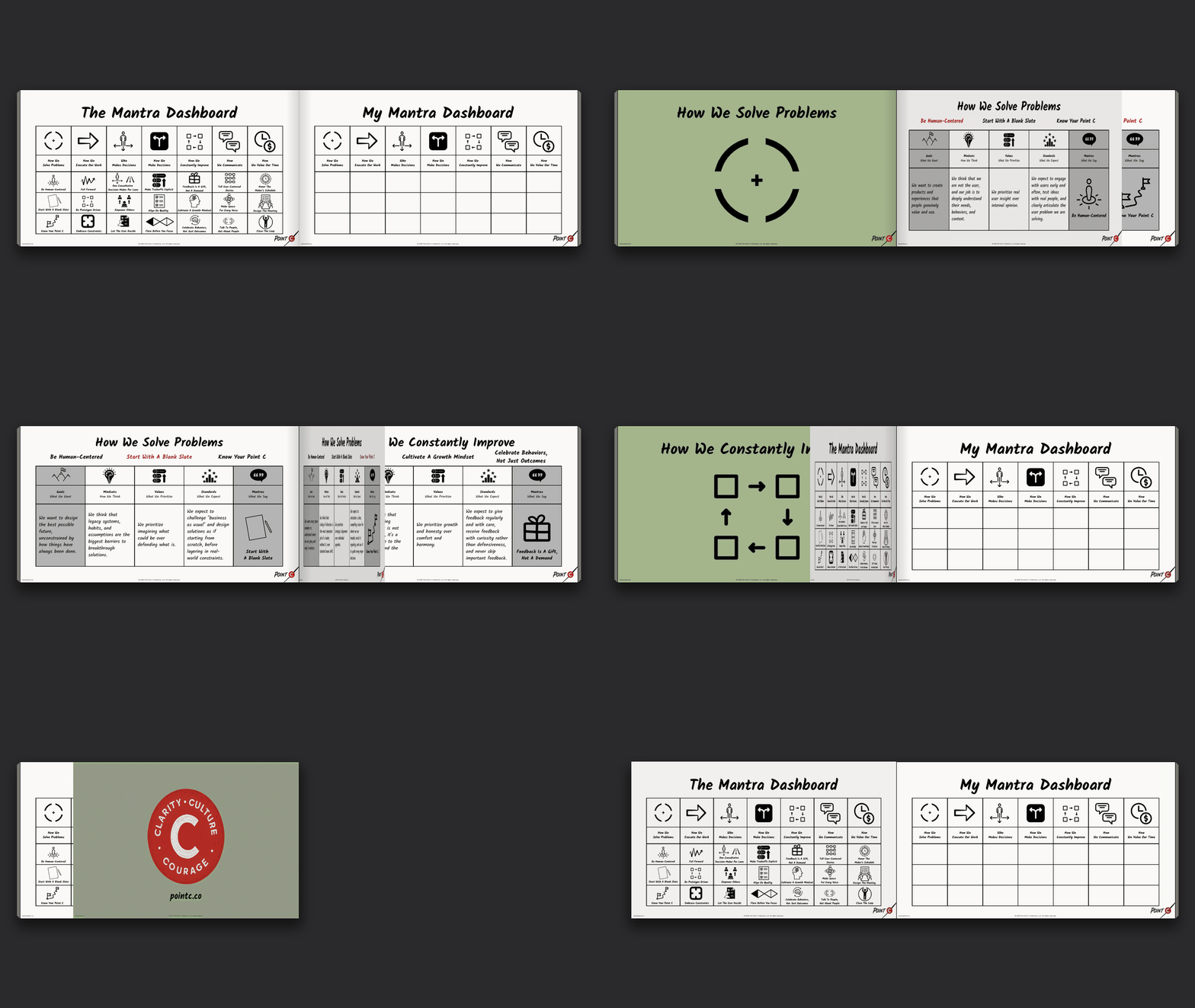
As a reminder, here are the ten corresponding mantras to increase psychological safety in your organization:
- Cultivate A Growth Mindset
- Fail Forward
- Feedback Is A Gift — Not A Demand
- Lead With Vulnerability
- Make Space For Every Voice
- Celebrate Behaviors, Not Just Outcomes
- Flare Before You Focus
- Make Expectations Explicit
- You Own Your Role, We Own The Outcome
- Design For The Roller Coaster
Next week, we dive into the mantra that pulls the lever of promoting inclusive leadership: Make Space For Every Voice.
About This Newsletter
The Idea Bucket is a weekly newsletter and archive featuring one visual framework, supporting one act of leadership, that brings you one step closer to building a culture of innovation.
It’s written by Corey Ford — executive coach, strategic advisor, and founder of Point C, where he helps founders, CEOs, and executives clarify their visions, lead cultures of innovation, and navigate their next leadership chapters.
Want 1:1 executive coaching on this framework or others? Book your first coaching session. It's on me.