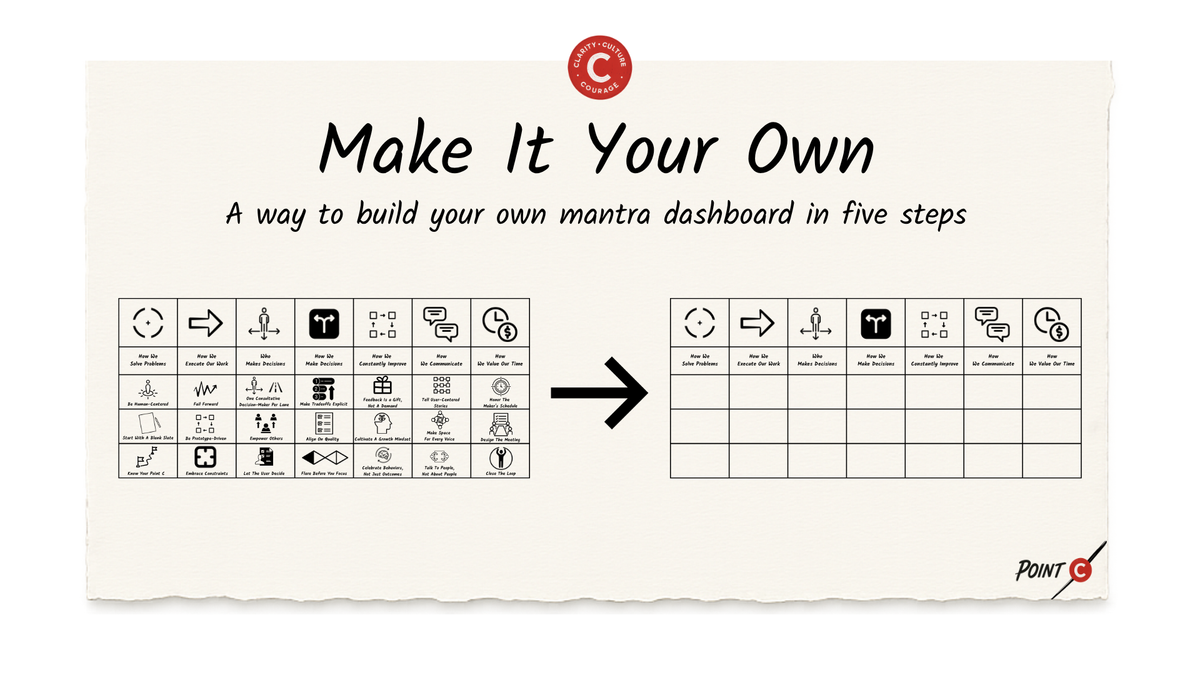
Make It Your Own
A way to build your own mantra dashboard in five steps

Was this forwarded to you? Subscribe here to get one leadership framework per week.
I operate really well on streaks. For a stretch of my life I ran it as a series of them, tracked in the Streaks app. How many days in a row can I run four miles? Four months, it turned out. How long can I eat vegan? Also four months. How many weeks can I publish one post without missing a deadline? As of last Thursday, I have my answer: sixty-six.
The streak is over. And I want to tell you what my executive coach, Ed Batista, taught me the last time one of my streaks ended, because it changed how I think about goals. My methodology, he pointed out, was fragile. It works beautifully while the streak lasts. But the day it breaks, the number becomes the enemy: I couldn't imagine running my way back to where I'd been, so I mostly stopped running. I've hardly run since. That's what fragile goals do; they shatter. What I actually wanted, he said, were resilient goals. The point was never the unbroken chain. The point is how robustly you bounce back when a link breaks.
So here is my commitment to resilience. The streak is over. The writing continues, uninterrupted.
And it's fitting that this week's post is about building something designed to be imperfect. Two weeks ago, I published The Mantra Playbook: the complete dashboard, all twenty-one ladders, and a blank worksheet waiting at the back. I also promised to show you how to build a version that's yours. Here's the method, the same sequence I use in my leadership classes, pulling together the best of what this series has built. You need a pen, about an hour spread across a week, and a willingness to write things that aren't finished.
One reframe before the steps, because it changes how you approach all of them. You are not starting from zero. You already lead with mantras; you just haven't been intentional about them yet. Under pressure, in meetings, in the hallway after meetings, you reach for the same phrases again and again. Some of them are helping you. Some of them are teaching your team things you don't mean. Noticing what your words are actually doing is the key that unlocks everything else. The method isn't about inventing language. It's about seeing the language you already use, keeping what deserves the job, and filling in what's missing on purpose.
Step One: Audit What You Already Say
Start with the map, not the phrases. Draw the seven categories of the Subculture Coverage Matrix as seven columns: how we solve problems, how we execute our work, who makes decisions, how we make decisions, how we constantly improve, how we communicate, and how we value our time. Every team needs signals from its leader in all seven.
You can also use this fillable worksheet:
Now spend a few days listening to yourself, and write each phrase you catch yourself repeating into the column where it belongs. The phrase you say in every prioritization fight goes under how we make decisions. The thing you say when someone brings you a rough draft goes under how we execute. Don't judge yet; just place them.
By the end of the week the map will show you two things at once. The columns where you're loud: that's where you're already leading on purpose, or at least by habit. And the columns where you're silent: those aren't neutral. Where your team hears nothing from you, they invent their own rules, and you inherit a culture you didn't choose. The audit shows you exactly where you're silent. Everything else in this method is how you fill those silences on purpose.
Step Two: Build One Ladder
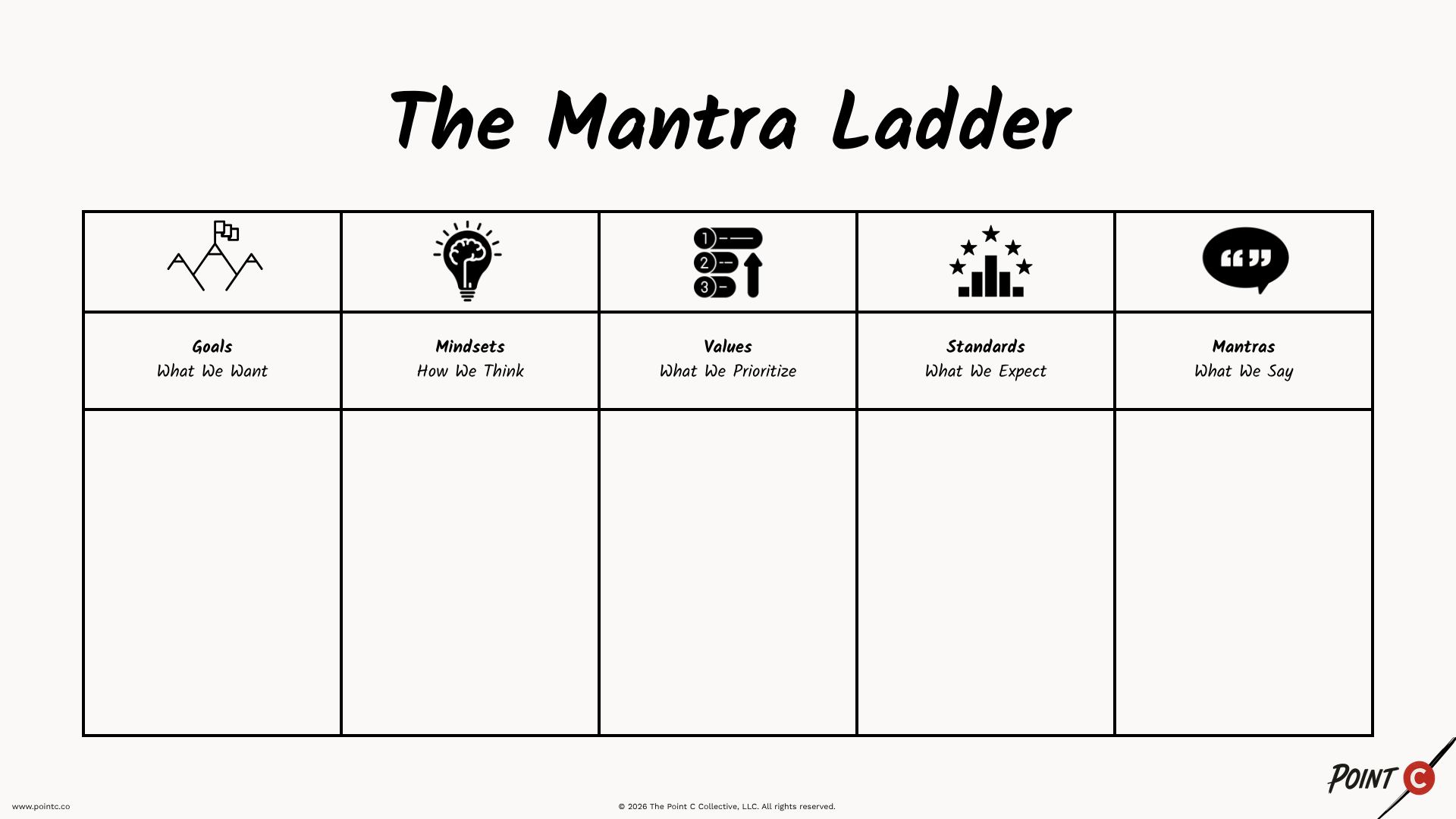
Take one phrase, whichever one pulls at you, and build a full Mantra Ladder underneath it. The ladder has five rungs, and each one is a question. Goal: what do we want? Mindset: how do we think? Value: what do we prioritize, and over what? Standard: what do we expect? Mantra: what do we say?
Two mechanical notes that make this work. First, start anywhere. If you have a phrase, dig down from it to find out why it works. If you have a goal for your culture, climb up from it toward language. If the thing you know best is a standard you won't lower, start in the middle and build in both directions. The ladder isn't a recipe you follow in order; it's a completeness check. You're done when every rung is filled and they connect.
Second, write the value rung as a tradeoff. Not "we value quality" but "we prioritize shared standards of quality over individual taste." Not "we value learning" but "learning velocity over being right." The over is the value. Until you've named what you're giving up, you've written a poster, not a priority.
And if nothing in your audit pulls at you, steal. Take a phrase from my dashboard, from a book, from your grandmother, and build your ladder under it in your context. The words can come from anywhere. The ladder is what makes them yours.
Step Three: Test It
Test the ladder with three questions, each one harder than the last.
Can you say it and mean it? Say the mantra out loud and picture using it in a real moment: the meeting that's drifting, the decision that's stalling. You're going to say this phrase so often that your team makes fun of you for it, and that's the goal; the teasing means it's landing. So the question isn't whether it's comfortable. It's whether it's clear, and whether it comes from conviction rather than fear. A mantra that's secretly an anxiety ("don't embarrass me") will teach your team to be afraid. A mantra that's a belief teaches them how to work.
Does it make sense to someone else? Start with empathy, not with your ladder. Say the phrase to one person and ask what it means to them. Their answer tells you what the words carry on their own, which is all your team will ever hear at first. Then show them the ladder and ask whether the phrase captures the standard. As I wrote when I introduced the ladder, a mantra that only makes sense to you isn't a mantra yet. It's a note to self. A real mantra is language your team can carry.
Is it doing what you want? After a couple of weeks of saying it, look at the behavior. If it isn't moving, don't just throw out the phrase. Look underneath it, because the weakness is usually in a rung: a standard you never made explicit, or a value that doesn't name a real tradeoff. Fix the rung, keep saying the phrase, and watch again.
Step Four: Put A Placeholder In Every Silent Column
Back to your map. In my classes, I ask everyone to leave with at least one mantra in every category. One per category is enough, and it doesn't have to be good yet. As I wrote when I first published the dashboard, a rough phrase is infinitely better than an empty lane, because even a rough phrase changes what your team hears from you this week.
I'll practice what I'm preaching here: there are a couple of mantras on my own dashboard whose language I still don't love. I've been told "One Consultative Decision-Maker Per Lane" is inelegant. It's not snappy enough. But I still use it, because the idea underneath it is one I refuse to leave unsaid. I prioritize essential over sexy.
The bottom line is that these mantras can be placeholders. They hold the lane while I keep hunting for better words, and they've held it for months. That's allowed. What's not allowed is a blind spot: leaving a whole category of your culture unspoken because you haven't found the perfect phrase for it yet. Your team is living in that column either way.
When every column has one, congratulations. You have a dashboard. It's version 1.0, and version 1.0 is the most important one to get down.
Step Five: Make The Implicit Explicit
Don't let your mantras leak out one at a time and hope the team reverse-engineers what you mean. Have the conversation.
Here's why this step matters more than any other. Norms are the actual rules of how your team works together: the behaviors that get rewarded, tolerated, and refused. Every team has them. The only question is whether they stay implicit, where everyone operates on private guesses about what you expect, or become explicit, where everyone is working from the same page. In the absence of a stated norm, people make stuff up. And teams that never talk about their norms while things are calm are the ones that blow up when things get hard. High performing teams set their ground rules at the top of the roller coaster so they can survive the bottom.
So bring your dashboard to your team as a strong first draft and walk through it directly, one mantra at a time: Here they are. Here's why I use each one. Here's what I mean by it. This is our culture. What can I clarify? Expect the clarifying to be where the value is: No, fail forward doesn't mean flailing around, and it doesn't mean randomly trying things; it means we state a hypothesis, test it, and learn by doing. That exchange, repeated across your dashboard, is your team discovering what you actually expect, out loud, instead of guessing. Then invite them to sharpen it. Direction comes from you; refinement comes from everyone.
Then repeat your mantras more than feels natural. Repetition is the mechanism, and you'll know one is working when someone on your team says it before you do.
And hold the whole thing as a prototype. Sharpen the language, swap a mantra that isn't landing, retire one that's done its job. Mine looks different than it did a year ago, and it should. Resilient, not fragile. Which is where we started.
Your Challenge This Week
Download The Mantra Dashboard Worksheet above. Run the audit and build one ladder. Sort the phrases you catch yourself repeating into the columns, and build one full ladder under the phrase that pulls at you.
The rest of the method will still be here. Version 1.0 starts with one honest map and one ladder.
Next Week
A mantra tells your team what you believe. A ritual is where they find out whether you meant it. Next week, the second ladder: how a phrase becomes norms, reinforcement, and finally a practice that lives on your team's calendar. Next week: The Ritual Ladder.
Know someone who would find this useful? Forward this email to them. They can subscribe here to get their own weekly half sheet.
About This Newsletter
The Idea Bucket is a weekly newsletter and archive featuring one visual framework, supporting one act of leadership, that brings you one step closer to building a culture of innovation.
It’s written by Corey Ford — executive coach, strategic advisor, and founder of Point C, where he helps founders, CEOs, and executives clarify their visions, lead cultures of innovation, and navigate their next leadership chapters.
Want 1:1 executive coaching on this framework or others? Book your first coaching session. It's on me.