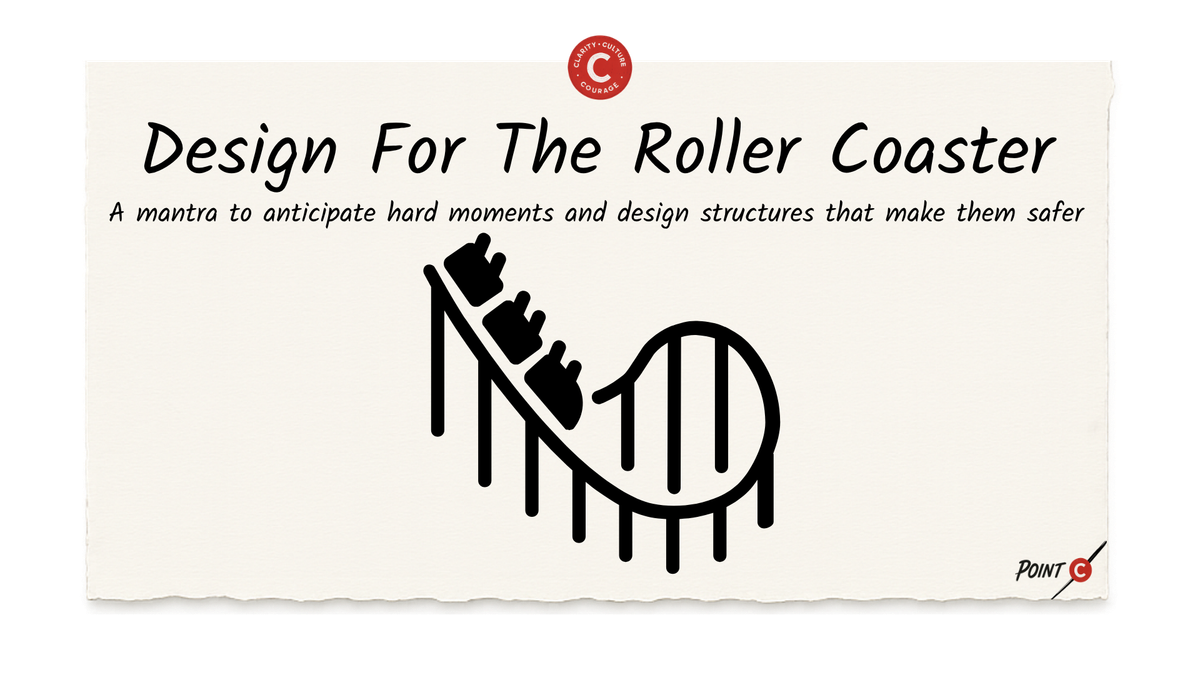
Design For The Roller Coaster
A mantra to anticipate hard moments and design structures that make them safer

This week in The Idea Bucket we continue our dive into the mantras behind the ten levers that you can pull to increase psychological safety in your subculture. So far we've explored the following mantras:
- Cultivate A Growth Mindset
- Fail Forward
- Feedback Is A Gift — Not A Demand
- Lead With Vulnerability
- Make Space for Every Voice
Today we pull the lever of providing structure for difficult conversations.
The innovation journey is never up and to the right. Although design is a structured, creative process, because the end product is by definition not yet known, the journey can feel like a roller coaster.
This has tremendous implications for the success or failure of an innovation team. Instead of assuming that everything will always be harmonious on the team, great leaders understand that they need to lay the foundation for a high-performing team early and Design For The Roller Coaster.
Provide Structure for Difficult Conversations
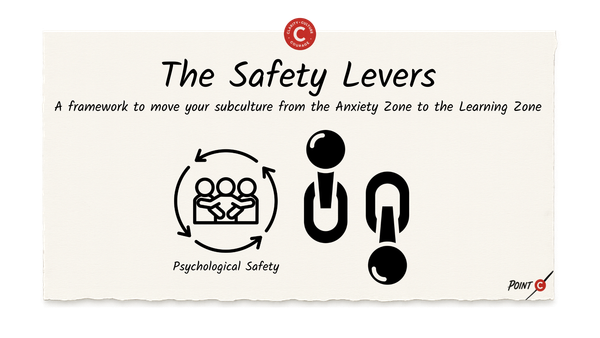
As a reminder, one of the ten levers you can pull to increase psychological safety in your subculture is to provide structure for difficult conversations.
Unstructured hard conversations rely on confidence and power. Structured ones rely on shared tools and expectations.
In the Anxiety Zone, difficult conversations feel personal and unpredictable.
When you provide structure:
- You separate observations from interpretations
- You create regular forums for hard conversations
- You model structured feedback yourself
This is not about scripting people. It’s about making hard conversations safer and more productive.
If you want resilience, design for the roller coaster and build structures that make hard moments safer.
The problem is that most teams don’t think about this until they are already in the middle of a difficult moment.
When tension rises, stakes are high, and emotions are running hot, that is the worst possible time to figure out how to communicate. By then, people fall back on instinct. And instinct, in most organizations, looks like avoidance, defensiveness, or escalation.
That’s why great leaders don’t wait for the hard moment. They design for it in advance.
Go Slow To Go Fast
One of the key things I focus on in my coaching and facilitation work is helping groups of co-workers become high-performing teams. I've done this in multiple contexts, from start-up founders to the C-suite of a Fortune 500 global brand. Sometimes I get to do that at the very beginning of team formation, where we can intentionally set the norms for how the team will operate. But often, I’m brought in after things have already started to break down.
The pattern is almost always the same. In an effort to move fast and show early progress, teams skip the foundational work. They don’t align on mission and purpose. They don’t clarify roles or decision rights. They don’t define how they will give feedback or handle disagreement. They say that "everyone is an adult here" and assume everyone already knows how this should work. (Trust me, if this foundation is not set, you'll soon find out that everyone will NOT act like an adult in the room.)
Individuals on the team may get a quick win or two but then they hit their first real point of friction. And without a shared foundation, that friction turns into dysfunction.
So instead of jumping straight into execution, strong leaders go slow to go fast. They take the time to lay the foundation of a high-performing team by building its operating system. They instill feedback rituals early when things are going well so that those self-correcting muscles are strong when they inevitably hit the bottom of the roller coaster.
They don't design their team for just the best case scenario. They design for the roller coaster.
Designing For The Roller Coaster
Designing for the roller coaster means putting structure in place before you need it. It means making sure your team has shared ways to handle the moments when things get hard.
While there are many things you should do with your team to lay a solid foundation, the dysfunctional teams that I have worked with tend to miss at least one of these three things:
1) Convergent Goals
A high-performing team must be aligned on its mission, purpose, and goals. Dysfunctional teams think they are aligned but what they've actually done is skip the hard conversations to stress test their goals. A deeper conversation would reveal that they have goals that will ultimately diverge rather than converge. To ensure that teams have convergent goals, I recommend that they develop selection criteria. This is a force-ranked set of priorities that you agree on upfront—before ideas are generated—that you will later use to evaluate and choose between them. To do this, run The Selection Stack ritual with your team and key stakeholders.
2) Clear Roles & Decision Rights
Without clear swim lanes and decision rights, individuals on teams feel disempowered and projects tend to stall out. This often happens when leaders are hesitant to explicitly give up their own power or when they want to maintain the appearance that the team is a democracy. High-performing teams have clear roles for each team member and are clear about how decisions are made. Because without that clarity, interpersonal conflict takes over. While a leader has many choices about how to set up lanes and decision rights on their team, I highly recommend operating by the mantra One Consultative Decision Maker Per Lane.
3) A Feedback Culture With Reinforcing Rituals
A leader who designs for the roller coaster inherently understands that they need to design a self-correcting organism. Just like how user feedback improves a product, regular individual and team feedback improves a team. First, the leader must establish the core value of having a free flow of information on the team and give individuals on the team the language they need to embrace that mindset. I use the mantra Feedback Is A Gift - Not A Demand. Then the leader needs to set up rituals for feedback to regularly occur in the organization, in good times and in bad. The rituals I use include The One-on-One Gift Exchange, The Team Gift Exchange, and The Design Review.
These structures may feel unnecessary when things are going well. But they are exactly what allow a team to stay functional when things are not. When you hit the bottom of the roller coaster, the foundation of your team truly reveals itself. Not what you hoped it was, but what you actually built.
Your Challenge This Week
Think about your team at its most difficult moment. Not when things are going well, but when something breaks.
Now ask yourself: Do we have a shared way to handle that moment? Or do we improvise every time?
This week, don’t wait for the next hard conversation. Design for it.
Introduce one simple ritual. Try The One-on-One Gift Exchange or The Team Gift Exchange.
Because the time to figure out how your team handles hard moments is not during the moment. It’s before.
Next Week
As a reminder, here are the ten corresponding mantras to increase psychological safety in your organization:
- Cultivate A Growth Mindset
- Fail Forward
- Feedback Is A Gift — Not A Demand
- Lead With Vulnerability
- Make Space For Every Voice
- Design For The Roller Coaster
- You Own Your Role, We Own The Outcome
- Celebrate Behaviors, Not Just Outcomes
- Flare Before You Focus
- Make Expectations Explicit
Next week, we dive into the mantra that pulls the lever of creating shared accountability: You Own Your Role, We Own The Outcome.
About This Newsletter
The Idea Bucket is a weekly newsletter and archive featuring one visual framework, supporting one act of leadership, that brings you one step closer to building a culture of innovation.
It’s written by Corey Ford — executive coach, strategic advisor, and founder of Point C, where he helps founders, CEOs, and executives clarify their visions, lead cultures of innovation, and navigate their next leadership chapters.
Want 1:1 executive coaching on this framework or others? Book your first coaching session. It's on me.