Start With A Blank Slate
A mantra to escape “business as usual” and design what’s next

In The Idea Bucket, we've now explored one of the three key mantras in the How We Solve Problems category in the Subculture Coverage Matrix: Be Human-Centered.
Today, we move to the second: Start With A Blank Slate.
This mantra helps your team escape the gravitational pull of “business as usual” — and design the future without being trapped by the past.
The Job Of The Innovation Leader
Your job isn't to manage the status quo. It's not even to come up with the next big thing.
In a world of exponential change, even your best idea might be obsolete by the time it launches.
Your real job is to build the team, the process, and most importantly—the culture—that will constantly:
1) Anticipate shifting top-down trends
2) Empathize with changing bottom-up user needs
3) Prototype, test, and iterate on new solutions
4) Adjust your venture design to find viability and defensibility
5) Craft a concrete, compelling story that guides the company to its next destination
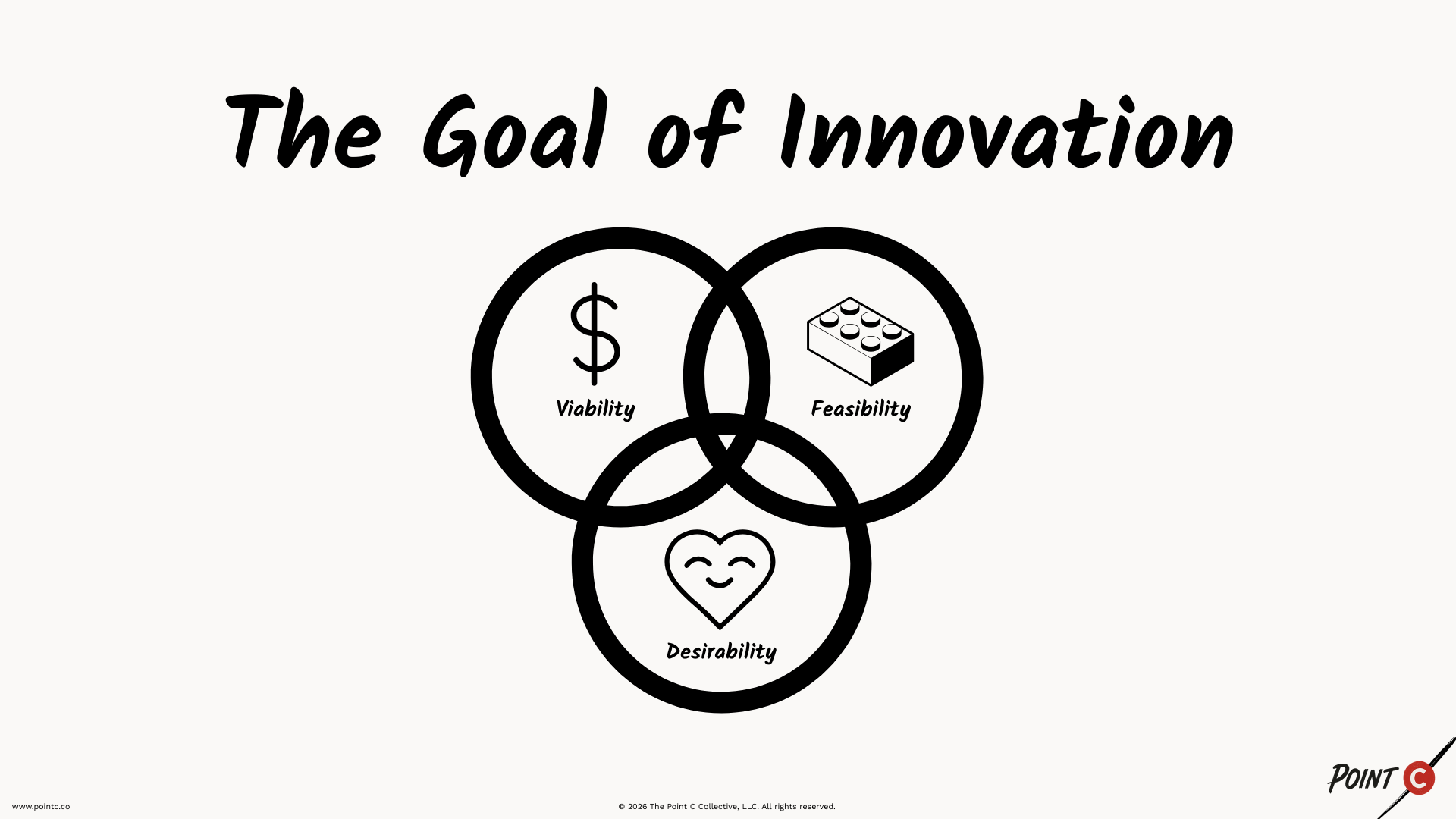
Your goal is to help your team stay in the innovation sweet spot:
Desirable. Feasible. Viable.
The Trap of Thinking in Nouns
Every successful company once found this sweet spot. But over time, many fall out of it. Why?
They begin to define themselves by what they are instead of what they do.
They become a noun:
- "A newspaper company."
- "A typewriter manufacturer."
- "A taxi business."
But nouns trap you in the past. Verbs point toward the future.
The most resilient organizations define themselves by the jobs they help users accomplish:
- "We help people stay informed."
- "We help people communicate."
- "We help people move."
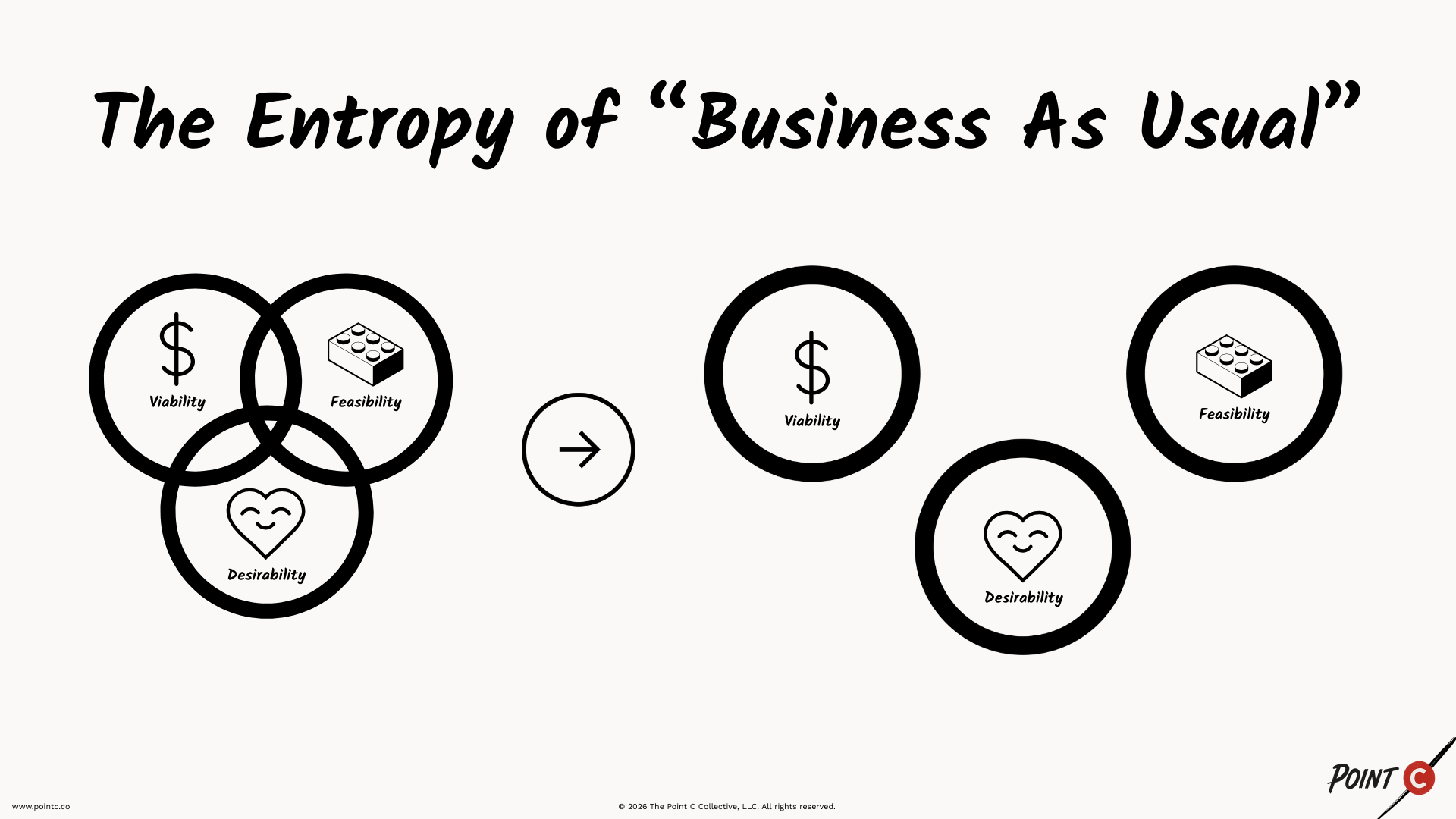
Innovation dies when companies cling to their noun. The world shifts around them, but their offerings stay the same. That’s the entropy of "business as usual."
Before they realize it, the company falls out of the innovation sweet spot and it has lost the ability to bring the three rings of desirability, feasibility, and viability back together.
But you are building something different.
You're embedding a subculture of innovation—one where:
- Being human-centered ensures your team stays needs-focused and solution-agnostic.
- Being prototype-driven builds comfort with imperfection and iteration.
- And starting with a blank slate pushes your team to design for where the world is going, not where it's been.
What It Means to Start With A Blank Slate
When you’re crafting a new strategy, wipe the slate clean and ask:
“If we were starting from scratch, what makes the most sense given where the world is going?”
That first answer becomes your Point C—your concrete next destination.
Then ask:
“How do we get from here (Point B) to there (Point C)?”
This contrast is the essence of strategic storytelling.
Prototype in Parallel
Now that you've defined your blank slate Point C, you’re ready to prototype alternatives.
Run this exercise as a time-boxed sprint:
1) 45 minutes: Design the best version of the future (your Point C) with a blank slate.
2) 30 minutes: Ask how to get there from where you are now (Point B).
3) 30 minutes: Explore two constrained alternatives based on today’s realities.
4) 15 minutes: Compare trade-offs across short, medium, and long-term dimensions.
This “parallel prototyping” approach gives you clarity on the ideal, options for reality, and language to articulate trade-offs—one of the most underdeveloped skills in strategy conversations. Oftentimes, starting with a blank slate surfaces a scenario that truly takes into account the medium and long-term risks and opportunities in a way that the business-as-usual scenarios tend to miss.
Your job as a leader is to know the target scenario, make a plan to get there, ask for the resources necessary to get there, develop alternatives based on key constraints, and articulate the key trade-offs, risks, and opportunities between the options from a short-term, medium-term, and long-term point of view.
Examples of Starting With A Blank Slate
This mantra isn’t just for strategy work. “Start With A Blank Slate” is a mindset that can—and should—be applied across a wide range of leadership decisions.
Here are two places where applying it can unlock clarity and momentum:
1. Budgeting: Fund the Future, Not the Past
Your budget isn’t just a financial document. It’s a strategic artifact. It reveals what your organization truly values.
And yet, most budgeting cycles reinforce the status quo. Leaders add or subtract percentages from last year’s budget—effectively making the future a minor variation of the past.
That logic breaks down in moments of inflection—especially during layoffs or strategic pivots. These are precisely the moments to rethink everything.
Instead of across-the-board cuts, ask yourself:
If we were starting from scratch, how would we invest to reach our next destination?
This is where Point C budgeting comes in. Ask every team to define their Point C—the concrete outcome they can deliver that aligns with the company’s next destination. Then, force-rank those visions and fully fund the top ones.
This approach doesn’t just optimize. It reorients the entire organization toward a shared, forward-looking strategy.
2. Team Construction: Build the Team the Venture Needs
When pitching a new venture or initiative, most teams start with the wrong question:
Why should you bet on us?
That’s backward. It locks you into defending your current org chart.
Instead, ask:
What combination of skills and experiences would this venture need to succeed—if we were starting from scratch?
Only then should you assess the current team against that ideal. The gaps you identify become real strategic risks—ones you need to name clearly and address intentionally.
This shift turns team construction into a forward-looking design exercise, not a backward-looking justification.
Your Challenge This Week
Practice the Start With A Blank Slate mindset:
- Choose a focal point: a strategy, team, or budget.
- Ask: What would the ideal scenario look like if we were starting from scratch?
- Spend 45 minutes designing that future (your Point C).
- Then take 30 minutes to map how you’d get there from where you are now.
- Compare that plan to your current course. What trade-offs emerge?
- Reflect on what you’ve learned.
- Consider running the same exercise with your executive team. Share this post as context.
Next Week
We've now explored some of my core mantras in the Subculture Coverage Matrix. I have more to cover here and will return to this matrix often to give you more mantras and frameworks to build a subculture of innovation.
But with the New Year approaching, I thought I would end my year with some frameworks that I use often with my coaching clients when they want to shift away from strategy and leadership discussions and begin to talk about their personal journeys.
Next week, we'll dive into the key framework I use to help my clients be focused and ambitious in the face of uncertainty: The Go/No-Go Date.
About This Newsletter
The Idea Bucket is a weekly newsletter and archive featuring one visual framework, supporting one act of leadership, that brings you one step closer to building a culture of innovation.
It’s written by Corey Ford — executive coach, strategic advisor, and founder of Point C, where he helps founders, CEOs, and executives clarify their visions, lead cultures of innovation, and navigate their next leadership chapters.
Want 1:1 executive coaching on this framework or others? Book your first coaching session. It's on me.