The Go/No Go Date
A way to maximize your energy & runway during a risky endeavor

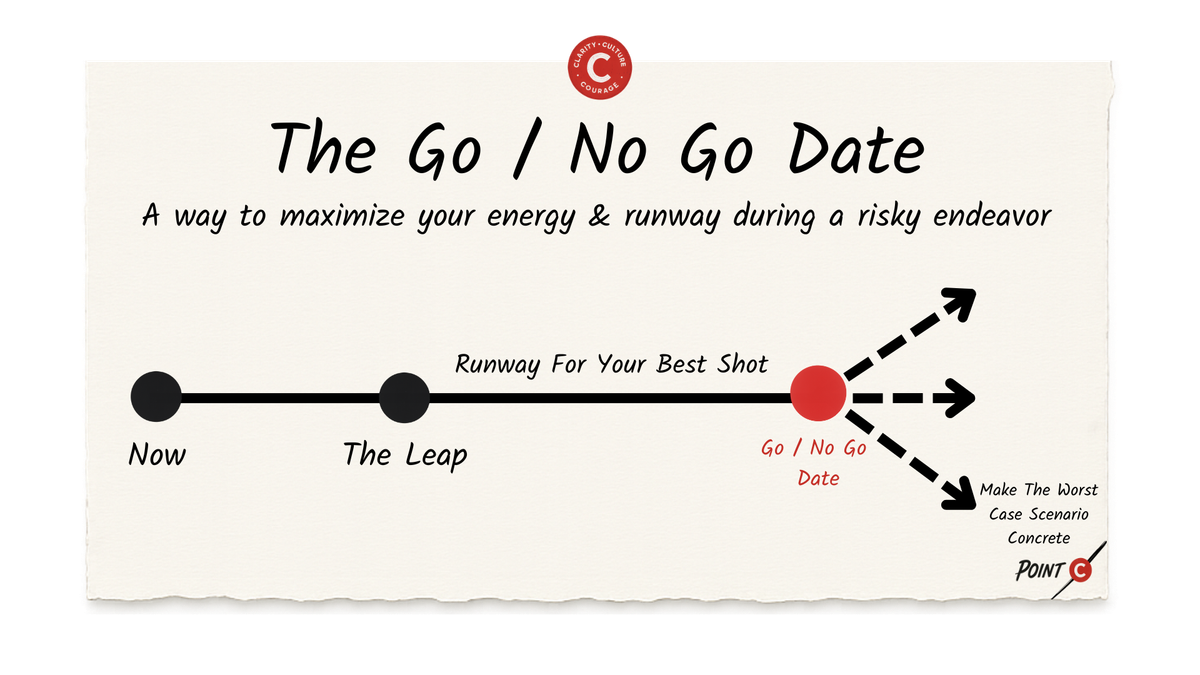
As we head into the New Year, I want to zoom out. We’ve spent the last few months diving deep into strategy and leadership. Now, it’s time to focus inward — on you.
The next few issues will feature the personal growth frameworks I use most often with clients. These are the tools that help ambitious leaders move forward, even in moments of deep uncertainty.
Today, we’re starting with one of the most powerful: The Go / No Go Date.
To Be Ambitious Is to Be Afraid
I work with clients on clarifying, envisioning, and reaching ambitious goals.
Some are starting their own companies for the first time. Some are stepping into a leadership role that has no map. And some are beginning a journey to land their next big career role.
Each of these clients will succeed or fail based on how they manage their mindset in the face of uncertainty. Will they find a way to focus, fully explore, and give it their best shot? Or will the perceived risks and uncertain outcome cause them to mentally spin, depleting precious energy and runway, leading to conservative choices, the diminishing of a dream, and, ultimately, regret looking back on a wasted opportunity?
Most people who set out to do ambitious things don’t set their minds up for success. Their days are punctuated by moments of fear and paralysis. They imagine horrible things happening to them when they imagine failure is inevitable: I'll never be able to get another job. I'll lose my house. My family will be starving on the streets. People will think I'm a failure.
Feeling fear goes hand-in-hand with being ambitious. Imposter syndrome is real and normal. In fact, if you aren't feeling fear in what you do, I'd argue that you aren't being ambitious enough.
The goal isn’t to avoid fear. The goal is to feel the fear, name it, and act anyway. Your job as an ambitious person is to practice standing in fear, becoming comfortable in that spot, and doing what you set out to do.
That’s why one of the first tools I teach ambitious clients is The Go / No Go Date — a simple but powerful exercise that helps you clarify your commitment, manage your energy, and reclaim your power in the face of uncertainty.
The Go / No Go Date is an exercise that you can do early on in a journey of ambition that helps you manage that fear in order to maximize your energy and utilize the precious runway that you have.
Setting Your Go / No Go Date
When you’re reaching for something ambitious, the outcome is uncertain by design. I’ll say it clearly: if the outcome is guaranteed, it’s not ambitious.
So how do you manage that uncertainty?
Start by mapping your journey as three distinct phases:
- Now: Where you are today. You haven’t committed fully yet — but you’re considering the leap.
- The Leap: The moment you go all-in. This is when you begin giving your goal your full focus, time, and energy.
- The Go / No Go Date: The date you’ll pause, reflect, and decide whether to persevere, pivot, or pause.
That third date — your Go / No Go Date — is the one we’re focused on here.
It’s the first time you’ll give yourself permission to step back and ask: Is this still the right path for me? Until then, you’re committed. You’re not second-guessing. You’re all in.
To choose your Go / No Go Date, ask yourself:
“How many months of fully dedicated effort would feel like I gave this a real shot?”
That’s your date. Put it on your calendar. Write it on a Post-it. Stick it to your screen. It’s a psychological contract: between now and then, I’m showing up fully.
A few things this is not:
- It’s not the date you must “succeed” or “fail.”
- It’s not a forever commitment to the path.
- It’s not a rigid milestone.
Instead, it’s your first real checkpoint. A moment where you can pause, look at the evidence, and make a more informed decision — not from a place of fear or ambiguity, but from experience.
Instead of being overly committed to the distant, untested future, I ask that you be bold about your next destination - your Point C.
Ambition comes by courageously leaping to your next personal "fundable lily pad" and then determining if the best next investment in yourself is making the next leap.
Embrace The Worst Case Scenario
Now, figuring out your Go / No Go Date will be unique to your own personal circumstances. This will most likely be determined by your own personal financial runway. What’s the runway that gives your ambition a real shot — without cutting too close to the bone of financial stability?
In order to interrogate this further, you need to do the critical step in The Go / No Date exercise: Embrace Your Worst Case Scenario
I want you to look at your Go / No Go Date. Assuming that you fully dedicate your time and energy between your Leap and your Go / No Go Date, I want you to concretely define your worst case scenario.
And I don't want to hear some false bravado like: Failure is not an option. You cannot control the outcome. You can only control your effort and your strategy. Sometimes you bet the world will go left, and it goes right. That’s the nature of innovation — the natural balance of risk and reward. So let's truly face what the worst case scenario would look like:
- What is your financial situation at that date?
- What are your career options if you need to pause this journey and pivot to another?
- What assets have you built up on this journey? In terms of skill set, network, and reputation, are you in a better place than you would have been if you hadn't made the leap? Has this journey opened up other options that would not have been there if you had never made this leap in the first place?
Concretely and realistically imagine failure: How manageable is it? What options do you now have? What would you do next?
Imagining failure is critical to achieving ambition. More often than not, when my clients do this exercise they realize something critical: If they make this leap AND truly give it their best shot, they might actually be in a better position, even if they fail.
The stories we tell ourselves about failure when we haven't fully embraced the worst case scenario are usually much worse than it actually would be: My family isn't going to starve. I will be employable again. I will have learned A TON. And I will have discovered that the people I truly want to work with respect acting on courage, being ambitious, and pursuing a vision, despite the ultimate outcome.
Fear Failure Less. Fear Regret More.
The final step in the Go / No Go Date exercise completes the reframe of your journey. Ask yourself:
What does regret look like on my Go / No Go Date?
Instead of fearing failure, we want to fear regret. We want to anticipate what it would look like to not take advantage of this opportunity. It usually involves being too timid, not taking the right risks, and depleting our limited energy, resources, and runway by spinning out on failure narratives that were never true to begin with.
Setting a Go / N0 Go Date means setting yourself up to give your ambition the best shot, without regrets.
Your Challenge This Week
Pick an ambitious goal you have for The New Year and run The Go / No Go Date exercise on it:
1) Put your journey on a timeline. Define Now, The Leap, and Your Go / No Go Date.
2) Define the worst case scenario.
3) Imagine what regret would look like.
5) Share your Go / No Go Date with an accountability partner. Forward this email for context.
Next Week
We’ve now set the Go / No Go Date — a tool to help you commit fully and act through uncertainty.
Next week, we’ll build on that foundation with another essential tool: The Personal Selection Stack.
It’s a version of The Selection Stack exercise designed not for stakeholder alignment, but for your own personal clarity — helping you define what “success” actually looks like before you make the leap.
About This Newsletter
The Idea Bucket is a weekly newsletter and archive featuring one visual framework, supporting one act of leadership, that brings you one step closer to building a culture of innovation.
It’s written by Corey Ford — executive coach, strategic advisor, and founder of Point C, where he helps founders, CEOs, and executives clarify their visions, lead cultures of innovation, and navigate their next leadership chapters.
Want 1:1 executive coaching on this framework or others? Book your first coaching session. It's on me.