Psychological Safety Is A Leadership Choice
A strategic imperative for building a subculture of innovation

The Idea Bucket is all about giving you the leadership and strategy tools you need to build a subculture of innovation.
In my earlier post, The Learning Zone Matrix, we set the target. As an innovation leader, your goal is to create a subculture that has BOTH high standards and high psychological safety.
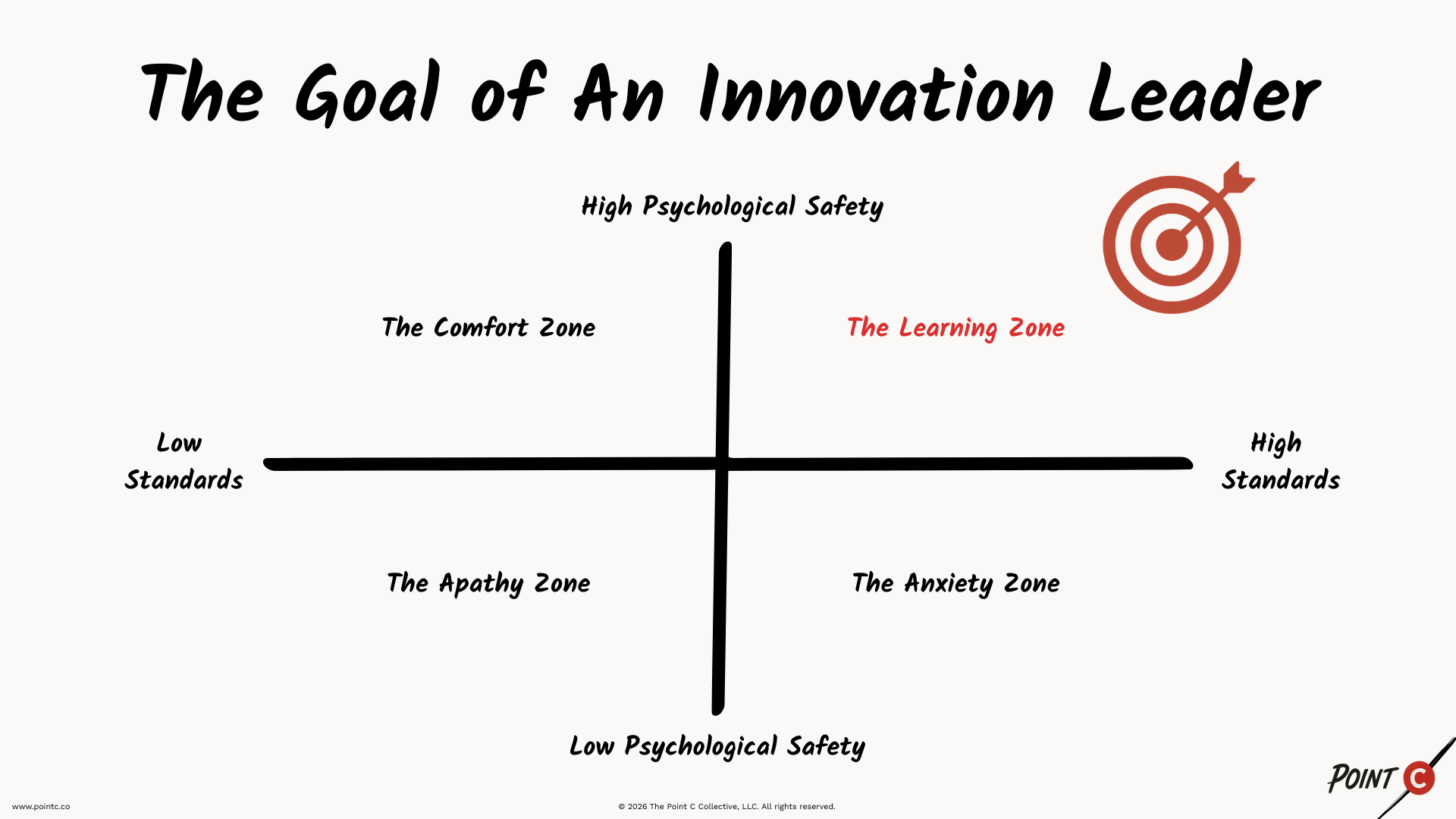
Many leaders think that having high performance standards means they must lower psychological safety. But you now know it’s a matrix, not a binary tradeoff.
Creating a subculture of innovation takes intention. Many times, we inherit a culture that is starting from a deficit.
If you find yourself in a culture that is squarely in The Anxiety Zone, how do you move your subculture from low psychological safety to high psychological safety?
Next week, I’ll give you ten levers you can pull to increase the psychological safety of your culture. But before you can pull those levers, you have to make a choice.
You can either let the culture shape you, or you can choose to shape the culture.
Here’s the strategic imperative you must adopt if you want to lead a subculture of innovation:
Psychological Safety Is A Leadership Choice.
What is Psychological Safety?
HBS Professor Amy Edmundson, author of The Fearless Organization, defines psychological safety this way:
"Psychological safety exists when people feel their workplace is an environment where they can speak up, offer ideas, and ask questions without fear of being punished or embarrassed."
Interestingly, she found that levels of psychological safety varied across groups within the same organization:
"The data are consistent in this simple but interesting finding: psychological safety seems to 'live' at the level of the group. In other words, in the organization where you work, it's likely that different groups have different interpersonal experiences; in some, it may be easy to speak up and bring your full self to work. In others, speaking up might be experienced as a last resort...That's because psychological safety is very much shaped by local leaders."
This is extremely important for you to know. Based on her research, leaders are the difference:
"What was clear was that leaders in some groups had been able to effectively create conditions for psychological safety while other leaders had not."
You have agency to build a subculture that has high psychological safety.
This is possible even if there is low psychological safety elsewhere within the broader culture of your organization. Psychological safety is a leadership choice at the group level. And, next week, I'm going to give you some choices you can make to raise the psychological safety of your subculture.
But, first, let's get clear on what psychological safety is not.
What Psychological Safety Is Not
When we talk about psychological safety, some people have an immediate negative reaction to it. They think it means creating an environment that is too nice, where you can't speak the truth, and trades away performance standards to make people feel comfortable.
That's not what we are talking about here.
According to Edmondson:
"Working in a psychologically safe environment does not mean that people always agree with one another for the sake of being nice. It also does not mean that people offer unequivocal praise or unconditional support for everything you have to say. In fact, you could say it's the opposite.
Psychological safety is about candor, about making it possible for productive disagreement and free exchange of ideas.
It goes without saying that these are vital to learning and innovation.
Conflict inevitably arises in any workplace. Psychological safety enables people on different sides of a conflict to speak candidly about what's bothering them...
Psychological safety does not imply ease of comfort. In contrast, psychological safety is about candor and willingness to engage in productive conflict so as to learn from different points of view."
Importantly, psychological safety is also not about guaranteeing that someone's job is safe. While challenging, you can create psychological safety in groups even when the organization is facing existential threats and going through lay-offs. In fact, in order for individuals to survive, it is essential that the group experience psychological safety so that they can focus on the shared goal of innovating their way towards a more sustainable future rather than the individual goal of self-protection.
This requires being clear about the complex challenges required for the organization to succeed and creating the space for people to experiment their way towards the solution. As Edmondson distinguishes:
"I'm not referring to anxiety about being able to accomplish a demanding goal or about the competitive business environment but rather to interpersonal anxiety. The experience of having a question or an idea but not feeling able to share it can be deeply unsatisfying work. And it is a serious risk factor in any company facing volatility, uncertainty, complexity, and ambiguity, or VUCA...In a VUCA world, high-performance occurs when people are actively learning as they go."
In order to survive in uncertainty, a leader must create the conditions where, instead of focusing on individual survival instincts, the group focuses on a common goal of innovating toward sustainability.
You Have Agency
In summary, the levels of psychological safety in your subculture are something that you as a leader can control.
You don’t have to wait for the broader organization to change. You can be intentional about your Subculture Expansion Zone.
It's not about being nice or lowering standards. And it's not about guaranteeing people's jobs.
It’s about raising the bar. Not just for outcomes, but for how you get there.
The only way to innovate your way forward is to leverage the full range of experience and viewpoints on your team.
That only happens when people feel safe to contribute.
And the good news is: you can actually do something about it.
Your Challenge This Week
Start by assessing where your subculture stands.
Ask yourself:
- If someone makes a mistake on my team, what actually happens next?
- Do people bring up tough issues in front of me?
- Where might interpersonal risk be higher than I realize?
If you want to ground this in something measurable, Edmondson uses the following seven questions:
- If you make a mistake on this team, it is often held against you. (R)
- Members of this team are able to bring up problems and tough issues.
- People on this team sometimes reject others for being different. (R)
- It is safe to take a risk on this team.
- It is difficult to ask other members of this team for help. (R)
- No one on this team would deliberately act in a way that undermines my efforts.
- Working with members of this team, my unique skills and talents are valued and utilized.
These are on a 7-point scale from strongly agree to strongly disagree (with the R representing questions that would be scored in reverse).
Surface the data. Before you pull new levers, you need to see the current reality clearly.
At the end of the day, psychological safety is a shared feeling within the group. Your job as a leader is to surface it.
Next Week
We now know what psychological safety is, what it isn't, and why it's essential for leading innovation. Most importantly, we know that the level of psychological safety in your subculture is a leadership choice.
Now that we’ve established your agency, let’s talk about what to actually do about it.
Next week, I’ll give you an overview of the ten levers you can pull to increase psychological safety in your subculture: The Safety Levers.
About This Newsletter
The Idea Bucket is a weekly newsletter and archive featuring one visual framework, supporting one act of leadership, that brings you one step closer to building a culture of innovation.
It’s written by Corey Ford — executive coach, strategic advisor, and founder of Point C, where he helps founders, CEOs, and executives clarify their visions, lead cultures of innovation, and navigate their next leadership chapters.
Want 1:1 executive coaching on this framework or others? Book your first coaching session. It's on me.