Make Space for Every Voice
A mantra to widen participation and improve decision quality

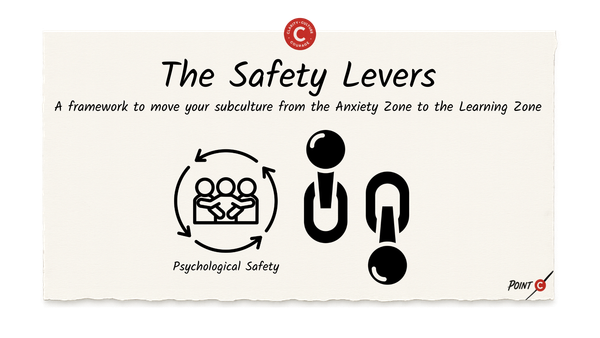
This week in The Idea Bucket we continue our dive into the mantras behind the ten levers that you can pull to increase psychological safety in your subculture. So far we've explored the following mantras:
Today we pull the lever of promoting inclusive leadership. Elevating the sense of psychological safety for every person on your team—bold or shy, veteran or novice—requires embracing the mantra Make Space for Every Voice.
Promote Inclusive Leadership
As a reminder, one of the ten levers you can pull to increase psychological safety in your subculture is to promote inclusive leadership.
Psychological safety is about who gets to shape the thinking. When only confident or senior voices dominate, safety shrinks.
In the Anxiety Zone, lower-power voices calculate risk before speaking.
When you promote inclusive leadership:
- You intentionally invite input from quieter voices
- You structure airtime
- You explicitly ask for dissenting perspectives
This is not about consensus. It’s about improving decision quality.
If you want stronger decisions, make space for every voice. Today, I’ll walk through a simple technique to actually do that.
Facilitation Matters
Making space for every voice is a leadership choice. And it really comes down to whether you recognize the need for strong facilitation in your team meetings or whether you think it will just work itself out because "we're all adults here."
Punting on facilitation leads to outcomes so predictable that you might as well be making a deliberate choice. We all know how it plays out. A question is asked to the group in a team meeting. The same people tend to be the first to speak up, they might be the loudest, the most extroverted, the most senior, the most powerful, or the most confident. And what they put out there tends to shape the rest of the meeting. The framing they introduce ends up dominating the conversation.
You also see another dynamic play out. People wait to see what the boss is thinking. Once the boss speaks, others begin to tailor their opinions in that direction. Unique, original, and contrary ideas stay inside of the heads of the rest of the team, especially if they are more on the introverted side or still figuring out if they really belong in the room.
The question on the table moves forward, but without the robust inputs necessary to truly shape it into an excellent decision. Lack of facilitation leaves excellence in the minds of participants.
Reflect First, Headline Second, Then Discuss
Any time there is a key decision to be made, important feedback to be collected, or key takeaways to be gathered, I always facilitate using a three-step technique: reflect first, headline second, then discuss.
This technique gives people space to think independently before they are exposed to the thinking of others. It also provides a structured way to bring those perspectives into the room.
Here's an example. When I ran my venture capital firm, we would have to make a lot of investment decisions. As part of our investment process, we would have entrepreneurs come to our office and pitch our team. It was a multi-step process that involved a rubric and a real-world project that tested how they approached building their venture. But what I want to focus on today is how I facilitated the discussion after we heard a pitch.
After the entrepreneur left the room, I would ask everyone who was in the pitch, from the director of investments, to the director of program, to our summer intern, the following question: Based on the pitch we just heard, should we advance this team to the next round?
Instead of opening the room up for debate, we followed a specific process. Each person, on their own, would write their answer privately on a post-it note. They had four options: Strong Yes, Lean Yes, Lean No, Strong No. They didn't have the option to sit on the fence so there were no maybes. But I also wanted to capture the strength of their conviction.
Once we all had written down our votes, we then revealed. Looking around the room, I could quickly get a sense of where the majority of people were leaning. I would then ask each person to share more about why they voted the way they did and I would start with the voices of people in the minority. Once everyone had shared their opinion (and I mean everyone, including the intern), only then would I, as the person with the most power in the room, share why I voted the way I did. It's very important for the boss to go last so as not to overly sway the conversation in the room.
Once all the opinions had been aired, the person who owns the ultimate investment decision (which at first was me and later was the director of investments) would then ask follow-up questions to push his or her thinking. I would repeat the mantra that we had One Consultative Decision Maker Per Lane and that Feedback Is a Gift - Not A Demand. I would reinforce that the director of investments owned the ultimate decision and that I expected they would listen hard to everyone's opinions but ultimately we knew that he or she would need to make the final call and would not be able to please everyone.
Finally, either in that meeting or in a subsequent meeting, we expected that the decision maker would close the loop. They would play back what they heard from us and tell us what they ultimately decided to do and why.
In this process of reflecting first, headlining second, and then discussing, we were able to efficiently surface all opinions in the room, regardless of the level of extroversion or status, and then discuss the major themes while preserving the decision rights of the person in charge.
That structure may seem simple, but it fundamentally changes the dynamic in the room. It prevents the first voice from anchoring the conversation. It ensures that every perspective is captured before groupthink can take hold. And it creates space for people who might otherwise stay silent to contribute meaningfully.
This is what inclusive leadership looks like in practice. It’s not about hoping everyone speaks. It’s about designing the conditions that make it likely. The question isn’t whether your team has good ideas. It’s whether your facilitation allows them to surface.
Your Challenge This Week
Try the reflect first, headline second, then discuss method.
In your next team meeting, pick one decision or question that matters. Frame the question clearly. Then have each person write their response independently before any discussion begins.
Go around the room and have each person headline their thinking. Only after everyone has shared should you open up discussion.
Then reflect:
- What surfaced that wouldn’t have otherwise?
- Who spoke that normally wouldn’t?
- Did the quality of thinking improve?
Because making space for every voice doesn’t happen by accident. It happens by design.
Next Week
As a reminder, here are the ten corresponding mantras to increase psychological safety in your organization:
- Cultivate A Growth Mindset
- Fail Forward
- Feedback Is A Gift — Not A Demand
- Lead With Vulnerability
- Make Space For Every Voice
- Design For The Roller Coaster
- Celebrate Behaviors, Not Just Outcomes
- Flare Before You Focus
- Make Expectations Explicit
- You Own Your Role, We Own The Outcome
Next week, we dive into the mantra that pulls the lever of providing structure for difficult conversations: Design For The Roller Coaster.
About This Newsletter
The Idea Bucket is a weekly newsletter and archive featuring one visual framework, supporting one act of leadership, that brings you one step closer to building a culture of innovation.
It’s written by Corey Ford — executive coach, strategic advisor, and founder of Point C, where he helps founders, CEOs, and executives clarify their visions, lead cultures of innovation, and navigate their next leadership chapters.
Want 1:1 executive coaching on this framework or others? Book your first coaching session. It's on me.