Cultivate A Growth Mindset
A mantra to frame work as a learning problem, not an execution problem

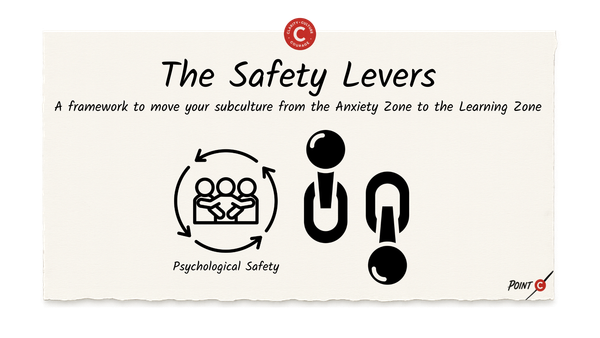
In my quest to help you build a subculture of innovation via The Idea Bucket, we've set the target: both high standards and high psychological safety. We know we have the agency to increase it. And we have ten levers that we can pull.
Now we can dive deeper into each lever.
This week, we tackle the first lever, frame work as a learning problem, not an execution problem, by unpacking its corresponding leadership mantra: Cultivate A Growth Mindset.
Frame Work as a Learning Problem, Not an Execution Problem
As a reminder, the first lever you can pull to increase psychological safety in your subculture is to make sure you are framing work as a learning problem, rather than an execution problem.
When leaders frame work as execution, they imply the answer is already known. When they frame it as learning, they acknowledge uncertainty is part of the work.
In the Anxiety Zone, uncertainty feels like incompetence. Framing it as learning turns ambiguity from personal threat into shared responsibility.
When you frame work as a learning problem:
- You acknowledge uncertainty explicitly
- You legitimize questions and experiments
- You reduce fear of being wrong early
This is not about lowering the bar. It’s about learning before committing.
If you want your team to treat being wrong as information, not identity, cultivate a growth mindset and reinforce learning, effort, and progress, not just outcomes.
In order to do this, we need to first do a gut check on our own mindsets before we cultivate the mindsets of others.
A Mindset Gut Check
I want you to pause for a moment and reflect on the following statements:
Your intelligence is something very basic about you that you can't change very much. You can learn new things, but you can't really change how intelligent you are.
You are a certain kind of person, and there is not much that can be done to really change that. You can do things differently, but the important parts of who you are can't really be changed.
Think deeply about these statements. How strongly do you resonate with them? Do you strongly agree with them? Do you agree with the first set but not the second set? Make note of your conclusions.
Now, wipe the slate clean and let's look at a second set of statements:
No matter how much intelligence you have, you can always change quite a bit. You can always substantially change how intelligent you are.
No matter what kind of person you are, you can always change substantially. You can always change basic things about the kind of person you are.
Again, think deeply about these statements. How strongly do you resonate with them? Do you strongly agree with them? Do you agree with the first set but not the second set? Make note of your conclusions.
Now, let's take a step back. Which set of questions did you agree with more?
It turns out that the answer to this question determines quite a lot.
Fixed vs. Growth Mindset
Stanford psychologist Carol Dweck tackled a fundamental question in her seminal book Mindset:
"What are the consequences of thinking that your intelligence or personality is something you can develop, as opposed to something that is a fixed, deep-seated trait?"
A LOT as it turns out:
"The view that you adopt for yourself profoundly affects the way you lead your life....How a belief that your qualities are carved in stone leads to a host of thoughts and actions, and how a belief that your qualities can be cultivated leads to a host of different thoughts and actions, taking you down an entirely different road."
Having a deep belief in the first set of questions I asked you, means that you are currently operating with what Dweck calls a Fixed Mindset:
"Believing that your qualities are carved in stone - the fixed mindset - creates an urgency to prove yourself over and over...Every situation calls for a confirmation of [your] intelligence, personality, or character. Every situation is evaluated: Will I succeed or fail? Will I look smart or dumb? Will I be accepted or rejected? Will I feel like a winner or loser? "
Having a deep belief in the second set of questions I asked you, means that you are currently operating with what Dweck calls a Growth Mindset:
"In this mindset, the hand you're dealt is just the starting point for development. This growth mindset is based on the belief that your basic qualities are things you can cultivate through your efforts, your strategies, and help from others. Although people may differ in every which way - in their initial talents and aptitudes, interests, or temperaments - everyone can change and grow through application and experience...They believe that a person's true potential is unknown (and unknowable); that it's impossible to force what can be accomplished with years of passion, toil, and training."
Dweck's research shows that one's mindset has huge knock-on effects, especially when it comes to how you think about risk and effort:
"It's startling to see the degree to which people with the fixed mindset do not believe in putting in effort or getting help...Risk and effort are two things that might reveal your inadequacies and show that you were not up to the task... [Meanwhile] the passion for stretching yourself and sticking to it, even (or especially) when it's not going well, is the hallmark of the growth mindset."
And it even separates people's ability to accurately assess themselves:
"If, like those with the growth mindset, you believe you can develop yourself, then you're open to accurate information about your current abilities, even if it's unflattering. What's more, if you're oriented toward learning, as they are, you need accurate information about your current abilities in order to learn effectively. However, if everything is either good news or bad news about your precious traits - as it is with fixed-mindset people - distortion almost inevitably enters the picture. Some outcomes are magnified, others are explained away, and before you know it you don't know yourself at all."
The good thing is that, as you may expect, Dweck has shown that your mindset is not fixed. If you are currently operating with a fixed mindset, you have the ability to develop a growth mindset, and unlock all the potential that comes with it.
The Duty To Cultivate A Growth Mindset
Dweck's book is a must read for pretty much anyone. It helps individuals recognize how their choice in mindset affects their ability to realize their full potential. But it is especially important for people who have the ability to shape the mindsets of others - parents, teachers, coaches, and yes, leaders of organizations.
And for leaders of organizations who need to innovate, cultivating a growth mindset is an imperative.
Think about it. If you reinforce a fixed mindset in your culture, you get the following outcomes:
- People are afraid to take risks because taking risks may expose them for not "being smart" and their personal self-worth, identity, and value are tied up in the perception that they are "smart".
- On top of that, in order to protect their fixed identities, your team stops seeing the world clearly, distorting information to fit their self-perceptions.
- Instead of rapidly learning and improving your organization to meet the needs of a changing world, you stagnate.
When leaders reinforce a growth mindset in their culture, the dynamics change dramatically:
- People take risks because mistakes are treated as information, not identity.
- Effort is recognized as part of mastery rather than evidence of weakness.
- Feedback becomes fuel for improvement instead of a threat to status.
- And most importantly, people become oriented toward learning rather than proving.
In other words, the organization becomes capable of adapting. And adaptability is the true advantage in an uncertain world.
Leaders Set the Mindset
Mindsets are not just individual beliefs. They are cultural signals.
Every time you hire, give feedback, respond to failure, or evaluate performance, you are reinforcing one mindset or the other:
- In hiring, are you looking for the "smartest" person in the room, or the person who can articulate how they would solve a problem they've never seen before?
- In feedback, do you focus on whether someone was right, or how they improved?
- In failure, is the first question “Who caused this?” or “What did we learn?”
- In promotion, do you reward people who have never made a mistake, or for stretching beyond their comfort zone?
Over time, the answers to these questions determine whether your culture optimizes for proving intelligence or developing capability. Small shifts in language signal whether the goal is learning or proving. And over time, those signals shape the culture.
In a fixed mindset culture, people optimize for looking smart. In a growth mindset culture, people optimize for getting better. Innovation requires the second.
Take a moment and imagine the difference from the employee’s perspective:
What kind of leader would you rather work for? A leader who is constantly evaluating whether you are smart enough…or a leader who is interested in how much you can grow?
Under the first leader, every mistake feels like evidence against you. Under the second, every mistake is part of getting better. One culture teaches people to protect their reputation. The other teaches them to expand their capability.
How To Cultivate A Growth Mindset
If you want to cultivate a growth mindset in your subculture:
1. Praise effort, strategy, and persistence, not just outcomes
Especially during evaluations or project reviews. Reward the behaviors that lead to improvement.
2. Treat mistakes as learning opportunities
When something fails, ask: “What did this teach us?”
3. Normalize being wrong early
In innovation work, being wrong early is how you get things right later.
4. Model learning yourself
Admit when you don’t know. Show how you change your thinking.
5. Hire and promote for learning agility
Look for people who are curious, coachable, and energized by learning, not just people who appear to already have the answers.
The Kryptonite of Smart
Ever since I was introduced to Dweck's groundbreaking work, there is one word that every time I hear it sounds like nails on a chalkboard to me:
Smart.
If you put your antennae up, you'll hear it all the time:
In hiring:
“Is she smart enough?”
“Are they the smartest candidate?”
In praise:
“He’s one of the smartest people on the team.”
“That was really smart.”
In staffing decisions:
“We need our smartest people on this.”
In evaluation:
“She’s brilliant.”
It sounds like praise. But it quietly reinforces the idea that intelligence is a fixed trait. The problem is not the word itself. The problem is what it trains people to optimize for.
And if being “smart” is the identity people are trying to protect, they will avoid the very behaviors that lead to innovation:
- asking questions
- admitting uncertainty
- taking risks
- exposing unfinished thinking
Because those behaviors might make them look not smart.
Growth mindset cultures sound different. Leaders praise learning, effort, strategy, and persistence, not intelligence.
Instead of saying: "You are so smart.”
They are specific about that process that led to the praiseworthy outcome: “I really like how you approached that problem. You recognized what you didn't know and then you did the hard work to figure it out and then adjust your hypotheses.”
The shift may seem small. But it changes what people optimize for.
Why This Matters for Psychological Safety
When people believe their abilities are fixed, mistakes feel dangerous. When people believe their abilities can grow, mistakes become part of the process.
That shift is what allows leaders to frame work as a learning problem instead of an execution problem. And when that happens, the Anxiety Zone begins to soften.
Your Challenge This Week
Listen carefully to the language you use with your team.
Ask yourself:
- How often do I use the word "smart"?
- Do I praise outcomes more than effort?
- How do I react when someone makes a mistake?
- Do I signal that learning is expected, or that people should already know?
Because the mindset you reinforce today determines how your team approaches uncertainty tomorrow. And uncertainty is where innovation lives.
Next Week
As a reminder, here are the ten corresponding mantras to increase psychological safety in your organization:
- Cultivate A Growth Mindset
- Lead With Vulnerability
- Fail Forward
- Celebrate Behaviors, Not Just Outcomes
- Flare Before You Focus
- Make Space For Every Voice
- Make Expectations Explicit
- Feedback Is A Gift — Not A Demand
- You Own Your Role, We Own The Outcome
- Design For The Roller Coaster
You now have a deeper understanding of the first lever you can pull to increase psychological safety in your subculture.
Next week, we dive into the second and we challenge the common leadership trope of the infallible leader: Lead With Vulnerability.
About This Newsletter
The Idea Bucket is a weekly newsletter and archive featuring one visual framework, supporting one act of leadership, that brings you one step closer to building a culture of innovation.
It’s written by Corey Ford — executive coach, strategic advisor, and founder of Point C, where he helps founders, CEOs, and executives clarify their visions, lead cultures of innovation, and navigate their next leadership chapters.
Want 1:1 executive coaching on this framework or others? Book your first coaching session. It's on me.