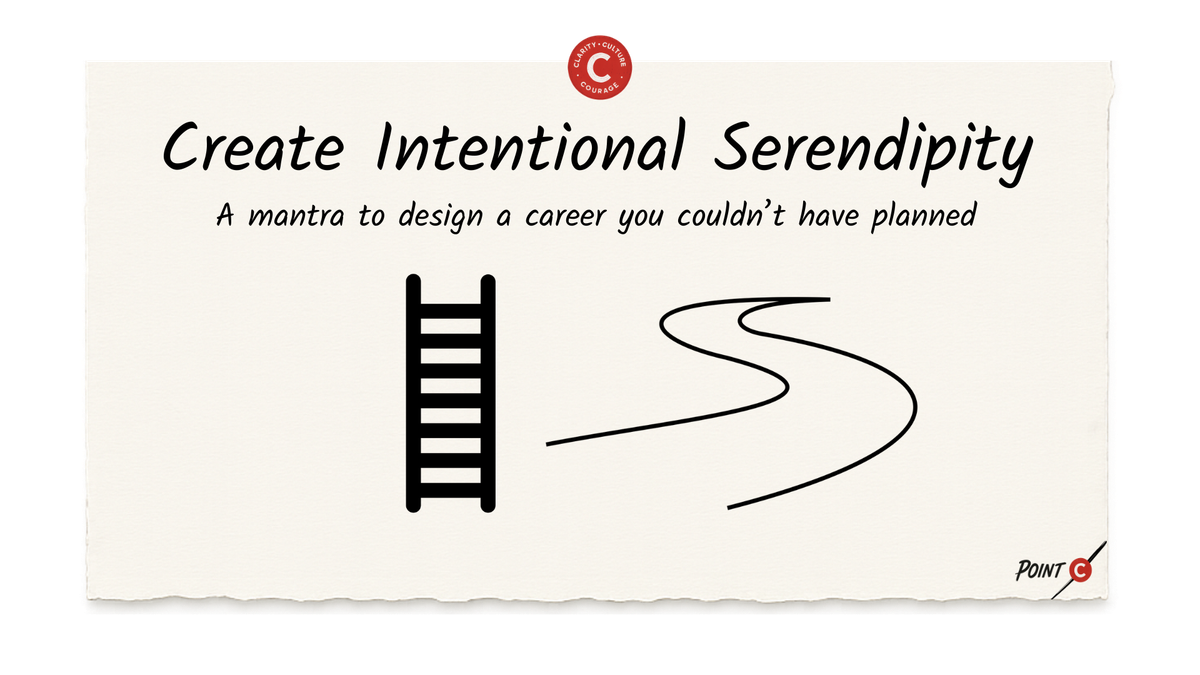
Create Intentional Serendipity
A mantra to design a career you couldn’t have planned

Lately in The Idea Bucket, I’ve been sharing the key frameworks I use with clients to help them navigate their careers.
So far, we’ve explored how to set a Go / No Go Date to maximize your energy and runway during a risky endeavor or period of exploration. Then, before making the leap, we defined a personal rubric through the Personal Selection Stack ritual.
Today, I want to share a mantra that has shaped my own career: Create Intentional Serendipity.
I’ve practiced it for over two decades, and it has consistently given me the courage to choose the path less traveled—what I call The Drunken Walk—over the ladder path.
The best way to illustrate this concept is to rewind the clock to 2013, when I gave a TEDx Talk on the topic at my alma mater, the University of North Carolina at Chapel Hill.
At the time, I was launching my venture capital fund, Matter. I wanted to put myself back in the shoes of a student—walk them forward to where I am today—and help them see over the horizon if they chose the drunken walk.
Here is the full transcript of my talk. It's longer than my typical post, but I think you'll find it's worth it:
My TEDx Talk: Intentional Serendipity (2013)
What do I want to be when I grow up? What am I going to do with my life? Am I on the right path?
I don’t know about you, but every time I allow myself to think of that question, I feel it right here in my gut — the fear of maybe getting it wrong.
That fear really never goes away because if I only got one shot, I better get it right, right? I better figure out what I want to be, come up with a perfect plan, and execute on it. And if I haven’t quite figured it out just yet, I better listen to what all these other people are telling me to do, which is pick one of these well‑defined ladders and start climbing it.

Be a lawyer. Be a doctor. Be a banker. Be a consultant. The rungs on those ladders are clearly defined, so just pick one, stop thinking, and start climbing.
What do I want to be when I grow up?
I had no idea what the answer to that question would be when I first arrived here at Chapel Hill as a freshman, and you know what? Seventeen years later I still have no idea what I want to be when I grow up. But I do know now what I wish I knew back then:
It’s okay not to know. It’s okay not to have a perfect plan. In fact, if you want to do something innovative, it’s actually better that you not have it all figured out quite yet.
You see, I’ve had one of those careers that only makes sense looking backwards and connecting the dots — a career I never really could have planned.
I started my career as a journalist at the PBS documentary series Frontline, making seventeen different films, and it was the best job I could ever imagine. You got to make stories about some of the most important topics going on in the world, go on adventures, and make this creative product that millions of people got to see. I was there on September 11th when the planes hit and the towers fell, and I got the opportunity to be part of Frontline’s first response to 9/11.
I believed deeply in what we did, but I came to the realization around 2005 that the world was changing dramatically and we weren’t changing at all. Public media and journalism had become a slow‑moving bureaucracy — we were being disrupted. And what I realized was that the ladder that I had chosen to climb — I wanted to do this for the rest of my life; I wanted to make these films for the rest of my life — that ladder was broken.
So I decided to step away from one of the best jobs in journalism. I still cared about what we were doing, but I didn’t know whether the industry would still be around.
I wanted to get out to Silicon Valley and learn more about entrepreneurship, innovation, and especially the culture and leadership around that so that I could either bring that back into public media and help make it stronger for the next generation, or perhaps start something that could take its place in the future to keep pushing on that mission.
So I left Frontline and I landed in Silicon Valley at Stanford Business School — the documentary filmmaker surrounded with a bunch of people from a bunch of different backgrounds — and I got the best entrepreneurship education in the world - except it was lacking something.
It was really entrepreneurship from point B to Z: you already have that great idea, that team, and here’s how you execute on it. But it was missing the whole creative side, what I call the A to B — the messy A to B of entrepreneurship. I want to start a company — how do I take the first step? How do you come up with that idea in the first place?
Fortunately for me, this little academic startup was just getting off the ground at Stanford called the d.school, the Stanford Institute of Design, co‑founded by IDEO co‑founder David Kelley. The d.school dropped itself in the middle of the Stanford campus, opened its doors to all graduate students, and said, “Come, mix, form multidisciplinary teams, solve real‑world problems using a process we’ll teach you called design thinking.”
Design thinking was all about being human‑centered, being prototype driven, and believing in radical collaboration. And I said, “This — this has got to be the A to B of entrepreneurship.” And from that point in time I became obsessed with combining this design thinking process with entrepreneurship and, wherever I could, trying to apply it to the future of storytelling.
What I learned about design there was that design is not an aesthetic. It’s not an event — although this is a great event. It’s not an experience and it’s not a product. Design is a process. It’s a way that you can come up with something new or make something better that is feasible, viable, and desirable that aims right at the intersection of business, technology, and design.
And now there are many ways to visualize the design process, but to me it really comes down to a very simple thing: it’s simply a series of flaring and focusing.
Flaring and focusing, flaring and focusing, flaring and focusing. Knowing how and when to explore and generate ideas, and knowing how and when to select and execute on them, and doing that as many times as possible in the time that you have — flaring and focusing so that you can do what I call the drunken walk of the entrepreneur.
Because real innovation happens not through perfect plans. It comes through making some hypotheses, taking experimental steps, learning and adjusting, learning and adjusting, learning and adjusting so that you end up in a place you never ever could have predicted, but is much more feasible, much more viable, and much more desirable than anything you could have come up with if you were just sitting down trying to come up with a perfect plan.
Innovation really — and entrepreneurship — it’s all about how do you increase intentional serendipity. You can’t plan for it, but you can increase the factors that make it happen. You can make diverse people meet each other. You can try ideas and test them quickly. You can increase intentional serendipity.
I started to realize that I was starting to do my own little drunken walk in my career, and I actually chose to join the d.school full‑time because I didn’t actually know where that would lead. It wasn’t a path to a professorship or anything. I chose it because I believed in intentional serendipity. I chose it because there were all these interesting connections being made there and I thought something would pop, something would pop for my career. So I dove in and I tried to focus this wherever I could on the future of media.
And I started to see some little sparks of hope. I had a student named Bert Herman who was a former AP bureau chief who had come to Stanford because he was tired of complaining about the future of newspapers and journalism and wanted to actually do something about it. By using this process with his co‑founder they ended up founding a company called Storify, which was being used by many news organizations around the world and other people to tell stories through social media.
Another student at the d.school, Akshay Kothari, was a shy d.school student about four months before the iPad was supposed to be announced. So he and his co‑founder decided to go sit in coffee shops and just sketch really rough sketches and test them with different people around them. And they went from something that was really bad to something that became an app called Pulse, which became widely used on iPhones and iPads.
These were just students who decided to take the first step and try something.
Back to my drunken walk. So I saw the potential for this and I thought I could take it somewhere. I was believing in intentional serendipity — something for my career would pop next — until it didn’t. My fellowship at the d.school ended after two years, and I hadn’t quite figured out where to put this messy jumble of what I’d done in my life together. Nobody had a job that said, “Oh, somebody must apply with journalism and design thinking and business skills.” So I actually flailed for a little while. It was actually kind of a dark time for me because I didn’t know where I was going to go.
And when you go down this drunken walk there are these times where you look back and say, “Gosh, maybe I should have chosen one of those ladders, maybe I should have been a lawyer.”
But fortunately intentional serendipity did work. I ended up getting a call from somebody who was starting an early‑stage venture capital firm for Eric Schmidt of Google, and they said, “We heard about what you were doing around design thinking and entrepreneurship at the d.school, and we actually would love for you to build a startup accelerator based around those principles for us.” So lo and behold I took off the journalist hat, took off the design thinker hat, and now am putting on this venture capital hat. I like to say that I’m now a sheep in wolf's clothing.
So I joined Runway and I had this challenge — I made a program called Runway — and the idea was: how can you start from a blank slate? My challenge was: can I build something that is pre‑team, pre‑idea? Can I help extraordinary aspiring entrepreneurs find each other, form a multidisciplinary team, and then dive into a space without knowing what they’re doing and uncover a business opportunity? Sounds crazy, right? Well, actually, it kind of worked.
I met, by building this platform, this wonderful aspiring entrepreneur named Monisha Perkash and through the program she met her other co‑founders. They decided to work together, we invested in them, they dove into healthcare, tech, transportation, education, and they went through a thousand different business opportunities — rightfully killed 999 of them — but then one popped. They are now a company called LumoBack and they are helping solve the big problem of back pain - because 80% of back pain is caused by poor posture - through a mobile health device that they’ve developed that has an avatar that can mirror all of your body movements and give you real‑time feedback on whether you are in the right posture or not. And this team that started absolutely from scratch without a plan - except to pursue intentional serendipity - just last month raised a $5 million Series A financing.
And in my drunken walk I had veered away from media and I wondered whether that would actually take me back. But then the world called — a foundation called the Knight Foundation and a startup called Public Radio Exchange — a nonprofit, and they said, “These accelerators out in Silicon Valley seem to be working to spark innovation. Why don’t we use that to spark innovation within the future of journalism and public media? Is there anybody out there who might know how to lead something like this — someone who has this weird expertise of depth in public media and has done venture capital and run an incubator?”
So it didn’t take long for them to find me. And now what I am doing is building an early‑stage venture capital firm and startup accelerator that is about supporting media entrepreneurs building a more informed, more engaged, and more connected society.
And my point is: I never could have planned this.
You never can sit down and make this perfect plan. You can only do it by having faith in this drunken walk. And you know what? I have no idea where this is going.

The thing about the drunken walk is you can never see more than two years down the line and you have to become comfortable with that.
But here’s what I do know: not just journalism but many industries are being disrupted and the ladders that we used to rely upon aren’t so reliable anymore.
So I’d argue that actually the safer bet is to learn how to do this drunken walk because now more than ever we need people who learn, who are prepared to solve the unknown problems that will come up in the future.
Now more than ever, we need a liberal arts education like we have here at Carolina to create creative problem solvers and entrepreneurs.
Now more than ever, we need people who don’t know what they want to be when they grow up — people who can sit with the fear and the ambiguity and who take little steps, make little bets, and believe in intentional serendipity.
Now, More Than Ever
I gave that talk in 2013, and I believe its lessons are more urgent than ever.
Back then, ladders still felt stable. But in 2026, they’re visibly wobbling. With the rise of AI, the ladders that seemed stable are beginning to tip over.
The most stable choice you can make is to choose the drunken walk. Choosing a path where you cannot see more than two years over the horizon but forces you to learn how to solve the unknown problems of the future ensures that your skillsets stay relevant.
Knowing how to be entrepreneurial—how to navigate ambiguity to build something that meets a real need and aligns with the world’s direction—that skillset is gold.
The future belongs to those who create intentional serendipity.
Your Challenge This Week
Reflect on your own career path.
Has it been more of a ladder path or a drunken walk?
Take a look at it from a risk perspective. Did you make decisions that seemed stable but look risky now? Did you make decisions that seemed risky but look stable now?
What skillsets did you learn on that path? Has it prepared you for navigating the ambiguity of an AI future? Or do you feel at risk of being replaceable?
Now, look at the path ahead. Does it look like a ladder or a drunken walk? Which seems riskier? Which would build up a more resilient skillset?
Next Week
Now that we have embraced the mantra of Creating Intentional Serendipity, let's put it into practice.
Next week, I’ll share a plan for approaching a job hunt that uncovers extraordinary, unlisted opportunities: The Curiosity Tour.
About This Newsletter
The Idea Bucket is a weekly newsletter and archive featuring one visual framework, supporting one act of leadership, that brings you one step closer to building a culture of innovation.
It’s written by Corey Ford — executive coach, strategic advisor, and founder of Point C, where he helps founders, CEOs, and executives clarify their visions, lead cultures of innovation, and navigate their next leadership chapters.
Want 1:1 executive coaching on this framework or others? Book your first coaching session. It's on me.