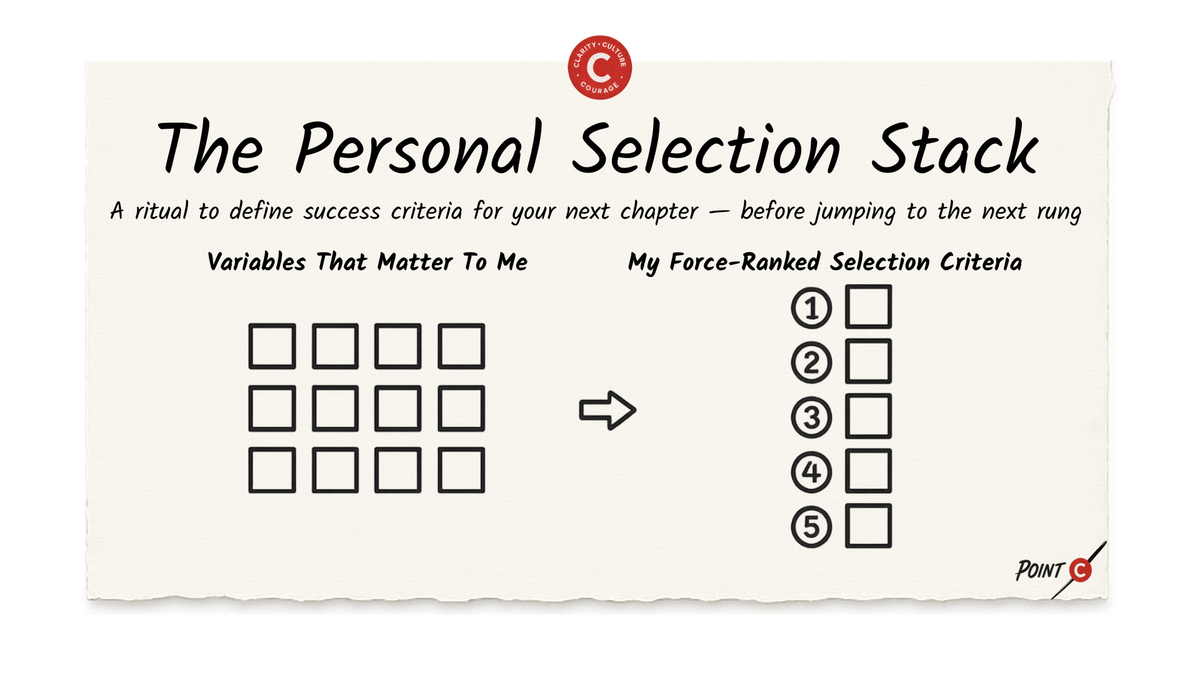
The Personal Selection Stack
A ritual to define success criteria for your next chapter — before jumping to the next rung

Happy New Year!
Last week in The Idea Bucket, I shared an updated version of The Venture Story Guidebook so that you can take a fresh look at your business strategy in the new year.
Today, we switch back to more of a personal career lens. We've discussed how to set a Go / No Go Date so that you can maximize your energy & runway during a risky endeavor or exploration process. But before you make that leap, it's important to step back and define the success criteria for your journey.
That's where The Personal Selection Stack comes in. It's a similar exercise to The Selection Stack we discussed when aligning key stakeholders on success criteria for a company project. But this time, the exercise is purely for you.
The Principles of Innovation Apply To You, Too
When starting a new phase of your personal career journey, it's important to recognize that you are starting a design process just like you would for any other innovation. But instead of building a venture or a product, you are building the next future for yourself.
So, for career design, we do what we do in venture design. We don't start with the what, we start with the why. We don't start with the solution or idea, we start with the person, their need, their context, and insights.
Unfortunately, career searches tend to start with the question: What job do you want next? And we fall into the trap of reacting to job postings we see on LinkedIn or reaching for the next obvious rung on the ladder.
Why do we do this? Because we are afraid of not being able to answer the cocktail party question: So...what do you do?
Resist the temptation to grasp at the next job title so you can make it easier for someone else to put you into a well-defined box.
Before we reach for that next rung on the ladder, it helps to take a step back and ask:
What do I want the experience of my day-to-day professional life to be like two years from now? And how does that manifest the overall life I would like to lead?
For a moment, set aside the allure of that concrete, predictable ladder, and allow yourself to sit in the discomfort of ambiguity. Set aside specific jobs, and take a step back to flare on the criteria that would make that next job great for you. Even more importantly, envision how that criteria would help you manifest the life you want for yourself.
Flare First: Generate Lots of Criteria
Like any good design process. The Personal Selection Stack exercise is a series of flaring and focusing. We start with a flare on some very focused questions. Our goal is to first generate as much criteria as possible that we can use to evaluate our next career options. Then, we'll focus and force rank that criteria to make it into a useful rubric, a compass for your journey.
For the flare, you can use any prompts that come to your mind that would generate concrete answers to the following question: What criteria would help me evaluate a job opportunity that came my way?
Imagine your ideal life two years from now. This should be unconstrained in terms of what is possible but grounded in the reality of what is controllable. (i.e. You haven't won the lottery.) What are the aspects of that life that pull you towards it?
Let Maslow Guide You
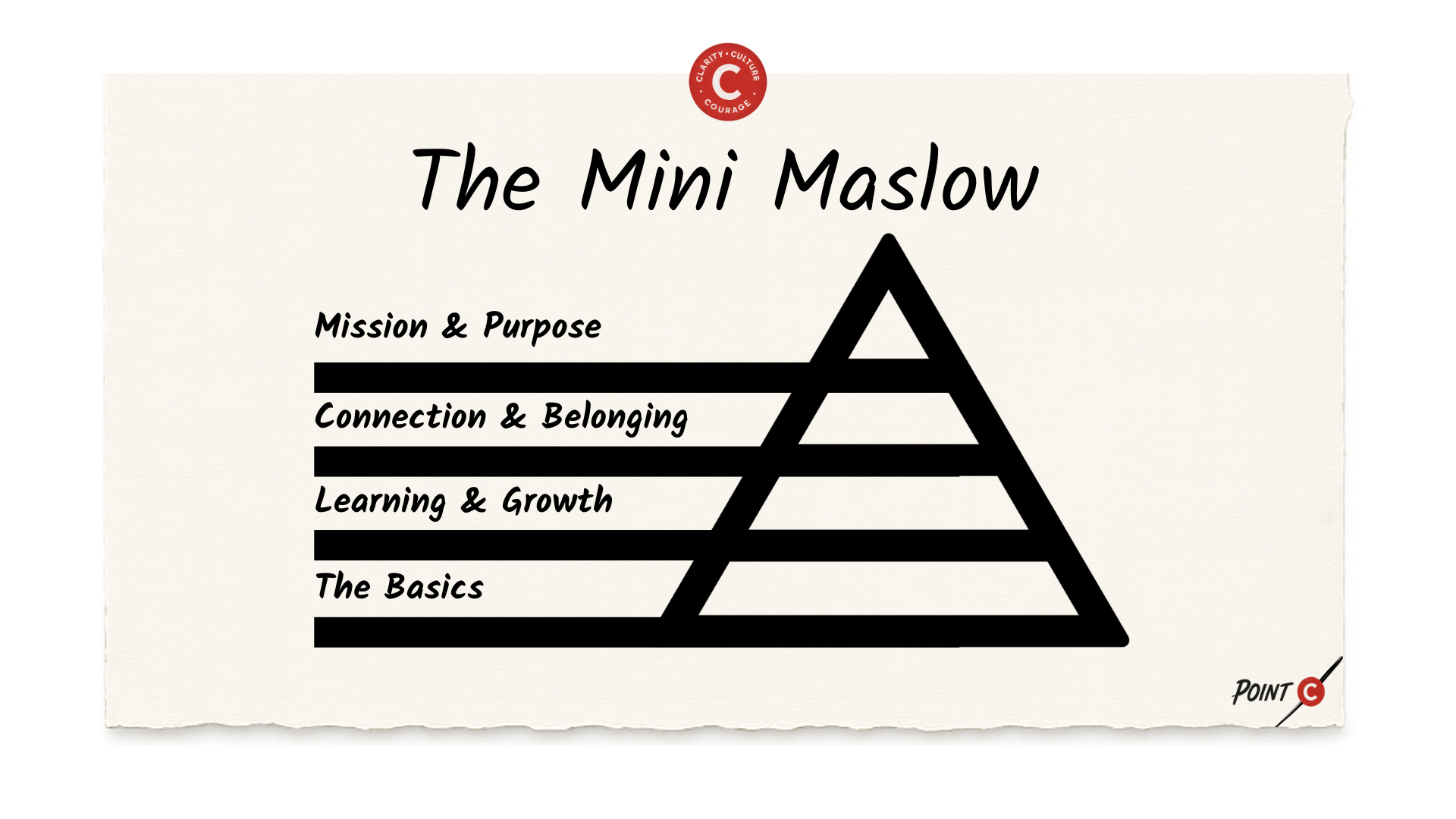
A framework I find useful to prompt these mini-brainstorms is a simplified version of Maslow's Hierarchy of Needs. Imagine a pyramid with four levels from the bottom to the top:
- The Basics: These are your true feasibility constraints in terms of money, location, and time. These are not your goals or targets, these are your non-negotiable foundational constraints:
- Money: What is the minimum amount of cash I need to generate every month to meet my financial obligations? (Assume that you are offered a dream job. What is the minimum amount you could be paid to say yes.)
- Location: Are you flexible in terms of location or are you fixed based on other obligations? (Assume that you are offered a dream job but you had to move. Would you accept it and deal with the other trade-offs associated with that move?)
- Time: Is your work schedule flexible or do you have obligations that you need to design your life around? (Assume that you are offered a dream job but it had a schedule or travel that conflicted with other obligations. Would you accept it and deal with the other trade-offs associated with that schedule?) What does your ideal work week look like?
- Learning & Growth:
- What do I most want to learn next? How do I want to grow? What do I want to be capable of two years from now?
- How do I need to be set up for success on that learning journey? Who can I learn that from? What structures need to be in place? What do I need to be empowered to do?
- Connection & Belonging:
- What kind of culture do I want to be a part of? What unlocks my full potential?
- What kind of people do I want to spend time with? Who gives me energy?
- What type and cadence of interaction will make me most fulfilled? Virtual, In-Person, Hybrid?
- Mission & Purpose:
- What type of work would feel aligned with my values and sense of purpose and mission?
- Is it important that I get this from my work, or do I feel fulfilled by getting this in other aspects of my life? What boundaries do I need in my work to ensure I can continue to find purpose in other areas of my life?
These types of questions can feel overwhelming. So let's embrace imperfection and time constraints to just get our thoughts out there.
Set a time timer for five minutes per question. Write down one constraint per post-it. Generate as many post-its as you can in five minutes. Then move on to the next question.
The goal here is breadth and volume. Not perfection. We aren't deciding your life right now. We are just playing with the variables.
If it helps to talk things out before you make sense of them (fellow Myers-Briggs P's out there, I see you!), you may want to partner with a coach or a buddy on this exercise.
Great design starts with empathy. Finding someone who can be truly empathic and curious can go a long way in pulling on these strings with you. (And it helps you from spinning out if it starts to feel overwhelming.)
Explore Your Ikigai
Usually the simplified Maslow's Hierarchy gets you to where you need to be in this exercise. But if you are looking for more prompts I also find the Japanese framework of Ikigai to be helpful.
Ikigai (A Reason For Being) sits at the intersection of:
- What you love
- What you’re good at
- What the world needs
- What you can be paid for
Ask yourself:
- What types of work energize me?
- What am I uniquely skilled at?
- What problems feel urgent or worthwhile?
- What would someone pay me to do?
The key to this framework is to isolate the questions and brainstorm them independently. Just like with a venture, if you try to solve all of the constraints at once at the beginning, you'll fail to generate anything innovative. We need to take them one at a time, pull on those strings, and then see how they affect each other.
Next, Focus: Force Rank Your Criteria
Once you have generated your selection criteria, you need to force rank it.
Take your various post-its and start gathering which ones truly jump out at you. Begin to stack one above the other. Which one would you choose if you had to make a trade-off?
Here is the key moment: Ask yourself why you would make that tradeoff.
In those whys lie the true insights for what you are trying to manifest for yourself. This activity begins to shape the compass that points you in the direction you should begin traveling in.
This activity also works well with a coach or a buddy. Having someone else be curious about your trade-offs can really help surface these insights.
Finally, Test It.
You've built a rough prototype of your personal selection stack. Now you test it.
Partner up with your coach or buddy. Have them interview you about your process. What ah-ha moments did you have along the way? Why did you rank X over Y? If you had to choose between Door A with this criteria and Door B with that criteria, which would you choose and why? Iterate on your selection stack as you go.
Once your buddy has pulled these strings, let's stress test your personal selection stack. Come up with various jobs (real or imagined) and throw them against your stack. Does your stack help you accept or reject each of these opportunities? Is it clear why? Is it surfacing a tradeoff that you haven't fully accepted?
Just like when we test product prototypes, the purpose of the test is twofold. It helps you understand how well this particular prototype is serving your need to evaluate career opportunities. But, more importantly, it helps you learn more about the user. And, in this case, that's yourself.
Once you have that tested, force-ranked list of personal selection criteria, you have your compass. Use it to:
1) Proactively seek the opportunities that would make this criteria come alive, and
2) Evaluate any opportunity you uncover on your journey.
Constraints Drive Innovation For You, Too
Before we conclude, I want to highlight how another essential mindset of design thinking applies to career exploration: Constraints Drive Innovation
Our tendency is to chafe at constraints, especially when they affect our personal lives. But a key to innovation is embracing constraints. It's not until you define the landscape you want to play in that the innovative ideas emerge. The key is to be thoughtful and intentional about framing, defining, and accepting the constraints that will guide you.
Let's take a look at The Basics in my modified version of Maslow's Hierarchy of Needs. There's a way to look at this part of the exercise that is limiting, and there is a way to look at it that is liberating. At the risk of oversharing, I'll use my own personal experience with this as an example.
I live in Oakland. I am a very involved father. And I am divorced and about to be remarried, with a blended family. I work with clients across the globe but, with my media background, there are a lot of opportunities for me in New York City. Big jobs. Ones that under different circumstances I would pursue, hard.
But I am not in a position to pursue those jobs. I don't have the ability to move away from Oakland. Actually, I do have that choice, but it doesn't line up with my selection stack. Being a very involved father with my two daughters and one step-daughter and being present with my fiancee are at the top of the stack for me. I could move away for a job opportunity. But that would not manifest the life I want for myself.
At first, I chafed at these constraints. (And to be honest, I still occasionally do when I see big opportunity.) But I was liberated when I embraced them. I knew that anything that I did required two things: 1) that I be based in Oakland, and 2) that I make a certain amount of money to sustain my home and family.
I knew my values and I knew my number.
This crossed many opportunities off the list. But it opened up even more. By embracing my constraints, I was able to focus on what matters most and then imagine what type of work unlocked my selection stack.
And that is why I am in your life now. Because I embraced my constraints.
Your Challenge This Week
Do the Personal Selection Stack exercise.
(You should do this regardless of whether you are looking for a career change or not. Mapping out what's important to you creates the compass you need for times of flare and times of focus.)
1) Flare on your criteria using the frameworks above.
2) Focus by force ranking your criteria. Ask yourself why you are making those trade-offs. Capture insights.
3) Test your stack on a buddy. Use hypothetical jobs to see whether your stack supports your decision making. Iterate.
4) Use your stack to seek (rather than react to) 1-3 potential career opportunities.
Next Week
With the new year, I am excited to continue writing in more depth about the tools and frameworks I use with clients not only for their strategy and leadership but also for their career.
We've now covered two career essentials for leaders looking to maximize their impact:
- The Go / No Go Date
- The Personal Selection Stack
Here's a preview of some of the posts I have in mind around careers that will be coming your way soon:
- Create Intentional Serendipity
- The Curiosity Tour
- Know Your Number
Next week, I am excited to launch the 2026 Cohort of Sulzberger Fellows. We kick-off with a two-week immersion at Columbia Journalism School. I still expect to deliver The Idea Bucket at its regular weekly cadence on Thursdays. But, as Mike Tyson supposedly said: Everyone has a strategy until they get punched in the mouth. Just in case you don't hear from me, you''ll know why.
Happy New Year! May the top of your selection stack lead you to the life you’re meant to build.
About This Newsletter
The Idea Bucket is a weekly newsletter and archive featuring one visual framework, supporting one act of leadership, that brings you one step closer to building a culture of innovation.
It’s written by Corey Ford — executive coach, strategic advisor, and founder of Point C, where he helps founders, CEOs, and executives clarify their visions, lead cultures of innovation, and navigate their next leadership chapters.
Want 1:1 executive coaching on this framework or others? Book your first coaching session. It's on me.