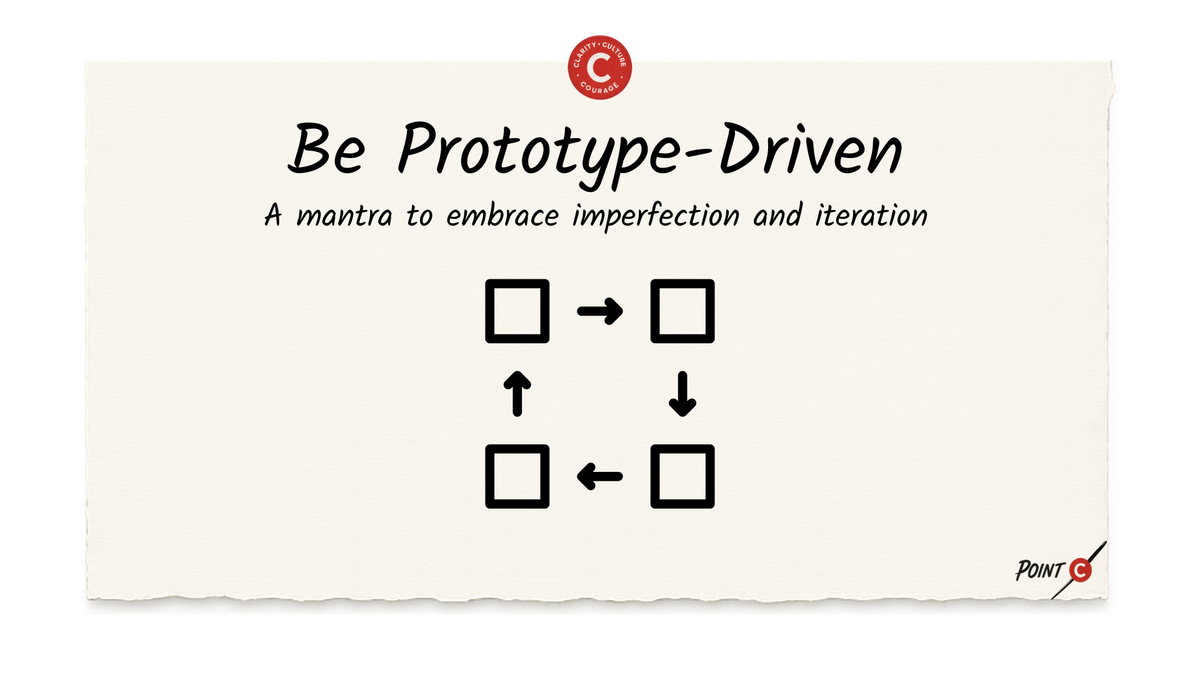
Be Prototype-Driven
A mantra to embrace imperfection and iteration

Last week in The Idea Bucket, we explored one of the two essential mindsets of design thinking: Be Human-Centered
This week, we tackle its twin mantra: Be Prototype-Driven
While Be Human-Centered is a core leadership mantra for the How We Solve Problems category in the Subculture Coverage Matrix, Be Prototype-Driven is the foundation for How We Execute Our Work.
For me, the mantra Be Prototype-Driven is the key to unlocking the mindsets of embracing imperfection and having a bias towards action so that your team can solve problems by failing forward. Without it, you will never unlock true innovation.
What It Means to Be Prototype-Driven
To Be Prototype-Driven means that you embrace imperfection. You use rough, rapid experimentation to test ideas in the real world — not just to validate solutions, but to deepen your understanding of the user and the problem. Let's break it down piece-by-piece:
- Embrace Imperfection: Every idea is a hypothesis. No matter how compelling it sounds, you assume it’s flawed in some way — and you move forward with the mindset: “Let’s find out how it’s wrong, fast.”
- Build To Think: Instead of talking about an idea in an abstract way, we get it out of our heads and into a concrete form that others can see and interact with. We know that building is a form of thinking — and that turning an abstract idea into a tangible prototype surfaces questions and details we would’ve otherwise missed.
- Make It Rough & Rapid - Since we know this idea is wrong in some way — big or small — we know that fully building it to perfection is a waste of precious time and resources. Instead, we embrace constraints to quickly get the answer to our core question. For example, we could put 45 minutes on a Time Timer and limit ourselves to only using materials we have on hand to build our first prototype. These constraints help prioritize our thinking — and the unfinished nature of the prototype actually invites users to fill in the gaps with us.
- Test to Learn, not to Validate: We know that the ultimate goal of a prototype is to create an interaction that enables us to learn more about our user. It's like doing empathy again, but this time instead of starting with a blank slate we are giving them something to react to. I like to think of a prototype like a piece of clay. My job is to imperfectly shape it based on my initial hypotheses and then to put it in front of my user and see how they then shape it to make it better.
- Iterate Relentlessly: Being prototype-driven means no version is final. You are seeking constant learning and improvement. That’s the real standard of excellence, not the outcome.
Why It Matters: Prototyping Reduces Risk
On its surface, prototyping looks inefficient. Why “play with ideas” when you could just build the real thing?
But you have to remember: The job of an innovator isn’t to create a perfect plan and execute it.
The job of an innovator is to always understand the top risks in their venture and to spend their limited time and limited resources reducing those risks.
Rapid prototyping and testing is how you uncover and reduce your top risks.
Compare these two teams:
- The Perfectionists: The team is ideas-driven, falls in love with a product concept early, and develops it in stealth mode, not wanting to show it to others until it is just right. They invest lots of time and resources before they are able to test their core hypotheses. Launch Day comes. This team has accumulated risks rather than reduced them. They've put themselves in a position of having a Capital-F Failure.
- The Prototype-Driven: The team is needs-focused and solution-agnostic. It generates its ideas from real, qualitative user research and centers the work on real, validated problems to be solved. They rapidly ideate, prototype, test, and iterate on ideas. What they started out with looks nothing like what they have now. Launch Day comes. They've reduced risks along the way and have failed forward.
Which Launch Day would you want to be a part of?
Being prototype-driven is what shifts your definition of efficiency:
From “execution speed” → to “learning speed.”
The Benefits of Prototyping
Yes, prototyping reduces risk. But that’s not all it does. It helps you:
- Learn more about your user
- Co-design with your user
- Get feedback on your solution
- Inspire new ideas
- Test hypotheses
- Decide between divergent directions
Notice that the primary goal of prototyping is to learn more about your user and the secondary goal is to get feedback on your solution. That's a function of being needs-focused and solution-agnostic. We prioritize validating the user need over any one particular solution.
Everything Is a Prototype
Prototyping is not just about products.
When you truly are Prototype-Driven, you start to see everything as an imperfect prototype to be tested.
For example, your team is an imperfect prototype that can be constantly improved. Instead of getting married to a co-founder right away, test the relationship. Do a weekend project. See what you learn. Reduce your key risks, then build from there.
Here are some additional Prototyping tips:
- Use What's Around
- Think With Your Hands
- Create An Experience
- Make It Interactive
- Test Early
For a deeper dive into prototyping, check out This Is A Prototype by my friend and fellow 2008/2009 Stanford d.school fellow, Scott Witthoft.
Your Challenge This Week
Embrace constraints to rapidly prototype a key idea:
1) Forward this email to your team to set the context.
2) Choose a backlogged project — one your team has over-thought or over-polished.
3) Bring the team together for a rapid prototyping session. Break the group up into an even number of teams.
4) Frame the core user need as a design challenge.
5) Set a Time Timer for 45 minutes and ask each team to build their own version of a rough prototype that would solve that user need.
6) When the buzzer sounds, have teams test on each other. Gather feedback.
7) Give teams 15 minutes to iterate on their prototypes.
8) Make a plan to test with real users.
9) Reflect: What did you learn in 90 minutes that you hadn’t learned in the last 90 days?
Next Week
We've now covered two key mantras in the How We Execute Our Work category in the Subculture Coverage Matrix:
- Fail Forward
- Be Prototype-Driven
Next week, we shift back to How We Solve Problems and add the core mantra: Start With A Blank Slate.
About This Newsletter
The Idea Bucket is a weekly newsletter and archive featuring one visual framework, supporting one act of leadership, that brings you one step closer to building a culture of innovation.
It’s written by Corey Ford — executive coach, strategic advisor, and founder of Point C, where he helps founders, CEOs, and executives clarify their visions, lead cultures of innovation, and navigate their next leadership chapters.
Want 1:1 executive coaching on this framework or others? Book your first coaching session. It's on me.