Use The Language of Interests
A mantra for navigating conflict by picking words that align, not alienate

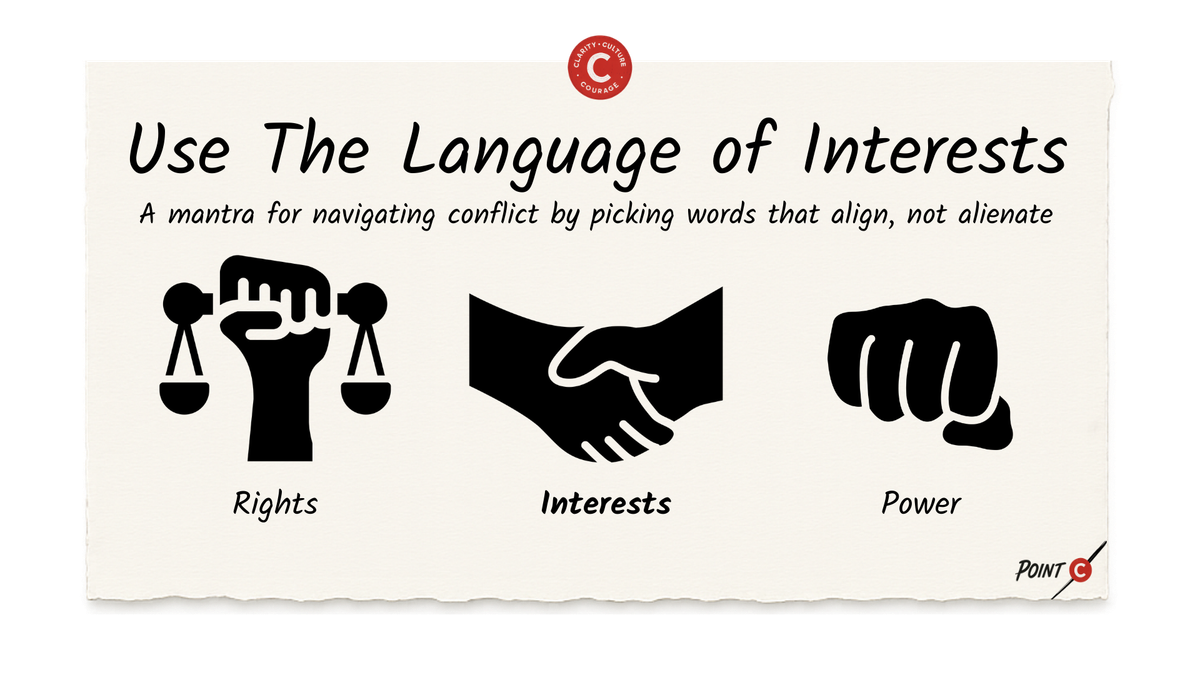
Lately in The Idea Bucket we've been talking about preparing for negotiations when navigating key career conversations.
I introduced a few negotiation concepts, such as knowing your Plan B, your Walkaway Point, and your Aspirational Goal, and core principles, such as Think in Packages, Uncover Interests & Reveal Interests, and Grow The Pie Before You Slice It.
Today I want to focus on one framework for navigating conflict that has been seared into my brain ever since I learned it from Columbia Business School Professor Shai Davidai when he taught it to my Sulzberger cohort:
In situations of conflict, Use The Language of Interests.
The Three Languages of Conflict
According to Professor Davidai, when it comes to navigating conflict, you have a choice in the language that you can choose to use. You can choose to use the language of power. You can choose to use the language of rights. Or, you can choose to use the language of interests. And, it turns out, that the choice you make on the language that you use will have a dramatic effect on the outcome.
So let's make sure we understand what each one looks like:
The Language of Power
This is the one I think we most viscerally understand because we can feel it in our bones when someone uses it against us. This is about coercion. We threaten to use our power to do something to the other person or withhold something from them if they do not comply with our demands. Examples include threatening to fire someone, give a negative review, withhold a bonus, not invest in a project, reassign them, or damage their reputation. This can take the form of "you must, or else".
The Language of Rights
This is when we evoke independent standards of legitimacy or fairness to make our case. These can include formal rights such as laws, company procedures, and contracts. They can also include informal rights such as norms, morals, past precedents, and verbal agreements. This can sound like: "That's not fair... It's my right... I deserve this...That is wrong."
The Language of Interests
This is when, instead of focusing on threats or rights or blame, we focus on voicing our needs, aspirations, and concerns as well as drawing out those of our counterpart. This involves introspection, disclosure, and curiosity. This can sound like: "Here's what I care most about...what do you care most about?", "What I am most concerned about is...what are your biggest concerns? ", "Winning for me in this looks like...what does winning look like for you?"
There's a time and place to use each of these languages. However, they each have their downsides.
The Trap of Power & Rights
When you use the language of power, you erode trust in the relationship. And if it's an ongoing relationship, you are building it on a shaky foundation. Over time, power dynamics may shift, increasing the likelihood that the same power will be used against you. The threat of force also requires that you actually follow through, which comes with real costs and depends on accurately estimating your power. Many of us overestimate it. Using power may accomplish your goals in the short term, but it often creates serious long-term consequences.
When you use the language of rights, your argument requires a shared understanding of what is "right" or "fair". More often than not, people have different interpretations of this, which causes the conversation to go off the rails. People also tend to pick the right that is closest to their interests, causing an argument about two different rights.
Using the language of interests avoids these traps. But it's not easy. Focusing the conversation on interests takes intention. And once you leave interests, it starts a cycle that is hard to pull back from.
Let's see how this plays out in real life.
The Cycle of Conflict
According to Professor Davidai, the cycle of conflict occurs because the type of language that you use tends to trigger a response with a similar language. Threats lead to counter-threats. Claiming rights leads to claiming other rights.
Imagine a performance review conversation between a manager and a senior team member who expected a promotion:
Version 1: The Language of Power
Manager:
“I’ve decided not to promote you this cycle. And frankly, if you keep pushing on this, it’s going to reflect poorly on your review.”
Employee:
“If that’s how this is going to work, maybe I should start looking elsewhere.”
Now we’re in escalation mode. Threat → counter-threat.
The relationship has shifted from problem-solving to positioning. Even if someone backs down, trust erodes.
Version 2: The Language of Rights
Employee:
“I’ve met all the criteria for promotion. According to the guidelines, I qualify. It’s only fair.”
Manager:
“The guidelines say promotions are discretionary. And based on my judgment, you’re not there yet.”
Now we’re arguing about legitimacy. Right → counter-right.
Each person selects the version of fairness closest to their interests. The employee points to performance criteria. The manager points to discretion.
Both feel justified. Both feel unheard. The conversation stalls.
Version 3: The Language of Interests
Now let’s rewind.
Employee:
“I want to talk about the promotion decision. What matters most to me is growth and feeling like I’m progressing. I’m worried that staying at this level signals I’m stuck. Can you help me understand what you’re optimizing for?”
Manager:
“I appreciate you saying that. From my side, what I care about most is making sure our senior leaders can operate independently across teams. I’m concerned about your cross-functional exposure. Let’s unpack that.”
Now we’re in a different space.
Not: Who’s right?
Not: Who has leverage?
But: What are we each trying to achieve? What are we worried about?
That doesn’t mean we’ll agree immediately. But now we’re diagnosing instead of defending.
Name The Interest Beneath The Position
When conflict escalates, it’s usually because we’re arguing about positions:
- “Promote me.”
- “Not yet.”
- “That’s unfair.”
- “It’s my call.”
Underneath each position is an interest:
- Growth
- Recognition
- Fairness
- Risk mitigation
- Team performance
- Retention
- Reputation
Your job as a leader isn’t to win the argument. It’s to surface the interests early, before the conversation slides into power or rights. And especially if you hold the most power in the situation, it’s your job to use restraint.
Using power early is, quite frankly, lazy leadership. It’s a shortcut that sacrifices long-term trust for short-term control.
Pull It Back To Interests
Leading with the language of interests is by far the best approach because once you leave it, it’s incredibly hard to get back.
Power invites counter-power. Rights invite counter-rights. And the longer you stay there, the more ego, identity, and status get layered onto the issue.
Which means the real skill isn’t just knowing about interests. It’s noticing when the conversation starts drifting, and pulling it back.
When you hear power or rights language, try this:
- Don’t counter-threat.
- Don’t debate fairness.
- Get curious about interests.
Here are some things you might say:
- “Help me understand what feels most important to you here.”
- “What are you most worried about if this doesn’t happen?”
- “What does winning look like for you in this situation?”
- “Here’s what I’m optimizing for, what are you optimizing for?”
You are shifting the frame from "Who's right?" to "What matters most?"
Your Challenge This Week
Listen for the way people around you are using language in their everyday negotiations. Are you hearing them default to the language of power, the language of rights, or the language of interests? Do they seem aware of the choice they are making? Do you see the matching response that their choice elicits?
Once Professor Davidai taught me this framework, I couldn’t unhear it. The subconscious choices that people are making become stark.
Once you have developed an ear for this, turn your attention to yourself. Can you catch yourself before you commit to one type of language in a conversation? Can you become more intentional about your contribution to the cycle of conflict? Can you shift from reacting by matching their language to becoming curious and intentionally shifting the conversation back to interests?
Next Week
Now that you have some core frameworks and mantras to guide you on your career journey, I'm going to zoom back out to the big picture of strategy and leadership.
There are many different directions that I can go next so I'm going to contemplate it and make the topic of the next post a surprise.
Since you've been on this journey with me, I’m eager to know what areas you’re curious to explore next. Let me know at theideabucket@pointc.co. It might just inform my next post.
About This Newsletter
The Idea Bucket is a weekly newsletter and archive featuring one visual framework, supporting one act of leadership, that brings you one step closer to building a culture of innovation.
It’s written by Corey Ford — executive coach, strategic advisor, and founder of Point C, where he helps founders, CEOs, and executives clarify their visions, lead cultures of innovation, and navigate their next leadership chapters.
Want 1:1 executive coaching on this framework or others? Book your first coaching session. It's on me.