The Safety Levers
A framework to move your subculture from the Anxiety Zone to the Learning Zone

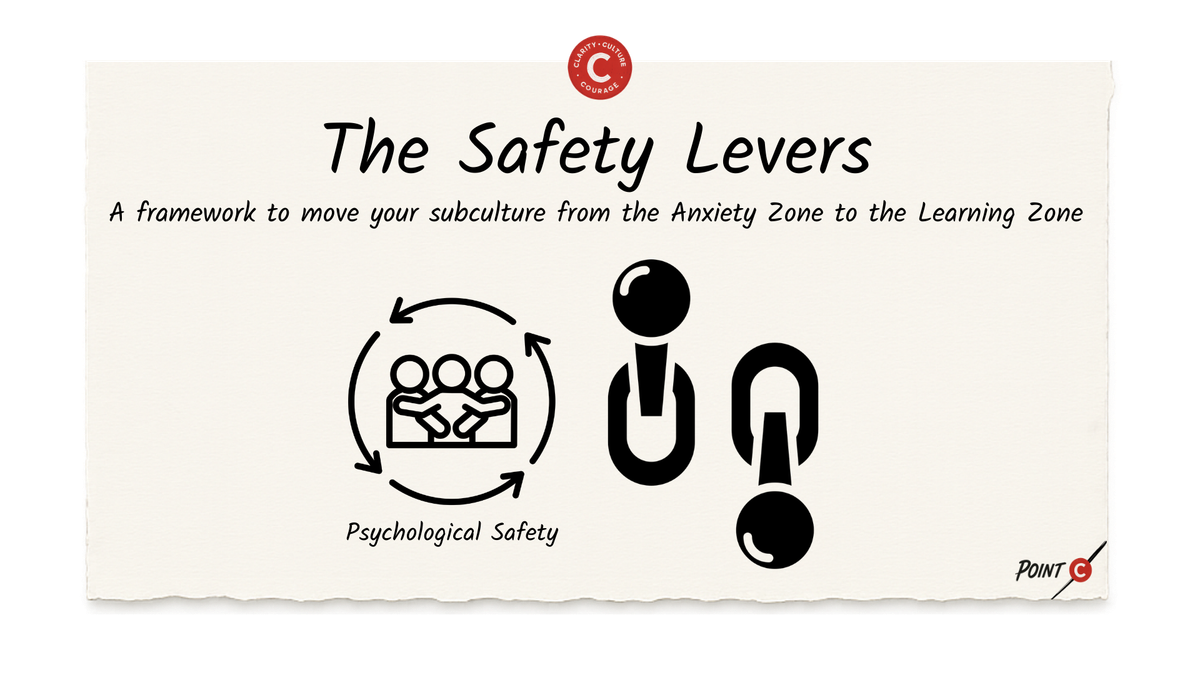
In last week's The Idea Bucket post, we went deep on psychological safety. I talked about what it is, what it isn't, and why it's essential for leading innovation. Most importantly, I showed how the level of psychological safety in a subculture is not fixed. In fact, it's a leadership choice.
Now let’s talk about what you can actually do about it. Today, I’ll give you an overview of the ten levers you can pull to increase psychological safety in your subculture: The Safety Levers.
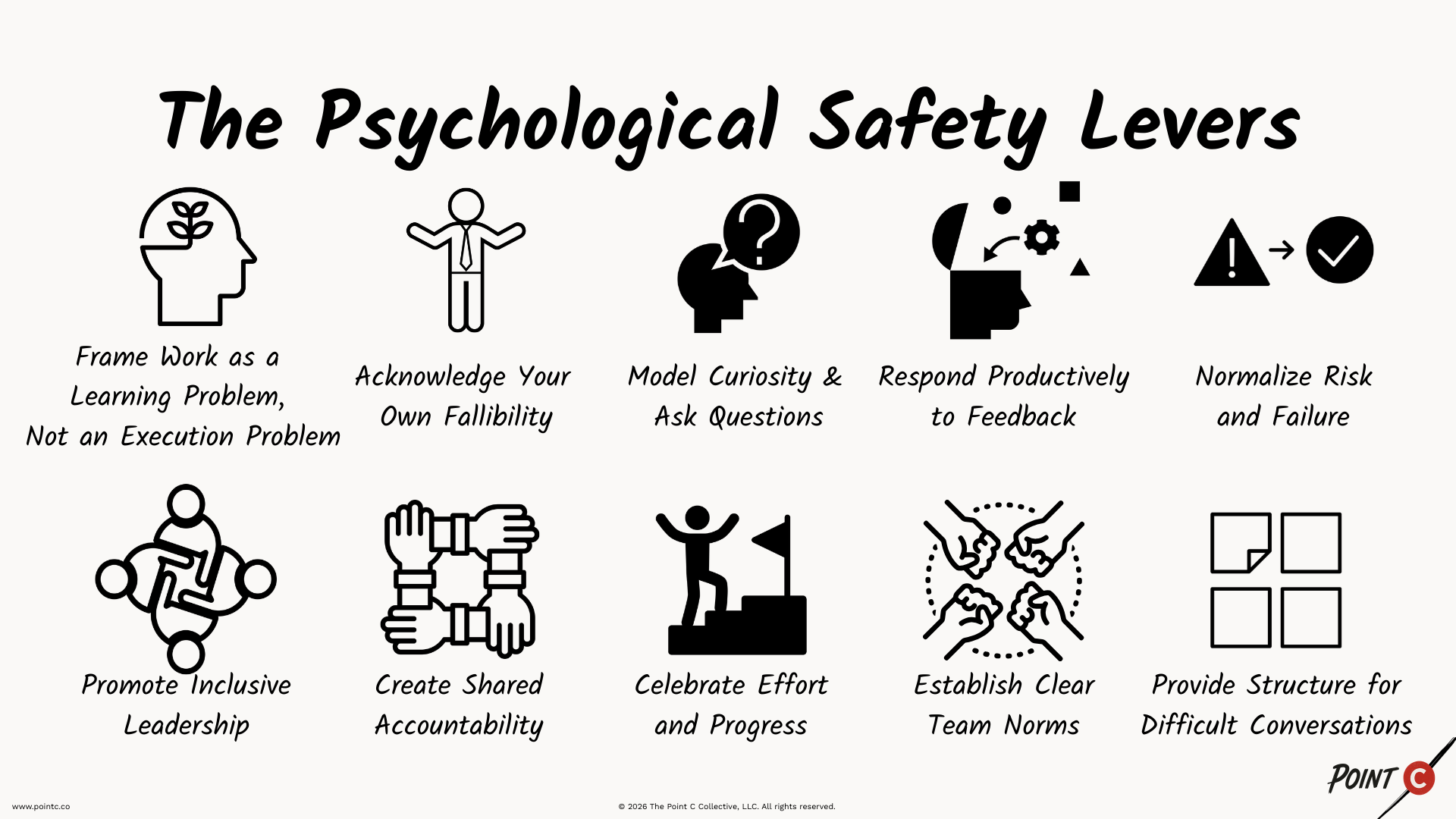
The Psychological Safety Levers
In order to move from The Anxiety Zone to The Learning Zone, you have to be intentional about how you show up as a leader. What norms are you establishing and what mantras are you constantly saying to reinforce them? If you want your team to feel like they can speak up, offer ideas, and ask questions without fear of being punished or embarrassed, these are ten levers you can pull.
These are leadership behaviors. Context-setting acts. Micro-choices that shape whether people feel safe to think, speak, experiment, and disagree.
1. Frame Work as a Learning Problem, Not an Execution Problem
When leaders frame work as execution, they imply the answer is already known. When they frame it as learning, they acknowledge uncertainty is part of the work.
In the Anxiety Zone, uncertainty feels like incompetence. Framing it as learning turns ambiguity from personal threat into shared responsibility.
When you frame work as a learning problem:
- You acknowledge uncertainty explicitly
- You legitimize questions and experiments
- You reduce fear of being wrong early
This is not about lowering the bar. It’s about learning before committing.
If you want your team to treat being wrong as information, not identity, cultivate a growth mindset and reinforce learning, effort, and progress, not just outcomes.
2. Acknowledge Your Own Fallibility
When leaders project certainty, dissent feels risky. When leaders acknowledge fallibility, speaking up becomes contribution, not challenge.
In the Anxiety Zone, authority amplifies silence. Naming your own assumptions lowers the interpersonal risk of disagreement.
When you acknowledge fallibility:
- You say “I might be wrong” before debates
- You name assumptions instead of conclusions
- You invite others to challenge your thinking
This is not about self-doubt. It’s about confidence without defensiveness.
If you want better thinking in the room, lead with vulnerability and model uncertainty, learning, and humility.
3. Model Curiosity & Ask Questions
Leaders shape the quality of thinking in the room. When curiosity leads, exploration feels expected. When answers lead, ideas get filtered.
In the Anxiety Zone, people self-edit. Curiosity signals that ideas are welcome, not risky.
When you model curiosity:
- You ask before asserting
- You hold back your opinion to avoid anchoring
- You explore disagreement instead of defending
This is not about indecision. It’s about exploration before convergence.
Before you narrow to a decision, flare before you focus and widen the thinking in the room.
4. Respond Productively to Feedback
People don’t decide to speak up based on your invitation. They decide based on what happens after they do.
In the Anxiety Zone, one defensive reaction can silence a team for months.
When you respond productively:
- You listen without interrupting or correcting
- You thank the person before reacting
- You separate feedback from immediate decision-making
This is not about agreeing. It’s about staying open long enough to learn.
If you want information to flow, treat feedback as a gift—not a demand.
5. Normalize Risk and Failure
If innovation is required, uncertainty is guaranteed.
When failure is punished, risk-taking disappears. When learning is visible, intelligent risk increases.
In the Anxiety Zone, people hide problems until it’s too late.
When you normalize risk:
- You distinguish between intelligent bets and sloppy execution
- You talk openly about what didn’t work
- You reward early signal detection
This is not about celebrating failure. It’s about learning fast when outcomes are uncertain.
If you want experimentation, make it clear that your team is expected to fail forward.
6. Promote Inclusive Leadership
Psychological safety is about who gets to shape the thinking. When only confident or senior voices dominate, safety shrinks.
In the Anxiety Zone, lower-power voices calculate risk before speaking.
When you promote inclusive leadership:
- You intentionally invite input from quieter voices
- You structure airtime
- You explicitly ask for dissenting perspectives
This is not about consensus. It’s about improving decision quality.
If you want stronger decisions, make space for every voice.
7. Create Shared Accountability
Ownership can be individual. Responsibility should be collective.
When failure feels personal, people protect themselves. When responsibility is shared, people surface risks earlier.
In the Anxiety Zone, you hear: “That wasn’t my role.”
When you create shared accountability:
- You speak in “we” language
- You focus reviews on systems, not blame
- You reinforce that noticing problems is part of the job
This is not about fuzzy ownership. It’s about fewer surprises and better outcomes.
Make it clear: you own your role, but we own the outcome.
8. Celebrate Effort and Progress
What you recognize gets repeated.
If you only celebrate outcomes, people optimize for visibility. If you celebrate effort and progress, you reinforce the behaviors that lead to excellence.
In the Anxiety Zone, invisible effort feels risky.
When you celebrate progress:
- You name learning milestones
- You recognize thoughtful experimentation
- You reinforce rigor and collaboration
This is not about participation trophies. It’s about reinforcing the behaviors that produce excellence.
Celebrate behaviors, not just outcomes.
9. Establish Clear Team Norms
Unclear norms force people to infer the rules from power and personality. Clear norms reduce guesswork and interpersonal risk.
In the Anxiety Zone, people spend energy calculating what’s safe.
When you establish norms:
- You make expectations explicit
- You name how meetings, feedback, and decisions work
- You reinforce norms in real time
This is not about policing behavior. It’s about reducing ambiguity so people can do their best work.
Make expectations explicit so safety isn’t left to interpretation.
10. Provide Structure for Difficult Conversations
Unstructured hard conversations rely on confidence and power. Structured ones rely on shared tools and expectations.
In the Anxiety Zone, difficult conversations feel personal and unpredictable.
When you provide structure:
- You separate observations from interpretations
- You create regular forums for hard conversations
- You model structured feedback yourself
This is not about scripting people. It’s about making hard conversations safer and more productive.
If you want resilience, design for the roller coaster and build structures that make hard moments safer.
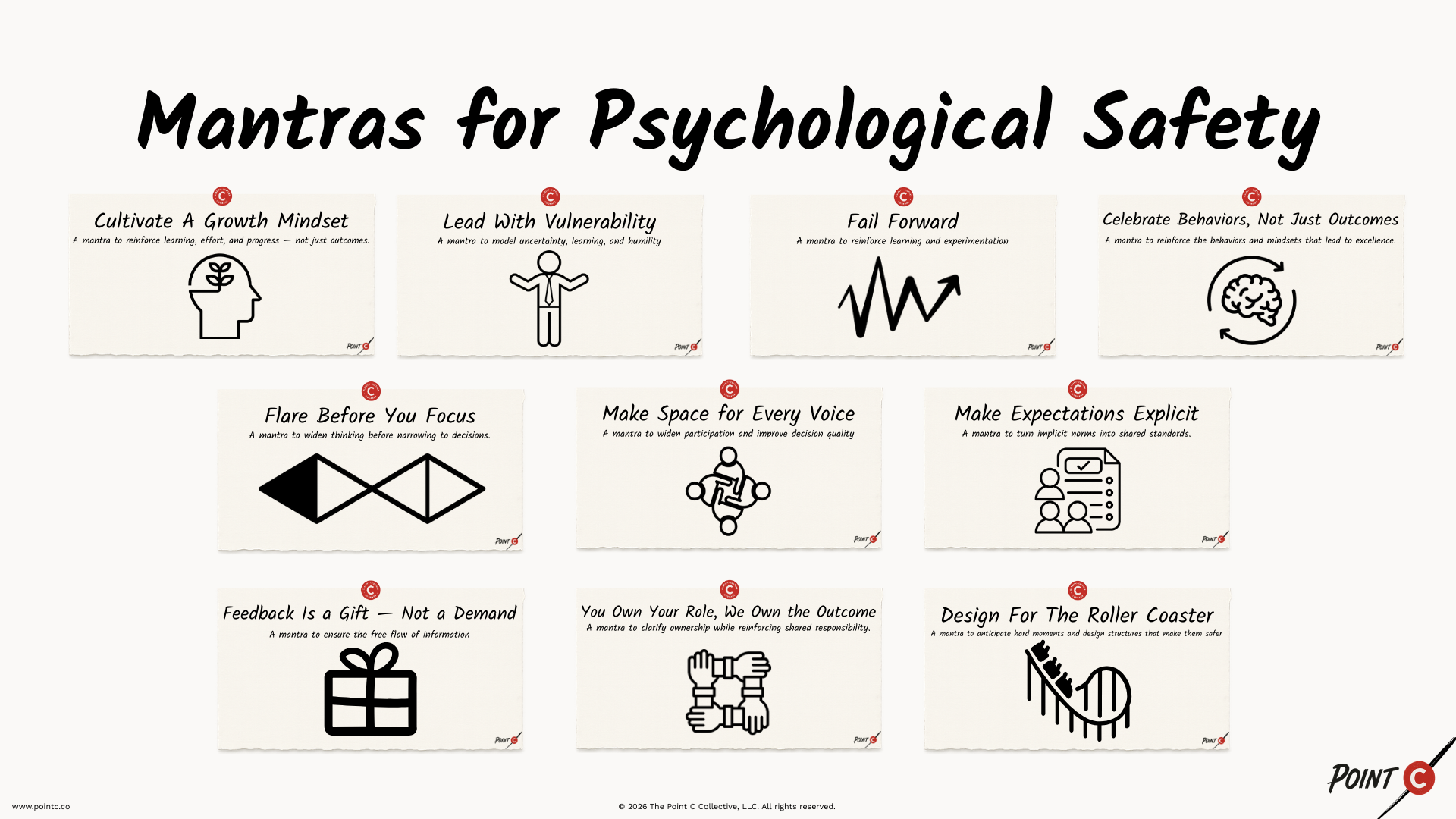
Mantras For Psychological Safety
Those are a lot of levers! The good news is, you have lots of ways to increase psychological safety in your organization. The bad news is that those are a lot of levers to keep in your head. That's where mantras come in - memorable sayings that can stick with you after you've read about these levers. Here are the mantras I'd like you to repeat to yourself and your team:
- Cultivate A Growth Mindset
- Lead With Vulnerability
- Fail Forward
- Celebrate Behaviors, Not Just Outcomes
- Flare Before You Focus
- Make Space For Every Voice
- Make Expectations Explicit
- Feedback Is A Gift — Not A Demand
- You Own Your Role, We Own The Outcome
- Design For The Roller Coaster
Your Challenge This Week
Reflect on how you are showing up on each of these levers:
1) Where might I be treating uncertainty like an execution failure instead of a learning opportunity?
2) Where might my confidence be unintentionally shutting down input from others?
3) Where do I move too quickly from asking questions to giving answers?
4) How do people learn it’s safe (or unsafe) to give me feedback?
5) Where might people be avoiding smart risks because failure feels unsafe with me?
6) Whose voice am I unintentionally amplifying, and whose am I missing?
7) Where do I hear “that wasn’t my role” instead of “we missed this”?
8) What effort or progress am I overlooking because it hasn’t produced results yet?
9) Where might people be guessing instead of knowing what’s expected?
10) Which conversations feel hard because I haven’t given people a safe structure?
Pick the three levers that you want to focus on first.
Next Week
We know the importance of building psychological safety into our subculture. We know we have the agency to increase it. And we have ten levers that we can pull.
We can now dive deeper into each lever. Next week, we'll learn more about framing work as a learning problem, not an execution problem by unpacking its corresponding leadership mantra: Cultivate A Growth Mindset.
About This Newsletter
The Idea Bucket is a weekly newsletter and archive featuring one visual framework, supporting one act of leadership, that brings you one step closer to building a culture of innovation.
It’s written by Corey Ford — executive coach, strategic advisor, and founder of Point C, where he helps founders, CEOs, and executives clarify their visions, lead cultures of innovation, and navigate their next leadership chapters.
Want 1:1 executive coaching on this framework or others? Book your first coaching session. It's on me.