Avoid The Pretzel Trap
A mantra to help you stay true to yourself and ask for what you need

Last week in The Idea Bucket, we continued our series on career frameworks with Know Your Number, a mantra to help you figure out the minimum price you should put on your time as an entrepreneur and/or the baseline salary you should use to evaluate prospective full-time roles.
I also introduced a few negotiation concepts, such as knowing your Plan B, your Walkaway Point, and your Aspirational Goal, and core principles, such as Think in Packages, Uncover Interests & Reveal Interests, and Grow The Pie Before You Slice It.
Today, I want to continue this theme of career negotiations with a mindset shift:
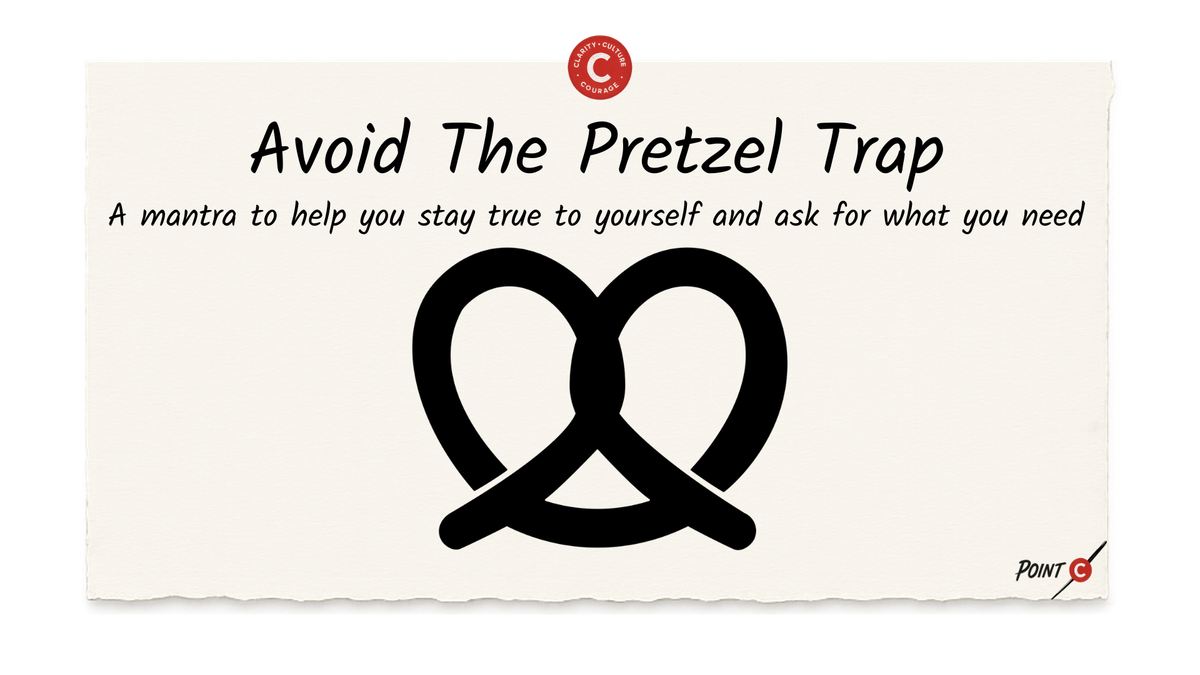
Most people think winning is getting the job. This causes them to pretzel themselves into whatever shape they think will get their future boss to pick them. More often than not, this strategy wins the battle, but loses the war.
If you want to win the war of finding a role where you truly can thrive: Avoid The Pretzel Trap.
Why We Pretzel
We've all been there. We're being considered for a new role that we're excited about and we really want to get the job. So we do a smart thing - we deconstruct the job description and try to figure out what they are really looking for. We then craft our story to speak to our fit for the role.
This is a great start! We should always know our audience and craft our story to move our audience from hesitation to excitement.
But a problem arises as the conversations advance. We may start to uncover potential misalignments - a difference in strategy, a gap in values, an issue in core work-life fit, a different prioritization of responsibilities, a doubt that this role can accomplish all the bullet points in the job description. And we also start to see what we would truly need to succeed in this role, but we're unsure whether it will be provided to us.
We're faced with a gap between our personal selection criteria and the new role and we're unsure whether we will get what we need to set ourselves up for success. And then, as Seth Godin would say, our lizard brain kicks in. We fear that if we name the perceived gaps, ask for what we truly need, or lay out a different vision, we'll lose the job opportunity.
So instead of offering a better plan and asking for what we need, we begin to pretzel ourselves. We parrot what we think they want to hear, we make agreements we don't actually agree with, and we say we will do things that we know we won't do. Because we want them to say yes and give us the job.
And it works! Congratulations, you now have a job that you didn't quite want, without the foundation you need to succeed, and you've set yourself up to eventually break trust with your boss because you aren't going to be able to deliver on what you said you would. You've started the relationship with all the wrong norms. You've won the battle but lost the war.
You've missed the opportunity to truly align on your vision for the role and to ensure you get what you need to be successful. And you've done that at the time when you had the most leverage – before you accepted the role.
A Mindset Shift: Fail Fast
To prevent yourself from getting into this position in the first place requires a shift in mindset. Winning is not getting this job. Winning is getting yourself into a role that aligns with your personal selection criteria, empowers you to pursue a vision and strategy you believe in, gives you what you need to be set up for success, and builds a foundation of trust and authenticity between you and your key stakeholders.
In order to achieve this, your goal must shift from getting this job to failing fast.
Instead of papering over the gaps as they come up, you name them. Instead of agreeing to a strategy you disagree with, you offer a better one. Instead of staying silent on what you need to succeed, you ask for it. Instead of pretzeling yourself to get to a yes, you accelerate the conversation to find out if it's a mutual no. You want to fail fast on as many opportunities as possible so you can get to the right one more quickly.
And when you truly embrace this mindset shift, you discover that there is power in authenticity. The right stakeholders for you will actually lean in rather than push you away. They will think: How rare it is to truly find someone who is willing to lead. I want to bet on this leader.
Leadership is not a position. It's an act. Leadership is proactively recognizing a problem or opportunity and taking the steps to solve it or pursue it.
By proactively shaping the role, the strategy, and the norms of the relationship you are demonstrating that you will truly lead and that you understand the nuance and trade-offs of what it takes to succeed.
You won’t just build trust, you might actually get what you ask for.
Of course, your confidence in this strategy should correlate with your experience. If this is your first job out of college, you probably don't yet have the perspective to lay out a robust alternative strategy. In that case, winning in the job hunt truly means just getting in the door.
But as you step into leadership roles, where you're expected to set strategy, build vision, and shape subculture, the cost of pretzeling rises dramatically. That's when Avoid The Pretzel Trap becomes non-negotiable.
Know Your Brand
When you get to a certain level, especially as a CEO, Executive Director, Founder, or in the C-Suite, you need to be clear about what you are and what you aren't. You need to know your brand.
A great brand is not all things to all people. It is the manifestation of a specific value proposition to a specific subset of people. And a great brand not only attracts that target subset of people, it will repel others. Because a great brand is a set of values, and our values signal what we'll prioritize. We attract people with the same priorities and we repel people who don't share them. This is a good thing!
While these principles apply to all consumer product brands, they also apply to leaders like you. As a leader, you have a specific brand. If a board or boss chooses you, they are getting a particular leadership style, strategy, and culture. They are getting a specific set of values and priorities. They are choosing a certain future.
Your job is to make that choice clear. You can and should force the decision on whether you are the right fit for them.
Offer A Choice
Imagine you are one of two finalists for an executive role. You could try to pretzel yourself into what you think they want and, ultimately, you'd probably seem comparable to the other candidate. Or, like any good brand, you can differentiate yourself.
You can enter that meeting offering the board a clear choice: You all have a choice ahead of you. You can go in direction A or direction B. If you want to go in direction A, I'm your choice. If you bet on me, here's what you'll get and here's what I will need to succeed. But if you want to go in direction B, I'm not the choice for you and you should pass on me.
This is how I raised my first fund for my venture capital firm. I was originally approached with a concept that squarely fit my personal mission, but tactically and strategically fell comically short. I believed in the mission but I did not believe in the strategy. I could have faked it and taken the money off the table. But then I would have been trapped. So, instead, I told the truth: I believe in the mission but this concept won't work. If you're interested in backing me to pursue my vision and strategy instead, I'm on board. If not, I'm not your guy. That's how it all started.
Remember that you will have the most leverage to get what you need to set yourself up for success BEFORE you accept the job. This is the moment to fail fast.
Avoid Audience Capture
I see so many leaders make the wrong choice in that moment.
They've done a good job of understanding the needs and interests of their audience. But they've done a poor job of prioritizing their own needs and interests.
This happens not just with job interviews but also with fundraising. Executive Directors at nonprofits tend to fall into the pretzel trap. A major funder has a priority and money attached to it. It's not aligned with the nonprofit's core strategy, vision, and/or operations. But it's money and it's low-hanging fruit. So they pretzel.
They get the grant and they think they've won. But now they have to deliver on an agreement that doesn't actually align with their strategy and operations. Soon they are scattered and stretched thin. They are no longer anchored by a clear vision. Instead, their strategy is now to pretzel themselves ad infinitum to keep the lights on. They've ceded their role as a leader.
Yes, you should know your audience. And yes, you should craft a story that moves your audience from hesitation to excitement. But you should not be captured by your audience.
Leadership means knowing your vision and strategy and knowing when to say no to something that does not fit it.
Your Challenge This Week
Reflect:
1) Think of a moment when you've pretzeled yourself.
2) Why did you do it? What assumptions were you making about how the stakeholder would respond?
3) What should you have asked for that you didn't?
4) How did it play out?
5) What would you have done differently?
Next Week
We’ve made our Personal Selection Criteria, set our Go / No Go Date, started our Curiosity Tour, created Intentional Serendipity, maintained momentum with Forwardable Emails, we Know Your Number, and we're shifting our mindset to Avoid The Pretzel Trap.
Next week, I'll conclude this series on Career by sharing one negotiation principle that has stuck with me ever since I was taught it: Use The Language of Interests.
About This Newsletter
The Idea Bucket is a weekly newsletter and archive featuring one visual framework, supporting one act of leadership, that brings you one step closer to building a culture of innovation.
It’s written by Corey Ford — executive coach, strategic advisor, and founder of Point C, where he helps founders, CEOs, and executives clarify their visions, lead cultures of innovation, and navigate their next leadership chapters.
Want 1:1 executive coaching on this framework or others? Book your first coaching session. It's on me.